


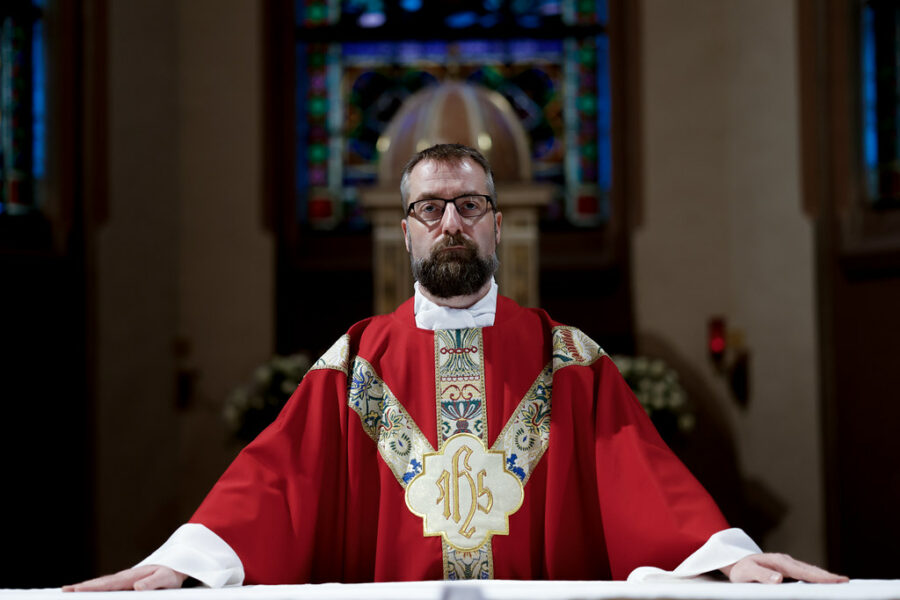
The Bishop of Oslo, Fredrik Hansen, has announced the convocation of the first diocesan synod of the Catholic Church in Oslo and has made clear from the outset which matters will remain outside discussion. “A diocesan synod is not a democratic assembly,” the prelate stated, recalling that, as bishop, he is obliged to exclude any issue contrary to the Church’s doctrine or that seeks to call it into question.
The synod will be held before the jubilee of St. Olaf in 2030 and aims to provide a diocese that has grown considerably with a common vision and a new pastoral plan for the coming decade. Hansen explained his objectives in an interview given to the diocesan spokesperson, Hans Rossiné, in which he placed among the priorities catechesis, pastoral care in different languages, and the need to gain a more precise understanding of the reality of the Catholic communities scattered across the territory.
“It is not for us to decide on matters of faith and morals”
Hansen expressly wished to distinguish the synodal consultation from a democratic procedure in which any issue may be submitted for deliberation.
“A diocesan synod is not a democratic assembly. As bishop, I am also obliged to exclude from the synod anything that contradicts the Church’s doctrine or calls it into question. It is not for us to decide on matters of faith and morals”, he noted.
According to him, the goal will be for the local Church to gather in prayer, carry out a rigorous assessment of its situation based on concrete data, and prepare plans and documents that will later be presented to the bishop, who will be responsible for making the decisions.
A broad consultation in a diocese marked by linguistic diversity
The preparatory process will seek to gather contributions from across the diocese and not only from the metropolitan area of Oslo. For Hansen, one of the main challenges lies precisely in obtaining a faithful picture of communities that are geographically dispersed and have different realities.
Catechesis and pastoral care in different languages will occupy a prominent place. The bishop recalled both the high number of young people receiving formation and the number of Masses regularly celebrated in languages other than Norwegian.
The consultation will begin with the diocesan bodies: commissions and councils, monasteries, parish councils, schools, and organizations. Subsequently, a more general phase will be opened so that the faithful may submit their contributions through parish meetings and an electronic form.
This process will also serve to prepare the evaluation that the diocese must present regarding the Synod on Synodality initiated by Francis. For this reason, the consultation phase will begin now and must conclude in the spring, when Oslo will send its contribution to the episcopal conference.
Hansen takes St. Charles Borromeo as a reference
In explaining why he has chosen to convoke a diocesan synod, Hansen drew on a historical precedent much earlier than the current synodal process. The bishop recalled the synods held by St. Charles Borromeo in Milan in accordance with the provisions of the Council of Trent.
In the history of the Church, he explained, the diocesan synod has served precisely to carry out a thorough assessment of the situation of a particular Church and to prepare pastoral plans, documents, and, especially, diocesan norms.
The preparation of the Oslo meeting will follow several stages. There will be an initial phase dedicated to drafting proposals, followed by several large assemblies in which representatives from across the diocese will participate. Between these meetings, work on the texts will continue.
Hansen compared this methodology to that used during the Second Vatican Council. Although Canon Law already establishes certain norms regarding who must participate in a diocesan synod, the preparatory commission will still have to specify the composition of the assemblies. According to the bishop, it could be something similar to a considerably expanded pastoral council.
The consultation will thus cover numerous aspects of the diocese’s pastoral life, but Hansen has established a precise limit in advance: the Church’s doctrine and matters of faith and morals will not be subject to decision by the synod.