


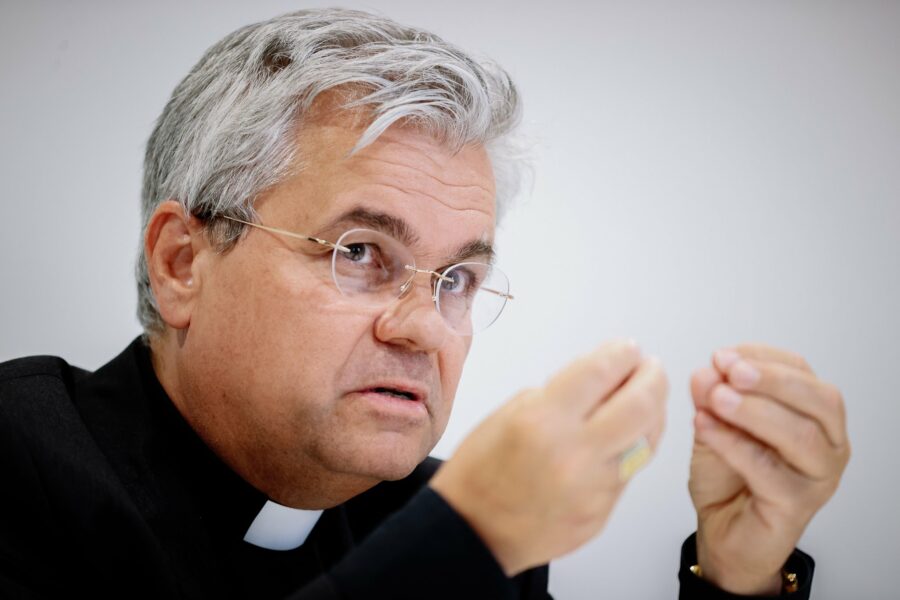
The Christian identity «is not rigid or clearly delimited,» but can be considered «in a certain way liquid.» This was stated this Sunday by the Archbishop of Paderborn, Udo Markus Bentz, during his speech at the Salzburg University Weeks, where he also warned about a proximity that, he claims, exists between certain sectors of the Catholic Church and political currents he described as «identitarian and authoritarian.»
The statements, reported by KNA, were made during the academic event that closed the meeting held from August 3 to 9 in the Austrian city. This year’s edition was precisely dedicated to the concept of identity under the motto «Who we are and who we want to be. Identity: superpower and problem zone.»
A «liquid» Christian identity
Bentz developed his intervention based on what he called a «relational» identity. «My identity as a Christian is not rigid or clearly delimited, but is in a certain way liquid, with an inner core that we hope is firm», he maintained.
For the archbishop, this identity is shaped by different elements that interact with each other. Among them, he placed Christ, the Church and its Tradition, but also the biographical and cultural circumstances of each person and the way others recognize them as Christian.
From this perspective, Bentz linked his approach to synodality. In his view, synodal life should not be limited to discussing certain contents, but also encompasses the way relationships are built within the Church.
The prelate turned to Scripture to explain this conception. He presented Israel as a pilgrim people sustained by God’s faithfulness and pointed out that, in the New Testament, Christ becomes the fundamental point of reference for those who follow him. Christian identity should be understood, as he summarized, as a «relationship with Christ received, narrated and lived.»
Bentz questions a Catholic identity based on delimitation
In the face of secularization, Bentz criticized the search for an identity based on «delimitation,» the «isolation of what is supposedly one’s own» and a mentality focused on preserving acquired positions.
For the archbishop, this way of conceiving ecclesial identity finds «resonance and inspiration» in certain identitarian political movements.
His warning was then directed toward the interior of the Church. Bentz said he was concerned that the «affinity» between these «identitarian and authoritarian» political currents and «certain groups and dynamics in the Catholic Church» would have ceased to constitute a marginal phenomenon.
In his view, this proximity «forms a toxic mixture.»
Against a «frozen» Christian identity
The archbishop also questioned a conception of ecclesial identity that relativizes historical evolution or seeks to «freeze it» at a certain moment. According to him, this approach does not correspond to the orientation assumed by the Church from the Second Vatican Council and during the subsequent decades.
His proposal involves a Christian presence that can affirm its convictions within a plural society without imposing itself on those who do not share them.
Bentz summarized this attitude through a series of contrasts: «Be present without appropriating. Bear witness without compelling. Confess our hope without threatening the freedom of others. Speak without silencing others. Contradict without destroying. Invite without appropriating.»
According to the information released about his intervention, the Archbishop of Paderborn did not identify which specific groups or dynamics within the Catholic Church he considers linked to the «identitarian and authoritarian» currents whose proximity he described as a «toxic mixture.»