


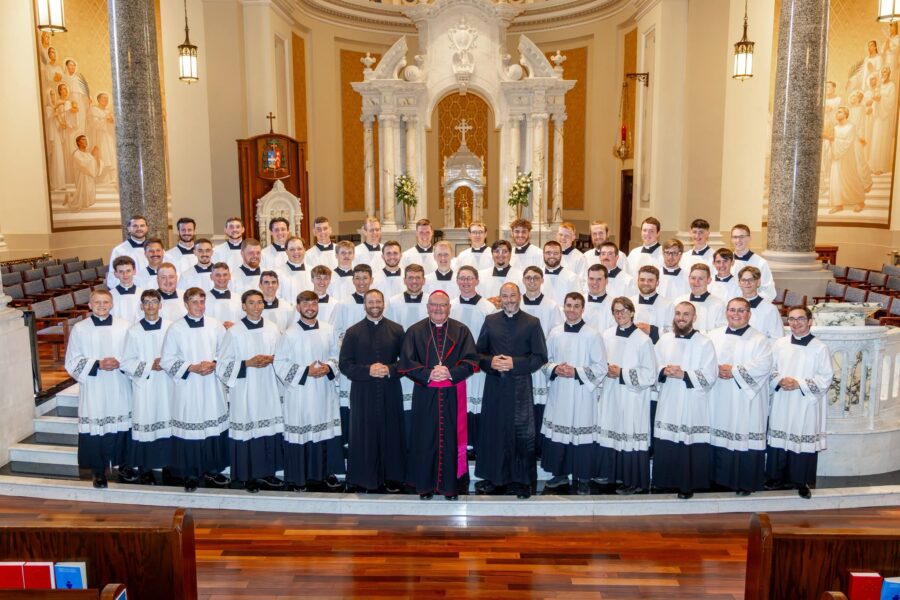
The Diocese of Wichita, in the state of Kansas, United States, will officially establish the St. Philip Neri Seminary on August 26, a new institution for priestly formation that emerges from the transformation of St. Joseph’s House of Formation, opened in 2017. The project began with seven young men and a two-year program and, after nine years of development, expects to have 42 or 43 seminarians for the upcoming academic year.
According to the diocese itself, the new seminary will allow canonical recognition and consolidation of the priestly formation work that Wichita has been carrying out over these years. Father Chad Arnold, current director of St. Joseph’s House of Formation and responsible for the diocesan seminarians, will continue to lead it and will formally assume the role of rector.
“It is very exciting to take this step, because it formally recognizes the hard work of our diocese,” Arnold explains. In practice, much of the work will continue as before, but the priest believes the transformation confirms the fruits obtained during these years: “It is a testimony that the Lord has been working in this and has shown us many good fruits.”
From seven young men to a complete four-year program
St. Joseph’s House of Formation opened its doors in August 2017 under the direction of Father Mike Simone, with Arnold as the first associate director. During that first academic year, seven young men resided there, and the diocese initially envisioned a program of only two years.
The seminarians completed their first four semesters of university studies at Newman University, a Catholic university in Wichita, before continuing their formation at another seminary. However, the results obtained quickly led the diocese to reconsider the project.
“After that first year, we moved to a four-year program because we clearly saw the good fruits and the action of the Holy Spirit,” Arnold recalls. It was then that he began to consider that the house of formation could one day become a seminary.
Bishop Carl A. Kemme of Wichita has explained that the growth in the number of candidates and collaboration with Newman University made it possible to develop the full four years of the university stage. The propaedeutic stage was later added, conceived as an introduction to seminary life for those who have already completed their university studies.
The diocese has chosen, however, not to incorporate the subsequent pre-theology stage, which will continue to be carried out in major seminaries, in order not to overload the facilities or the human resources available in Wichita.
A diocese leading the United States in priestly vocations
The transformation of St. Joseph’s House of Formation takes place in an especially favorable vocational context. A national report published in January 2025 by Vocation Ministry placed Wichita at the head of U.S. dioceses in two indicators related to vocations to the priesthood.
In the so-called priestly replacement rate, which compares the number of seminarians with the priests who must be replaced through new ordinations, Wichita reached 195%. A result of 100% means that a diocese has enough seminarians to replace its priestly population. The second U.S. diocese in this indicator was Nashville, with 111%, followed by Lincoln, with 107%.
A second indicator, which analyzes the same phenomenon taking into account the previous decade, again placed Wichita in first position, this time with 255%. Nashville reached 170% and Springfield, in the state of Illinois, 160%.
The study classified Wichita among the U.S. dioceses serving a population of between 100,000 and 300,000 Catholics. However, its results not only led that category but surpassed those of all dioceses in the country.
Bishop Kemme has linked Wichita’s vocational strength to various elements of diocesan life, including eucharistic adoration, Catholic schools, Mass attendance, the presence of young priests, and specific work promoting vocations. The bishop especially highlighted eucharistic adoration and noted that numerous young men have told him they perceived the call to the priesthood during it.
More than 40 seminarians next academic year
This context is also reflected in the dimensions reached by the institution that will now become a seminary. Bishop Kemme estimates that during the next academic year there will be 42 or 43 young men at St. Philip Neri, although not all belong to Wichita.
The new seminary will be primarily intended for candidates to the priesthood from this diocese, but it currently also receives seminarians from Salina and Dodge City, the other two dioceses located wholly or partially in western and central Kansas.
Kemme does not intend, however, to turn St. Philip Neri into a large institution or actively recruit candidates from other parts of the country.
“I don’t want St. Philip Neri Seminary to be too large,” he explained. His intention is to maintain dimensions that allow for the proper development of formative life without losing individual accompaniment and preventing the young men from ending up being treated “more as numbers than as persons.”
The bishop believes the institution has currently reached an appropriate balance between both needs.
Collaboration with Newman University
Academic formation will continue to develop in collaboration with Newman University, a relationship Arnold considers fundamental to explaining the growth of St. Joseph’s House of Formation.
“The collaboration with Newman has been wonderful,” the priest states, particularly highlighting the work of the departments of Theology, Philosophy, and Languages.
“Newman enriches the education of our men, and I believe our men enrich the community and Catholic identity of Newman,” he adds.
The erection of the seminary will therefore not entail a transfer or radical transformation of daily life. The seminarians will continue in the same buildings, with the same formation team, and maintaining the model developed over the past years.
The transition from house of formation to seminary
The main difference will be canonical and institutional in nature. Bishop Kemme explains that the new status will give the institution an ecclesial recognition that goes beyond the diocese itself and will allow the work already being done in Wichita to be identified more clearly.
According to the bishop, there are just over twenty university-level seminaries in the United States, many of them historically linked to large archdioceses. Smaller dioceses usually send their candidates to institutions located outside their territory.
“That Wichita is among a number like that is almost unheard of,” Kemme noted.
The new status will also allow the institution to be recognized before the Holy See in relation to the Dicastery for Culture and Education and the Dicastery for the Clergy, as well as before the other bishops and seminaries in the country.
For Arnold, the designation will also resolve a practical difficulty: outside Wichita, it was not always understood what exactly a “house of formation” was or what preparation candidates for the priesthood received there. The word seminary, on the other hand, immediately identifies the purpose of the institution.
Father Chad Arnold will be the first rector
The transformation will also involve the formalization of Arnold’s responsibilities. With the erection of St. Philip Neri, he will cease to be director of the house of formation and will become rector of the seminary.
Bishop Kemme explained that the bishop is the primary person responsible for priestly formation in his diocese, but he delegates this task to the rector. The new position will also entail specific canonical obligations: Arnold will publicly make the profession of faith and take the oath of fidelity to the Church.
“He is the right man for the position. He has proven it,” Kemme stated, highlighting the trust that both priests and the seminarians themselves have placed in him.
For Arnold, many of his responsibilities will remain the same. The difference will be in “greater clarity, precision, and official recognition” of the mission he already carries out.
St. Philip Neri, patron of the new seminary
The name of the seminary was chosen after a process involving the bishop, priests, and seminarians. Kemme and Arnold had separately considered St. Philip Neri and later confirmed that his name was also one of the most proposed when they consulted the rest of the diocese.
“We didn’t tell anyone we were thinking of St. Philip Neri, but his name was recommended by a wide margin over any other,” Arnold relates. “We felt it was a confirmation.”
The diocese wants to especially highlight the joy, humility, and evangelizing zeal of the sixteenth-century saint. The seminary will adopt as its motto the Italian expression attributed to St. Philip Neri Siate umili, state bassi, which can be translated as “Be humble, remain small.”
Arnold also related the priestly model the institution wishes to transmit to another phrase attributed to the saint: “The world is your parish, but my parish is my world.”
“That is really how we want our diocesan priests to be: the parish is the world where we live, love, serve, and sacrifice,” he explained.
Nine years later, a seminary of its own
Bishop Kemme will canonically erect St. Philip Neri Seminary on August 26 by reading the corresponding decree. The new institution will thus begin its formal activity on the foundations built during the nine years of operation of St. Joseph’s House of Formation.
The bishop has asked the faithful to pray for the new seminary and to continue encouraging young people to consider discerning a possible priestly vocation. Kemme says he continues to encounter young people during his pastoral activity who tell him they are considering entering the seminary.
In this way, the project that began in 2017 with seven young men and a program of barely two years will reach its tenth academic year converted into a seminary, with a complete university program, candidates from three dioceses, and more than 40 young men expected for the next academic year.
“We hope to make this the best university seminary in the country,” Bishop Kemme concluded.