


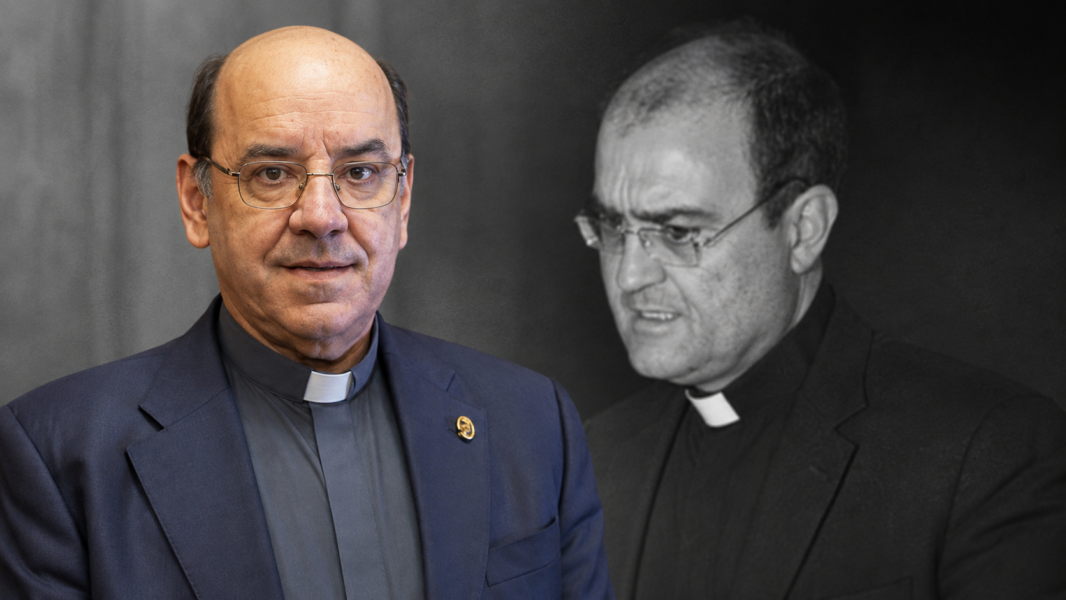
The Archbishopric of Pamplona publishes on Wednesday a note about Father Javier Aizpún, parish priest of Huarte and canon of the cathedral, who, amid the Ceuta crisis (49,000 entries and 88 deaths according to National Security, the Army deployed at the border), had called on X to bomb Rabat “if necessary.” So far, the facts.
The note itself continues: the archbishop, Florencio Roselló, calls the priest; the priest deletes the account, personally asks for forgiveness and begs him to extend that forgiveness to the Church and to society at large. Case closed in the office, the reader might think. Not so: with the pardon already in hand, the Archbishopric decides to publish it anyway.
And what it publishes: that it was an opinion “strictly personal” that “in no case represents nor is shared by this diocesan Church”; that the archbishop thinks like Leo XIV and like Francis (in case any doubt remained in some Roman office); that the priest’s words were “very ill-advised”; and, as a bonus, that the Diocese “apologizes for the confusion and unease.”
Notice the maneuver, which has its own clockwork. If the opinion was strictly personal, the interested party’s penance was enough: no one apologizes for what is not theirs. If the Diocese apologizes, then something of its own was involved, and the “personal” claim collapses. The note wants both things at once: to wash its hands and to hand over the head. Pilate, at least, did not draft a communiqué.
And to whom is the head handed over? To the Huarte council, where Geroa Bai and the PSN demand the parish priest’s replacement (parish appointments are not yet made by the municipal corporation, but everything comes in time); to Cadena SER, which airs the screenshots; to Religión Digital, which headlines “hate-filled priest” and celebrates the rectification as “swift.” In that charged atmosphere the note appears. Not a line about the campaign, not half a word of protection: the shepherd sees the wolves coming and opens the gate for them, lest they scratch themselves on the fence.
Correcting a priest is a bishop’s job, and Roselló had already done it: in private and with instant success. What happened on Wednesday does not correct, it adds: the public shaming of the corrected and the purity certificate of the corrector. The note reminds Aizpún that the parish priest is called to be “an instrument of communion, dialogue and reconciliation”… and the three virtues are practiced in the act: communion with SER, dialogue with Geroa Bai, reconciliation with all who demanded punishment. With everyone except the priest. A marvel of paternal solicitude.
It is now worth looking at the calendar. Omella turned eighty on 21 April and the Barcelona see is in the middle of a transfer market: Religión Confidencial placed Roselló in October as the leading candidate, sponsored by Omella and by Cardinal Cobo; in February he was received by Leo XIV in a private audience; afterwards he publicly ruled himself out, which in the hierarchy is the most orthodox way of staying in the race. A footballer in a transfer year does not go in hard: he paces himself, avoids the card, smiles at the stands and saves his ankle for the signing. An archbishop in a transfer year, it seems, does the same. Wednesday’s note does not clash a comma with the prevailing winds: that is its function, not its oversight.
Roselló is a Mercedarian. The Merced was founded by Saint Peter Nolasco in Barcelona (patroness of the city, by the way: everything stays at home) to redeem captives, and its friars took a fourth vow: to remain themselves as hostages in order to free the prisoner. Eight centuries later, a son of Nolasco hands over the prisoner in order to free himself.
He must have thought that, being a Mercedarian, it fell to him to leave his priests at the mercy of the enemy. The fourth vow, updated. And Barcelona is well worth a little press release.
Full statement of the Diocese of Pamplona and Tudela:
In view of the statements made by the parish priest of Huarte, Javier Aizpún Bobadilla, through his social media, the Diocese of Pamplona and Tudela wishes to state:
- That this is a strictly personal opinion, which in no case represents nor is shared by this diocesan Church.
- That the position of the Diocese is fully consistent with the Gospel message of Pope Leo XIV, who during his visit to the port of Arguineguín recalled that “human dignity has no passport” and stated that “one cannot speak of dignity and allow the seas to become cemeteries,” inviting us to face migration challenges from justice, peace and respect for every person.
- That the Archbishop of Pamplona and Bishop of Tudela, Monsignor Florencio Roselló Avellanas, has on numerous occasions publicly expressed himself on this issue in the same line as both Pope Francis and Leo XIV.
- That he held a dialogue with the parish priest to request the appropriate explanations regarding statements he considers very ill-advised, especially coming from a priest, and a parish priest at that, who is called to be an instrument of communion, dialogue and reconciliation.
- That the priest has proceeded to delete his account on the social network X, from which those statements were disseminated. In addition, he has personally asked the archbishop for forgiveness and, through him, wishes to extend this request for forgiveness to the Church and to society.
- The Diocese of Pamplona and Tudela apologizes for the confusion and unease that these statements may have caused and reiterates its commitment to a culture of encounter, respect for the dignity of every person and the search for solutions inspired by peace, justice and dialogue.