


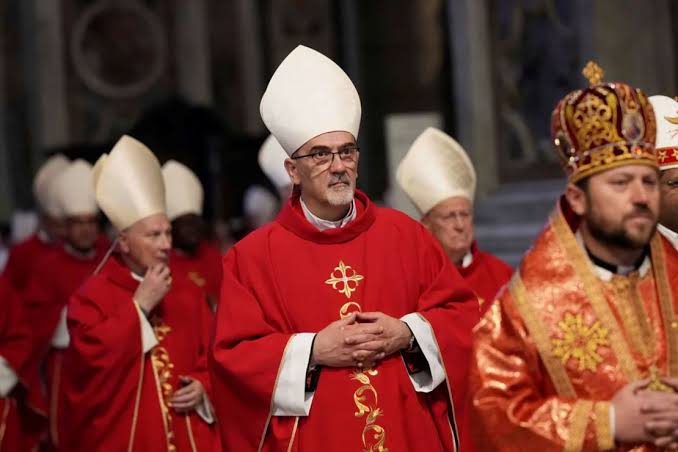
Cardinal Pierbattista Pizzaballa, Latin Patriarch of Jerusalem, has warned of the growing fatigue and loss of trust spreading among Christians in the Holy Land after years of war, violence, and successive announcements of agreements that never translate into stable peace. His main concern, he says, is that the region will remain trapped for a long time in a situation of “neither war nor peace.”
In statements given to Vatican News during his stay in Assisi, Pizzaballa described a scenario in which massive bombings have decreased, but where violence continues to shape relations in Gaza, the West Bank, Israel, and the Palestinian territories. The cardinal was in the Italian city for the inauguration of the Global House of Friendship and Hope and for the pastoral visit that Leo XIV made to Assisi on August 6.
“There is great fatigue”
Pizzaballa acknowledged that a deep weariness has settled among Christians in the face of the succession of negotiations, announcements, and subsequent denials.
“Among Christians, as among everyone, there is great fatigue with this back-and-forth, with these communications that are later contradicted by the facts,” the patriarch explained.
The repetition of frustrated expectations has, according to Pizzaballa, eroded the population’s trust to the point that even positive news is met with skepticism.
“No one believes anymore, not even in things that may later turn out to be true,” he lamented. In his view, when a hopeful event finally occurs, many still fail to believe it because “they are no longer used to seeing it.”
This distrust is precisely one of the problems that most worries the Latin Patriarch of Jerusalem. The current situation, he maintains, risks becoming entrenched without an open war of the previous scale, but also without a political solution capable of offering a stable outlook.
The danger of remaining in a situation of “neither war nor peace”
“What worries me most at this moment is that we remain in this situation of neither war nor peace, in this ambiguous situation,” Pizzaballa stated.
The cardinal warned against the possibility of continuing to talk about solutions without creating the real conditions to carry them out. The consequence, he says, is growing cynicism among a population that has been subjected to violence and uncertainty for years.
“All of this worries me because it creates in people’s minds an increasingly cynical attitude, one of distrust, which is the greatest danger I see at this moment,” he noted.
InfoVaticana already reported last June on the patriarch’s warnings about the deterioration of the situation of Christians in the Holy Land. On that occasion, Pizzaballa insisted that the Church must continue to act as a “bridge of hope” in a society where distrust and fear are growing.
The 541 Christians who remain in Gaza
One of the communities that best reflects this situation is that of the Catholic parish of the Holy Family in Gaza. Pizzaballa put the number of Christians currently remaining there at 541.
“We know them all, one by one,” he said.
The community is trying to regain some normality amid a still extremely precarious situation. According to the patriarch, efforts are being made to reopen the school, a medical center has been set up, and priests and religious sisters are maintaining activities for children, including minors who do not belong to Christian families.
“Within such a deteriorated situation, the main goal is to recreate a healthy and serene environment as much as possible,” he explained.
The parish of the Holy Family, the only Catholic parish in Gaza, was hit on July 17, 2025, by an Israeli attack that killed three people and left eleven wounded. A year later, the community remembered the victims while continuing to function also as a shelter for numerous people affected by the conflict.
Pizzaballa himself visited Gaza again last June, together with the Orthodox Patriarch of Jerusalem, Theophilos III, to accompany Christian families and assess their living conditions on the ground.
“There are still antibodies against the virus of violence”
Despite the scenario described, Pizzaballa rejects the idea that hope has disappeared from the Holy Land. The patriarch said he continues to find people willing to maintain relationships and build bridges even when doing so involves personal costs.
He spoke of young people, teachers, and elderly people who continue to commit themselves in Gaza, the West Bank, and Israel to meet others and defend spaces of coexistence.
For the cardinal, these people show that society still has “antibodies” capable of preventing “the virus of violence” from contaminating everything.
Pizzaballa’s gaze is directed especially toward young people. “The elderly are memory, but the young are hope,” he said, stressing the need for new generations to learn from the mistakes they have inherited and be able to build “something different” from what they have received.
Pizzaballa calls for “new faces” ahead of elections in Israel
The patriarch also referred to the Israeli elections scheduled for next October 27 and lowered expectations for those who believe the vote alone can resolve the crisis.
“Everyone is waiting for the elections as if they were a solution to all problems, but in reality the problems in the Middle East are ones that will require a lot of time,” he said.
Pizzaballa noted that Israel needs “new faces” and “new figures,” although he recalled that it is up to the voters to determine who will lead the country politically.
His statements come at a time when the Churches of the Holy Land have denounced in recent months various incidents that have directly affected Christian communities, from difficulties experienced during liturgical celebrations in Jerusalem to incidents recorded in Christian towns in the West Bank.
A possible visit by Leo XIV to the Holy Land
Asked about his relationship with Leo XIV, Pizzaballa said the Pontiff continues to closely follow what is happening in the Holy Land.
“The Pope is very close to us and is very well informed about what is going on, which is very important. He is present,” he noted.
The patriarch also believes that a visit by Leo XIV to the Holy Land will eventually take place, although he ruled out that it could happen while the current instability continues.
“Sooner or later it will surely happen, but it must take place in a context of serenity,” he said.
While that possibility remains open, Pizzaballa insists that the immediate challenge is not only to stop the violence, but to rebuild a social trust that has been severely damaged. Without it, he warns, any agreement risks remaining just another announcement incapable of giving Christians and the rest of the inhabitants of the Holy Land a real prospect of peace.