


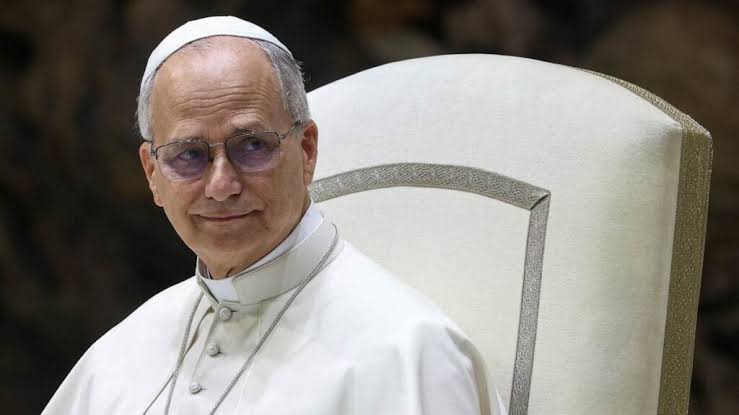
Santiago Roncagliolo, author of El pastor y los lobos, recounts in an interview how the then bishop of Chiclayo directed the work of journalists Paola Ugaz and Pedro Salinas on the Sodalicio, sent their materials to Rome through the nunciature, and arranged papal audiences as a sign of support.
Peruvian writer Santiago Roncagliolo, winner of the Alfaguara Novel Prize, has published El pastor y los lobos, a work of non-fiction investigating Robert Prevost’s trajectory from his missionary years in Peru to the conclave. The book originated as a publishing commission on the very day of the papal election, according to the author himself. On the occasion of its presentation, Roncagliolo gave an extensive interview to the Peruvian channel Qubo, conducted by journalist Daniel Titinger.
Roncagliolo knows the case from within journalistic circles. In the interview he speaks of his friendship with Paola Ugaz—“you yourself being very close to Paola Ugaz,” Titinger reminds him—and of his relationship with Pedro Salinas, who interviewed him on his program and whom he interviewed for the book: “It was very strange to interview someone for a book and be interviewed.” His account therefore comes from the direct sources of the Sodalicio case, in a book favorable in tone toward Prevost.
What that account describes is a highly coordinated management of the press, information, and image as an “extrajudicial” method. The interview notably describes the use of media mechanisms that are scarcely legalistic or transparent.
“He becomes the journalistic editor of Paola and Pedro”
Roncagliolo places the starting point in 2018, after the abuse crisis in Chile:
“Francis then realizes, in 2018, that the issue of sexual abuse can be brought against the Church, because a large part of its activity is educational. No one is going to put their children in a school where they are raped, nor follow the moral guidance of an institution that covers up rapists. (…) And at that moment, in the country right next to Chile, the Sodalicio case is exploding. And then this bishop, who is very close to the Pope, begins to present himself as the person in charge of those issues, of sexual abuse cases.”
Regarding Prevost’s specific role with the two journalists:
“Prevost begins, he becomes the journalistic editor of Paola and Pedro. He starts saying: I need this information, I need this testimony, this needs to be substantiated, I need a clearer explanation of this. And all that information begins to rise to the Vatican.”
In the scheme the author describes, the victims’ testimonies are directed toward journalistic investigation and their informational submission to Rome, rather than toward a rigorous canonical file with procedural guarantees.
“This whole almost spy-like operation”
Regarding how that information reached the Vatican, Roncagliolo details:
“They even choose the days to send it through the nunciature and check who is handling the mail that day, because there are those who can send it and others it’s better not to. And this whole almost spy-like operation is what feeds information to Pope Francis.”
This method, as described, would indicate bias and a certain lack of transparency and consistency in the information sent to the Pope.
The author also notes the internal context that, according to him, justified these precautions: “There are forces that defend them in the Vatican as well. The Sodalites have partners and friends in the Vatican.”
What is sent to Rome through this channel is, in the biographer’s own words, “information,” selected and forwarded outside the ordinary channels of the nunciature itself. A formal procedure would have left records, deadlines, and identifiable responsible parties; the method described leaves no such trail.
“Getting a photo with the Pope, that is: the Pope is on our side”
The third element of the account is the management of papal audiences:
“They then arrange for the Pope to receive Paola Ugaz, which is a sign of protection, right? Getting a photo with the Pope is saying: the Pope is on our side.”
Titinger points out: “Or so they believed, right?” And Roncagliolo replies: “Of course, that’s what Paola believed, because later they continued… everything continues until they end up closing them down.”
According to the writer, the same pattern continues during the pontificate:
“Right now he has recently received Gareth Gore, who has written a book on Opus Dei, and he is following a bit the same logic: using journalists to support his concerns about congregations and, if necessary, getting the photo so they see he is listening to them. It’s subtle, but very clear.”
In the treatment the book describes, support for the complainants is expressed through audiences and photographs; no procedural act—admission of complaints, precautionary measures, rulings—is mentioned as accompanying them.
“What did Prevost say? No, he didn’t say anything”
The interview devotes several passages to the personal style of the current Pope:
“As a character to narrate, he was a nightmare. He has no quotes, no scenes, no gestures. You ask the sources: and do you remember what Prevost said at that dramatic and crucial moment? No, I don’t think he said anything. Even in his last words before the conclave (…) the cardinals I spoke with, I ask them: and what did he say in that speech? No, I don’t remember. (…) But what everyone says is that then he leaves and things happen.”
Titinger proposes an image in the conversation: “Because he’s always a Trojan horse, right? He understands the adversary, he doesn’t confront him openly, but he always neutralizes him from within. He’s always quiet, that’s why he wasn’t well known.” And regarding the journalists’ own perception, Roncagliolo notes: “There are passages in which Salinas is openly furious with Prevost because, of course, it seemed like he wasn’t doing anything and yet he was doing things behind the scenes.”
“Prevost divided Opus Dei”
The same style of management appears, according to the book, in the internal governance of the diocese. Roncagliolo reads a passage in the interview attributed to “a collaborator of Prevost in Chiclayo”:
“Prevost divided Opus Dei. He offered important appointments to several of their most promising young members, who otherwise would have had to wait decades. By winning over part of them, he nullified their ability to act as a bloc.”
Titinger adds: “And one of them is the current papal assistant, Edgar”—referring to Fr. Edgar Rimaycuna, now in the immediate circle of Leo XIV.
The danger of non-guaranteed methods and media-driven processes
What Roncagliolo’s account ultimately raises is a question of law. The Church has a legal system that establishes how cases are investigated, prosecuted, and resolved: with adversarial process, right of defense, regulated evidence, and the possibility of appeal. The method the writer attributes to Prevost—testimonies directed to the press, selective dossiers sent to Rome, photographs as resolution—takes place entirely outside that system. It is the same pattern seen in the Roman phase of the Sodalicio case, handled by Monsignor Jordi Bertomeu: extremely serious measures without ordinary process, without a published sentence, and without the possibility of appeal. The canonical process is not a formality: it is the only guarantee that truth is established legally and not by the force of a campaign. When it is dispensed with, it is not only the accused of the moment who falls; the legal security of everyone in the Church falls with it.