


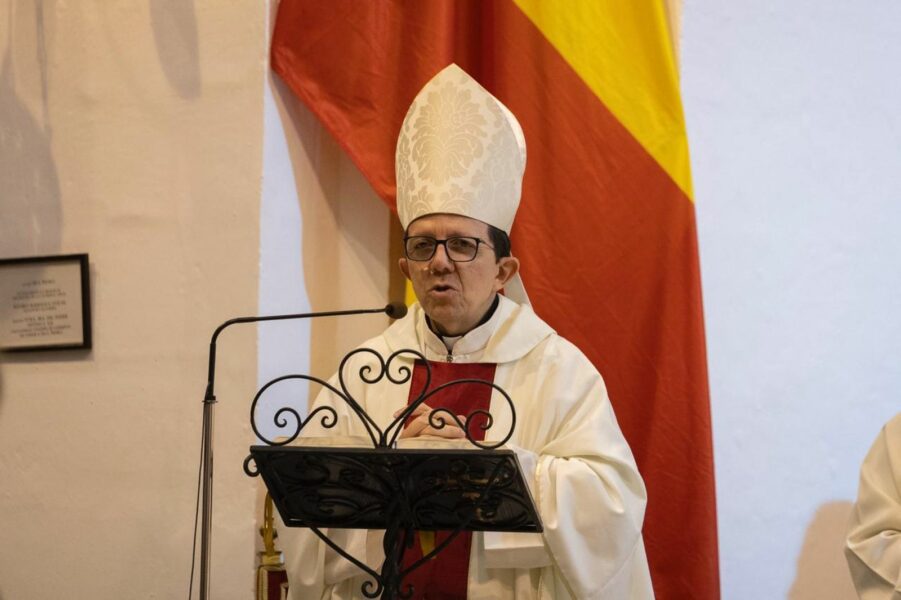
Auxiliary Bishop of Seville and Apostolic Administrator of Cádiz and Ceuta, Ramón Valdivia, has defended the response offered by the Church during the invasion recorded in Ceuta following the mass entry of illegal immigrants on July 30. In an interview given to Vida Nueva, the prelate maintains that the diocese acted from the first hours to coordinate assistance and states that the Church “has shown its maturity” in a situation he describes as an “international political crisis” and a “human drama.”
The diocese mobilized parishes, Cáritas and the San Antonio Center
According to Valdivia, the diocese began organizing its response as soon as the first irregular entries were detected on the morning of July 30. In coordination with parish priests, Cáritas and the Migration Delegation, it was decided to allocate the weekend collections to the care of the people arriving in the city, although he acknowledges that no one could have foreseen the scale of the episode.
The apostolic administrator notes that, a few hours later, Ceuta received an influx of people that exceeded all expectations. In that context, the San Antonio Migration Center, the various parishes and the diocese placed themselves at the disposal of the Government of the Autonomous City to collaborate in the emergency response, insisting that the Church’s contribution was made “to the small extent” of its possibilities.
He also describes the first hours as a situation marked by the presence of thousands of young people, women and children walking through the city streets, while residents watched with concern events that disrupted daily life in Ceuta.
Valdivia defines the situation as an “international political crisis”
The bishop maintains that what happened cannot be understood solely as a “migration crisis,” but as an “international political crisis” accompanied by a “human drama” whose consequences, in his view, have still not been fully assessed.
Valdivia believes the Church had to respond both through material assistance and spiritual accompaniment, especially on days when the city was celebrating its patronal feasts in honor of Santa María de África. According to him, the faithful’s participation in religious events increased during those days and the celebration of the liturgies became a meeting point for many Ceutans.
He acknowledges the population’s fear and calls for rebuilding trust
Asked about the Church’s actions, Valdivia states that the institution “has shown its maturity” in a situation he describes as “unprecedented.” At the same time, he recalls that this is the second mass entry of immigrants Ceuta has experienced since the May 2021 crisis.
The apostolic administrator acknowledges that feelings of “anger” and “fear” exist among the population and admits that many citizens feel vulnerable in the face of such episodes. In that context, he notes that it is up to the authorities to guarantee public safety, while the Church must help rebuild trust, accompany those who have suffered uncertainty and promote peaceful coexistence.
He also maintains that it is necessary to work to find a dignified solution for the people who have entered the city illegally, while defending mutual respect among all inhabitants of Ceuta.
He thanks León XIV for his support
Finally, Valdivia thanks the words spoken by Pope León XIV during the Angelus prayer regarding the situation Ceuta is facing. The apostolic administrator considers that this message has provided support for the diocese and states that it has served to reinforce the Church’s call to promote peace, stability and justice while the city continues to face the consequences of the recent “migration crisis.”
The crisis remains open on both sides of the border
Although most of the immigrants who entered Ceuta have already left the city, the consequences of the crisis are far from resolved. According to data from the Ministry of the Interior, “around 70,000 people have already left the autonomous city,” but Ceuta continues to face strong pressure on its reception services, especially due to the presence of unaccompanied foreign minors.
The Ceuta government currently puts the number of minors under the care of the Autonomous City at 1,017 and acknowledges that the protection system is under “extraordinary pressure,” which has forced the opening of new resources while the government seeks a solution for their redistribution among the autonomous communities.
On the other side of the border, Morocco has begun to assign responsibilities for the mass crossings of July 30. According to the Moroccan Association for Human Rights (AMDH), the country’s authorities have prosecuted 86 people in Tétouan and Nador for their alleged involvement in the clandestine entries into Ceuta. Some of those charged have already received prison sentences for offenses related to the organization of irregular departures and the use of electronic means to promote them.
While the debate on the distribution of minors among the autonomous communities continues, the president of Ceuta, Juan Jesús Vivas, will be received by Felipe VI and will also present the city’s situation at an extraordinary meeting of the European Parliament’s Committee on Civil Liberties, Justice and Home Affairs (LIBE), where the “migration crisis” on the southern border will once again take center stage.