


Every August 5 the Church celebrates the dedication of the Basilica of Saint Mary Major, the first great Marian shrine of the West. Its origin is linked to an ancient tradition that has given rise to the title Our Lady of the Snows and that, for more than sixteen centuries, recalls the Virgin’s special protection over the Church of Rome.
Beyond the legendary character with which tradition has transmitted some details, the account preserves a profound spiritual truth: when a person places trust in God, Providence finds unexpected ways to accomplish its designs.
The snow that marked the place chosen by the Virgin
Tradition places the origin of this devotion during the pontificate of Pope Liberius, in the fourth century. A Roman couple, known for their deep faith and generosity to the poor, suffered the sorrow of having no children. With no descendants to inherit their considerable estate, they decided to place their goods in the hands of the Virgin Mary and asked her to show them how to use them for the greater glory of God.
The answer came unexpectedly.
During the night of August 4–5, both the couple and Pope Liberius are said to have received the same message: the Virgin desired a church to be built for her in the place she herself would indicate.
The following morning the miracle that gave this devotion its name occurred. In the middle of the Roman summer, the Esquiline Hill appeared covered with snow. The Pontiff went in solemn procession with the couple and marked the perimeter of the future church following the outline the snow traced on the ground.
That first church would disappear with the passing of time. Decades later, after the Council of Ephesus, Pope Sixtus III erected on that site the present Basilica of Saint Mary Major, which has since become one of the principal centers of Marian pilgrimage in the world.
The first great shrine dedicated to the Mother of God
The rebuilding of the basilica was no casual event. In the year 431, the Council of Ephesus solemnly proclaimed Mary as Theotokos, Mother of God, against the Nestorian heresy. Shortly afterward, Sixtus III wanted Rome to have a temple worthy of that doctrinal event that would forever mark the history of the Church.
Saint Mary Major still preserves some of the oldest paleo-Christian mosaics in the West and houses important relics of the Christian tradition, among them the venerated boards of the crib of Bethlehem. The remains of Saint Jerome, translator of Sacred Scripture into Latin, also rest there, and from 2025 it likewise holds the tomb of Pope Francis, who throughout his pontificate showed a deep devotion to the Virgin venerated in this church.
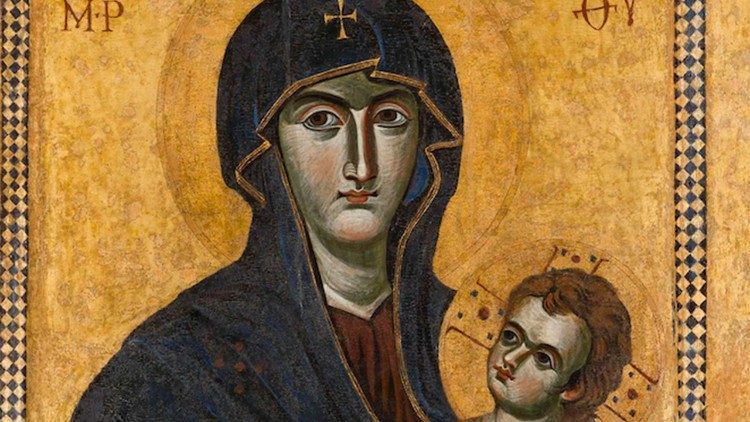
The «Salus Populi Romani»
Inside the basilica is kept one of the most venerated Marian icons of Christendom: the Salus Populi Romani, the Protectress of the Roman People.
Generations of the faithful and practically all the popes of the modern era have prayed before this image. Benedict XIV went every Saturday to sing the Marian litanies, while Saint Paul V asked to be taken before the Virgin only hours before he died.
The tradition of entrusting to the Mother of God the decisive moments in the life of the Church has remained alive to our own day, making this icon one of the greatest symbols of Roman Marian piety.
Mary, Queen because she was the first to serve
At the close of the Marian Year of 1954, Pope Pius XII solemnly crowned the image of the Salus Populi Romani and proclaimed the liturgical feast of Saint Mary Queen, celebrated today on August 22.
It was not a matter of granting the Virgin a new dignity. From the earliest centuries the Church had invoked her as Queen of Heaven and Earth. The liturgy simply came to express in solemn form a truth the Christian people had been confessing for centuries.
From Rome to Vitoria: Spain’s White Virgin
The devotion of Our Lady of the Snows also found a deep welcome in Spain. One of its principal centers of devotion is Vitoria-Gasteiz, where the image of the Virgen Blanca, venerated in the church of San Miguel Arcángel, has been patroness of the city since the twentieth century, although her cult dates back several centuries. Every August 5, thousands of Vitorians renew their devotion to the city’s protectress in festivities whose origin lies precisely in the celebration of Our Lady of the Snows.
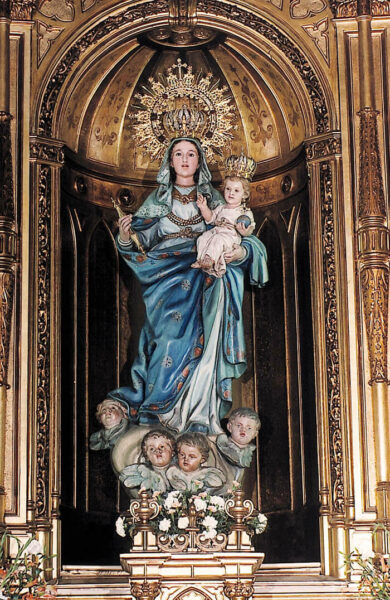
The image, carved in 1854 by Alejandro Valdivieso, receives the name Virgen Blanca as a popular expression of the ancient devotion of Our Lady of the Snows. In this way, the liturgical memory of the dedication of Saint Mary Major not only recalls the birth of the principal Marian shrine of the West, but also a devotion that has taken deep root in Spain’s religious history and that continues alive in cities such as Vitoria, where the White Virgin remains the spiritual heart of its patronal festivities.