


The other day, in Rome, an archbishop named Giordano Piccinotti presented the annual balance sheet of the Administration of the Patrimony of the Apostolic See, which is the solemn name of the strongbox, and read the figures with the placidity of a parish priest counting the collection from the twelve o’clock mass.
Two thousand six hundred eighty-six million euros in net assets, 4,281 real estate units in Italy, another 1,200 properties scattered around the world through companies based in London, Paris, Geneva and Lausanne, and a gold reserve that sleeps in a basement of the Federal Reserve, in Manhattan, as saints sleep in their urns.
The mission of the house, the archbishop explained, consists in “safeguarding and strengthening the patrimony”.
This happened months after the Pope signed an entire exhortation dedicated to love for the poor, and no one in the room found anything amiss.
A strongbox in motion
Do not think the patrimony is still.
There is movement: the house has launched a three-year plan to sell properties it calls non-strategic, and the communiqué specifies the destination of the money, which is not Lampedusa but reinvestment “in more profitable assets”.
Also under way is the exit from a Luxembourg fund whose name, Sloane & Cadogan, does not evoke existential outskirts but a tailor’s shop in Chelsea.
The year closed with 22.8 million in ordinary profit, compared with 62.2 million the previous year, and of that the Curia consumed 22.7 million for its own upkeep, so that, all accounts settled, 155,000 euros remained for the universal Church—what a storage room costs in the Salamanca district.
That was the year’s spare change: a storage room.
The sermon and the strongbox
One is not in a position to give lessons.
One has delivered memorable speeches on generosity at bars where someone else was paying the round, so one recognizes the genre at first sight.
But, reading the balance sheet, I found myself imagining the sermon applied to the strongbox.
I pictured the 4,281 doors in Italy opening one by one. I pictured the salons of Lausanne smelling of someone else’s stew and of children. I pictured the gold of Manhattan rising in ingots along Liberty Street to be turned into bread, into passages, into wells.
Then I did the math with a pencil and the fever passed, because the entire treasure of the Apostolic See today is smaller than that of a provincial American university and would not finance even one quarter of the homilies pronounced in its shadow.
The sermon signs checks the strongbox cannot cash.
Betania and Milan
The Church has known this dispute since its first week.
In Bethany, a woman poured over the Master a pound of pure nard, and the first to be indignant was the group’s treasurer:
“Why was this perfume not sold for three hundred denarii and given to the poor?”
The evangelist, who was present, notes immediately afterward that the man did not say this because of the poor, but because he carried the purse and dipped his hand into it.
Since then we have known that the proposal to liquidate the treasure for the poor usually comes from whoever administers the purse.
But we also know of Ambrose of Milan, who melted the sacred vessels, his own, to ransom captives, and answered the scandalized that the Church has gold to spend, not to keep.
Tradition blesses both things, keeping and melting, each with its saint.
What has no saint is the third option: keeping the gold and passing someone else the bill for the poor.
The patron of this accounting
And there remains the Samaritan, who is the patron of this accounting.
That man on the road to Jericho did not exhort the innkeeper to a culture of welcome nor explain his moral duties toward the wounded man.
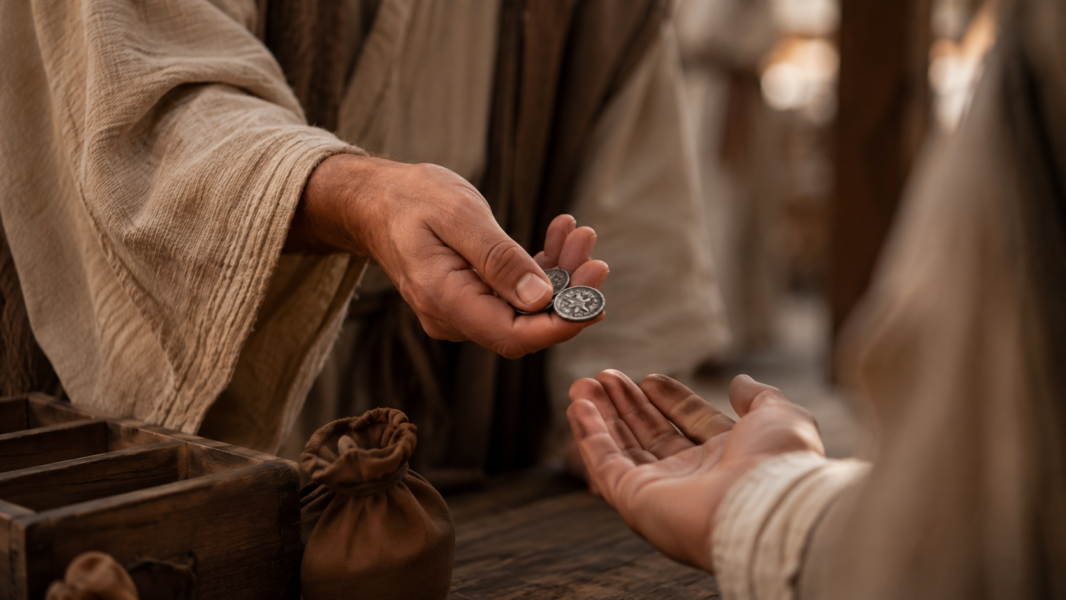
He loaded him onto his own mount, treated him with his own oil and wine, and as he left he took from his purse two denarii, two, and said:
“Take care of him, and whatever you spend in addition I will repay you on my return.”
He put up everything himself: the mount, the oil, the wine and the word.
The difference he left charged to his own credit, not the innkeeper’s. Two denarii, and from his own purse, that Samaritan.