


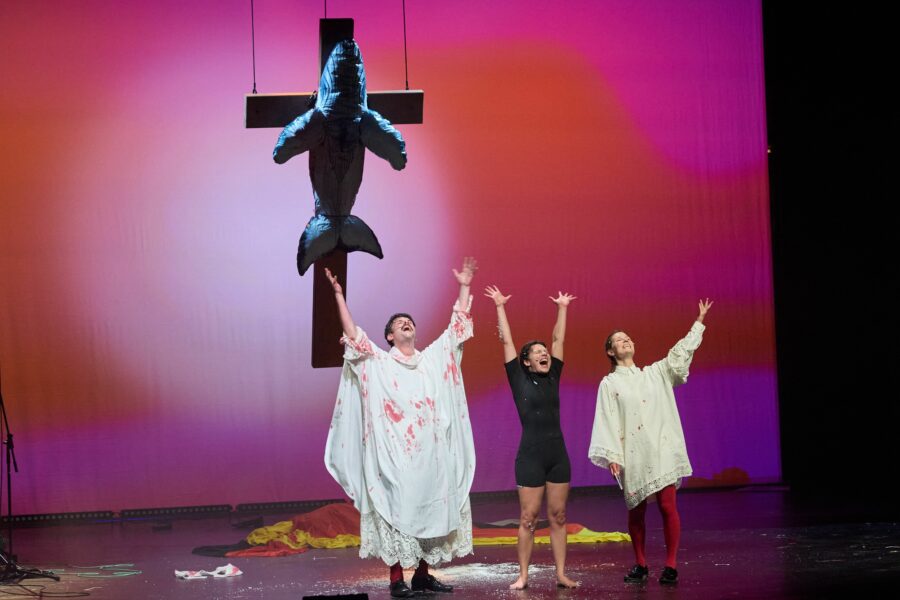
A theatrical work premiered at the Ernst Deutsch Theater in Hamburg has turned the Passion of Christ and the Holy Mass into a blasphemous parody. TIMMY: Die Hope stirbt zuletzt («Timmy: hope is the last thing to die») features a crucified humpback whale, celebrates a supposed «mass» in its honor, and replaces the «Alleluia» with the cry «Walleluja», drawing on some of the most sacred symbols of Christianity to construct its stage proposal.
The play’s director, Alexander Klessinger, describes the production as a «modern Passion story» and even as a «mass for Timmy». In his view, the whale has become a «kind of salvific figure» onto which millions of people project their longings for meaning, hope, and redemption.
A whale turned into a «figure of salvation»
The work takes as its starting point the case of Timmy, the humpback whale that became stranded and whose rescue attempt sparked intense public and media attention in Germany.
Building on that story, the performance constructs a parallel with the Passion of Christ. The cetacean appears nailed to a cross, is placed on an altar while an actor dressed as a priest celebrates a supposed «Holy Mass for Timmy», and its «resurrection» is greeted with cries of «Walleluja», a deliberate distortion of the Christian «Alleluia».
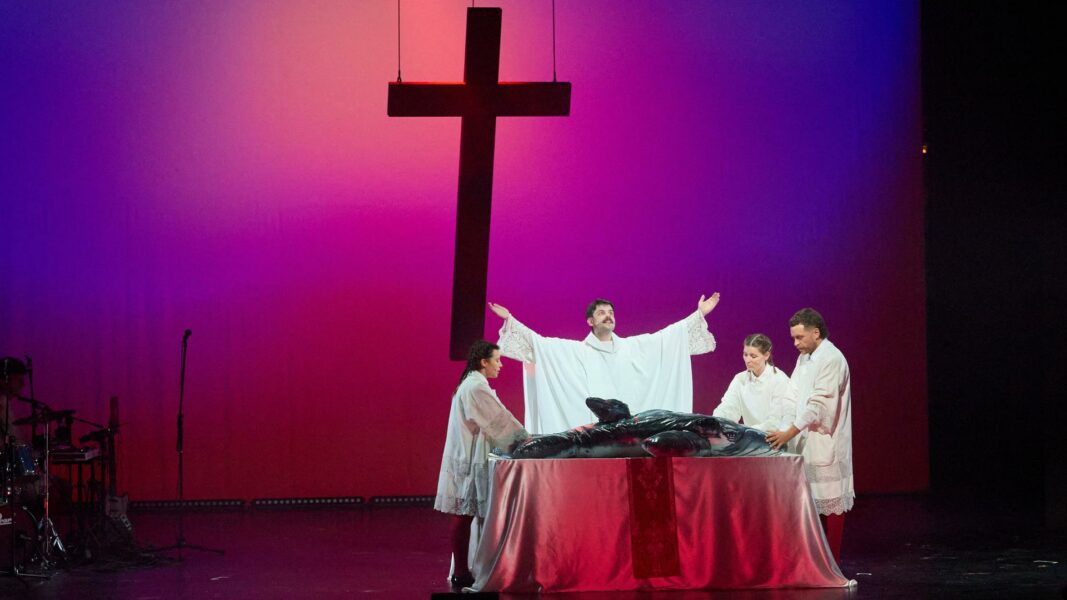
The director himself maintains that his intention is not to ridicule Jesus Christ, but to question the need of secularized societies to create new «figures of salvation» when traditional religious references disappear. According to this interpretation, the whale would have become a screen onto which to project ecological guilt and the hope of redemption through environmental commitment.
A new profanation of Christian symbols
The production joins a long series of artistic works that resort to the profanation of the Cross and Catholic liturgy as a provocative device. In this case, the play replaces Jesus Christ with a whale turned into a «figure of salvation» and transforms the Eucharistic celebration into a «mass for Timmy», using the altar, liturgical vestments, and the Church’s own language for parodic purposes.
For the Christian faith, the Cross is not an interchangeable symbol of suffering nor a dramatic device applicable to any cause. It is the sign of the redemptive sacrifice of Jesus Christ, while the Holy Mass sacramentally renews that unique sacrifice. The use of both as theatrical elements to construct a satire constitutes a trivialization of what millions of Christians consider sacred.
Although the director claims to intend to criticize certain social phenomena and new forms of «secular religion», the work ultimately uses precisely the central symbols of Christianity as the vehicle for that critique. The Passion of Christ, the Cross, and the Eucharist cease to be objects of veneration and become instruments of a stage provocation that would hardly have achieved the same impact without resorting to the parody of the sacred.
Blasphemy as a means of attention
This is not the first time that contemporary art has used Christian symbols to ensure media impact. Among the best-known precedents are the sculpture of the crucified toad by Martin Kippenberger, which provoked the protest of Benedict XVI, or the production SANCTA by Florentina Holzinger, in which a nun engaged in sexual relations with a crucifix.
The Cross is not an interchangeable symbol of suffering nor a dramatic device applicable to any cause. It is the sign of the redemptive sacrifice of Jesus Christ, while the Holy Mass sacramentally renews that unique sacrifice.
With the crucifixion of a whale, the celebration of a false Mass, and the replacement of Christ by an animal elevated to a «figure of salvation», TIMMY: Die Hope stirbt zuletzt joins the list of productions that resort to blasphemy and the parody of Christian symbols as their main element of provocation.