


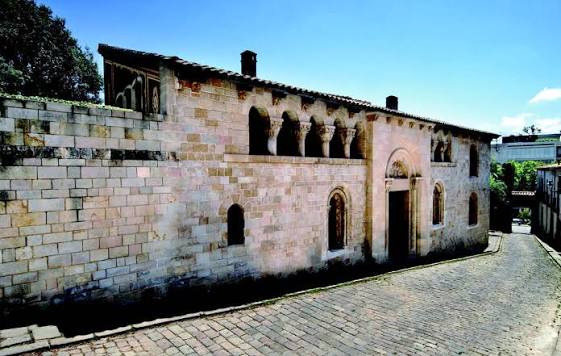
Let us briefly examine the concrete history of each of the “conventets” I was assigned to study and how they demonstrated that the working hypothesis of the project directors—that the abbess held the power—was erroneous, the result of an ideologically driven and unscientific approach.
The conventets, as we have said, were small convents initially composed of four friars minor, half of them ordained, located within or near Clarissan nunneries and whose purpose was to serve them sacramentally and to beg alms on their behalf. The cases studied are the conventets of the women’s monasteries of Santa María de Pedralbes, Santa Clara de Manresa, and Santa Clara de Balaguer. For reasons of space, we will limit ourselves to the most basic facts that occurred between the fourteenth and sixteenth centuries.
The conventet of the monastery of Pedralbes in Barcelona:
The documentation and bibliography on the Real Monasterio de Santa Maria de Pedralbes in Barcelona and its conventet are extremely abundant, disproportionate in comparison with the other two we will study. The monastery of Pedralbes was founded with the intervention of Queen Elisenda de Montcada, wife of James II, who in 1326 acquired land in Pedralbes, where the monastery still stands today; an enclave that, in the first third of the fourteenth century, though set apart from the city, was nearby and not so isolated. The first community consisted of fourteen nuns who came from the monastery of San Antonio and Santa Clara in Barcelona. When the queen issued her ordinances, she was organizing a monastery in which the community of women, the priests, and the friars were to live together, and for all of them she followed a common criterion in organizing their maintenance.
In the foundational stage, the male Franciscan order already participated actively. In 1326 the future abbess had obtained authorization from the vicar general for friars from the Barcelona convent to act as advisors in the construction work and, once the work was finished, to serve as confessors and enter the enclosure on certain commemorations. In the initial works, however, the Franciscans were not yet established as a community in Pedralbes, since the «conventet» does not appear (Monreal, 1971, pp. 18-19 and 22); from that date there is a papal order for them to travel from their Barcelona convent to solemnize certain festivities celebrated in the monastery (which was only a league from the city) whenever they were required by the abbess (Monreal, 1971, p. 22). In line with the rule, Queen Elisenda, already in the first ordinance issued in July 1327, allocated a sum of money to pay the four friars who would come to the monastery with their companions to act as confessors to the nuns (footnote #27: AMP; P/15, fols 27-32v, Perg. Núm 999, leg num 124, fundaciones).
The ordinances of 1334 marked a substantial change in this state of affairs (Monreal, 1971, p. 22): the permanent residence of four friars minor within the monastery enclosure was established. It is the ordinance of 1341 that provides the first explicit mention of a “Hospici edificat prop lo Monastir” (Monreal, 1971, p. 24) in which six ordained friars minor in sacris were lodged. Everything therefore indicates that the building that came to be known as the conventet was built around 1340-41. It seems clear that the aim was to fulfill the commitment made by Francis of Assisi that the Franciscan friars would serve the convents of nuns spiritually and sacramentally (Webster, 1987, pp. 127-129), in accordance with a passage from Chapter VI of Clare’s rule according to which Francis of Assisi drew up the nuns’ form of life, promising always to dispense “loving care and special solicitude” (Omaechevarría, 2004, p. 283).
Taking into account the location chosen for the erection of the monastery of Pedralbes, the factor that must have determined the construction of a residence for a few friars within the women’s monastery enclosure was the geographical distance from the male convent at a time when friars traveled on foot and had to fulfill their obligation of charismatic and sacramental spiritual service to the nuns. The building, which survives (with modifications) to this day, is an architectural structure that reproduces on a very reduced scale the layout of other residences of friars minor (Monreal, 1971, p. 47).
Over time, the friars, despite their economic dependence on the monastery, depended legally on the provincial father; in the words of Dr. Castellano: “the friars settled in Pedralbes ultimately depended on the Franciscan superiors, and although they lived apart from the main community they formed part of the common trunk, and were therefore involved in all the vicissitudes affecting the order” (Pedralbes a l´Edat Mitjana, Història d´un monestir femení, p. 174). Introducing the obligatory feminist and presentist wedge of any self-respecting “academic” research, despite explicitly stating that the friars of the conventet depended legally on their provincial superior, Castellano has no qualms about saying that “the dependence of the friars and priests on the nuns was total (Castellano, Pedralbes a l´Edat Mitjana, Història d´un monestir, p. 177); so that, practically speaking, one could speak of a “double monastery” like those constituted in the early Middle Ages, such as Fontevrault, but unlike those, in which men and women followed the same rule, in Pedralbes, although they belonged to a common trunk, they followed two different rules, one for the women and the other for the men.” I do not agree with this idea at all. I do not think a “conventet” of friars minor next to a Clarissan nunnery has anything to do with a double community like Fontevrault. There is no space here to address this question, but it is still surprising how little knowledge so many historians have of the Catholic Church.
The information about the conventet of Pedralbes is chronologically fragmentary (Monreal, 1971 p. 69), and here, for reasons of space, we are obliged not to go into the details of how the observant reform in Franciscanism affected it in its various stages. What Monreal does affirm is that “we can therefore conclude this hazardous—and at times confusing—account of the historical evolution of the “conventet” of Pedralbes by stating that the victory of the observant reform over the conventual branch of friars and nuns did not suppress the cura monialum, the spiritual and sacramental care of the nuns, in this monastery.” This statement, with a clear documentary basis, invalidates the hypothesis put forward by the project director that—at least in the case of the monastery of Pedralbes—the triumph of the Observance meant the end of the cura monialum.
Santa Clara de Manresa and its friars’ conventet
On the basis of primary documentation, Dr. Araceli Rosillo states that a convent of Santa Clara existed in Manresa, which began to be built outside the walls, next to the church of San Blas and San Lázaro, at the end of 1322, and whose foundational process can be considered complete in 1327 (Rosillo, 2016, p. 135), “near which some Franciscans lived.” Despite the existence of these Franciscans in Manresa, whose presence Jill Webster considers confirmed since 1292 (Webster, 1987, p. 136), it seems that, nevertheless, by the date of the foundation of the women’s convent of Santa Clara, no male convent had yet been founded in the city (Rosillo, 2013, p. 173). According to Webster, it seems possible that, due to circumstances unknown until now, the female branch of the Franciscan Order prospered in Manresa, but not the male branch; she attributes the presence of some friars to the prior existence of the Clarissan convent (Webster, 1987, pp. 129 and 132), and not the other way around, as was the general pattern, and considers that these Franciscans served the convent of Santa Clara (Webster, 1987, pp. 127-129), “as is to be expected from their condition as Franciscans.”
Dr. Araceli Rosillo states that “the formulas by which the nuns received assistance and placed themselves under the jurisdiction of the friars did not always fulfill the simple promise Francis made to Clare (2013, p. 176).” Also in the first chapter of Clare’s rule it is established: “the form of life of the Order of the Poor Sisters, instituted by the blessed Francis (…). Clare (…) promises obedience and reverence to the lord pope Innocent IV and his canonically elected successors, and to the Roman Church (Omaecheverría, 2004, p. 273). “The documentation has so far shed little light on the first Clarissans of Manresa,” Rosillo stated in 2013. Jill Webster states that, “as far as is known, the friars of Manresa were under the jurisdiction of the Custody of Barcelona and already from 1297 had a procurator (Webster, 1987, p. 129). The nuns were under the obedience and jurisdiction of their confessor (Sanahuja, 1959, p. 815).
Of the two friars mentioned in the documentation for the year 1322 (Rosillo, 2013, p. 177), without a convent and residing in Manresa, according to Webster’s statement, “to serve the convent of Clarissans,” the community of Franciscan friars linked to Santa Clara de Manresa grew and is documented to have consisted, throughout the existence of the nuns, of 49 men (a figure recorded in documents of 1373 and 1396 respectively), a fact which, according to Dr. Araceli Rosillo, confirms the “logical and necessary existence” of a conventet. This space, Rosillo states (2016, p. 258), is mentioned in a document of October 1401 that donates to the friar confessors of the sisters of Santa Clara some bedclothes and fabrics “for when they are sick or for the use of any brother who is passing through Manresa and lodged in the confessor’s house, located next to the monastery.” Analyzing this document, Rosillo states that “it does not seem to be a very large space, but it is sufficient to accommodate itinerant friars” (Rosillo, 2016, p. 258). Among the 49 friars documented in Manresa we can distinguish four categories: the confessors, the masters of theology, those who acted as witnesses in the sisters’ documentation, and the visitor.
Let us note for the moment that this seems to be a large “community” of Franciscans, which does not correspond to the concept of conventet seen in Pedralbes, and which accommodates “itinerant friars”, a concept again very interesting and novel with respect to the conventet of Pedralbes. In this regard, Araceli Rosillo states that “due to the characteristics of the monastery’s location, on the road to Barcelona, one could say that the conventet was a stopping place in the itinerancy of the friars who preached between Barcelona and Girona and, moreover, housed a small community of friars, two or three permanently according to the signatures, who assisted the nuns with good books of Sacred Scripture: “on the basis of the documentation, it seems that some of the friars of the community of Santa Clara would have been ordained, a fact that did not always occur and made the presence of priests necessary to perform liturgical offices and administer sacraments” (Rosillo, 2016, p. 264). “It seems, then, that in its development of the relationship with the friars the community of Manresa lived the primitive Franciscan-Clarian fraternity that Francis promised and that Clare asked for in her rule, or at least that is what can be inferred from the documents” (Rosillo, 2016, p. 265).
Up to this point, we have followed the research on the foundation of the convent of Santa Clara in Manresa and its conventet presented by Dr. Araceli Rosillo, its principal scholar, both in her doctoral thesis of 2013 and in an article of 2016. However, there seem to be data that do not fit the narrative and that, if so, would completely change the assumptions about a presumed female foundation unrelated to a prior male community in the place. Araceli Rosillo states that “it has not been possible to show that the Manresan Clarissan community had prior contact with the Franciscan friars who lived in Manresa, possibly, according to our hypothesis, in the space next to the chapel of Sant Blai i Sant Llàtzer that served as a leper hospital.” That is to say, the presence of two Franciscan friars in Manresa prior to the female foundation is documented, nothing less than since 1292, while the female foundation dates from the 1320s. Would it not then be more logical to propose the hypothesis, following the custom of Clarissan foundations where there was prior male presence, that the convent of Santa Clara was founded in Manresa because of the presence of the two friars in the chapel of San Blas and San Lázaro, because this nucleus intended to be the beginning of the foundation of a larger community and a convent? From this approach in line with the Franciscan and Clarissan logic of foundations, we could venture that the male foundation did not prosper and that, instead, the Franciscan superiors established a “conventet” to attend sacramentally and spiritually to the nuns which, moreover, served as a lodging for itinerant friars between Girona and Barcelona. The documented number of friars at specific moments lends strength to this hypothesis and contributes to dismantling the myth of the foundational autonomy of Clarissan convents without the need for prior male communities. These may have been occasional in some cases, but it does not seem to have been the case in Manresa, nor does it seem to have been the case in Balaguer, nor was it in Pedralbes either.
Santa Clara de Balaguer (Almatà) and its conventet
The Monastery of Santa Clara de Balaguer was founded in 1351. In 1347 James I of Urgel, son of Alfonso the Benign, had died, and in his will he arranged for the foundation of a Clarissan convent in the city of Balaguer to house his mortal remains inside the church. At first this was not possible and he rested in the convent of Sant Francesc in Barcelona. The wife and executors of James I of Urgel obtained the parish church of Santa María de Almatà, documented since the year 1094 and located in the upper part of the city, near the castle where the counts of Urgel resided.
Margarida de Montcada (1300-1368) had entered the Monastery of Corpus Domini in Naples in the year 1322 and her aunt, Queen Elisenda de Montcada, and the count-infante James called her for the foundation of Balaguer. The community was established shortly afterwards, with Margarita de Moncada as abbess (Triviño, 2020, pp. 418-425).
Sister Victoria Triviño states in the same writing that “there was still a project that does not appear in the documents, but was happily carried out: it was to have in Balaguer a “conventet of friars minor,” as in Pedralbes, for the help of the monastery. This small community served the sisters until the suppression of conventuality in 1557” (Triviño, 2020, p. 426). This statement leads us to raise a very basic question: if the conventet does not appear in the documents, how do we know of its existence?
Contrary to what Triviño states, the conventet of Balaguer is documented, albeit sparsely: the friar historian Agustí Boadas indicates that “the date of foundation of the convent of Sant Francesc de Balaguer, or also convent of Almatà or Conventet, is unknown” (Boadas, 2014); it seems that there are indirect references that consider it very ancient, such as the mention that a certain Bernat of the Centelles family was buried in the convent of Almatà of friars minor; it could be Bernat III, who died in 1277. On the same page it is indicated that “the good relationship of the Centelles family with the Crown (James I and James II) suggests that the foundation should be placed before the death of James I, before 1276.” It is a confusing matter, because again the first reference made by the friar and historian Pere Sanahuja to the male convent is from 1372, when it appears in a will, and he considers it a “conventet” located next to Santa Maria d´Almatà and serving the nuns of Santa Clara in a manner analogous to those in Pedralbes or Manresa (Sanahuja, 1959). Father Sanahuja states that the “conventet” was demolished in the siege of 1413 and was never rebuilt, while Sister Victoria Triviño mentioned in the cited article that the “conventet” had functioned until 1557, with the establishment of the Observance in the city.
However, if what Boadas states is correct—that the convent of Almatà belonged to friars minor, that it had also been called the convent of Sant Francesc and that it may have been founded before the death of James I the Conqueror (1276)—it would not be ruled out that from the existence of that first community of friars minor the nuns were subsequently established, also near the castle square and in close proximity to the friars. The fact that the first Franciscan foundation in the Crown of Aragon was in the city of Lérida in the year 1217, only 30 km from Balaguer, makes an early foundation in the latter city not implausible. In any case, there are not sufficient data to affirm it.
It is clear that this is a case around which there is considerable confusion. It is true that it is cited in the documentation, but, in addition to the date and reason for its end not being clear, there are also no archaeological remains of the “conventet,” which Father Sanahuja considered to be located at the opposite end of the square from the Clarissan convent, somewhere in front of or inside the castle.
On the other hand, and subsequent to the events narrated, a bull of Pope Eugene IV in 1443 authorized the foundation of the observant convent in 1446. This had already become a reality and the new establishment dedicated to Santa María de Jesús was under construction. There is no documentary evidence that the observant Franciscans served the Clarissans of Balaguer spiritually, although the distance between the two convents is 2.5 km and the approximate time to walk it without haste is 40 minutes. So the question raised about the relationship between the end of the conventet and the implantation of the Observance in Balaguer is a topic we must for the moment leave open.
Overview and preliminary conclusions
One of the most important works consulted was the one edited and published in 2017 by historians Xavier Costa, Marta Sancho, and Nuria Jornet-Benito, which showed the topographical location of the convents of friars minor and Clarissans in “medieval Catalonia” (sic), forcing them by cartographic evidence to reach the conclusion that, in thirteen of the seventeen cases analyzed, the Clarissans were established in the proximity of a prior male community. The four cases in which this did not occur were Pedralbes, Manresa, Balaguer, and Conques.
Of the four cases, the only one I had not analyzed was the Clarissan convent of Santa María de Conques, founded in 1342 in the present-day comarca of Pallars Jussà by the Lord of Orcau. I did not deal with it, since the existence of a “conventet” is not recorded in the documentation studied, but it was really a curious and interesting case; situated in an eminently agricultural environment, far from any minimally important city.
The present preliminary investigation of the three aforementioned small male convents located in women’s convents in the Crown of Aragon proves that there are more questions open than can have been resolved, beginning with the very approach to the reasons for the existence of the “conventets”: in no case does there seem to have been an intention of foundation without the presence of a prior male community. The main problem is the background of the question, the historian’s perspective, to which he adapts the facts, and not the other way around, as he should. The academic way of dealing with questions related to the Catholic Church seems to start not only from a great ignorance of the basic functioning of religious orders and of the fact that ordained friars must attend sacramentally to the nuns, but also from hypotheses formulated from a mentality totally alien to the people one intends to study.
It is common among academics to distrust so-called “confessional literature,” as biased, when they, intoxicated with ideology, formulate hypotheses designed to reach predetermined conclusions of supposed female empowerment and other themes approached with the mentality of the present from which they study. However, the data are usually stubborn and force, as in the case of the article “Monacato femenino y paisaje,” the recognition that “the close relationship between the Order of Saint Francis and that of Saint Clare is clearly perceived when the various maps are analyzed in detail: thirteen of the seventeen monasteries studied had a convent of friars minor in their immediate vicinity, the only exceptions being the houses of Manresa (questionable, as we have seen), Balaguer (idem) and Conques.” Thus, although they have no choice but to accept the facts, they try to ideologize them, since it continues:
“The Clarissan nuns, by virtue of being women, could not be entirely autonomous (…). They required a cleric, preferably Franciscan (…), since they could not celebrate Mass, administer communion (sic) or hear the confessions of their sisters (…). The civil and religious authorities of the Middle Ages always tried to control the nuns, limiting as much as possible their sphere of action within their own convents and subjecting them to the dominion of a hierarchical superior who, in all cases, was a man” (Costa, Sancho, Soler, 2017, p. 476).
We will conclude with some words of Joseph Pearce that sum up the question well: “If we attempt to study History through the prejudices and preconceptions of our own time, we will only succeed in misinterpreting the motives and intentions of historical actions. If we do not know what those people believed, we will not understand why they acted and behaved as they did. We will not really understand what happened. Our prejudice or our ignorance will have blinded us. To understand History, we must understand its protagonists well enough to empathize with them, even if we do not sympathize with them.”