


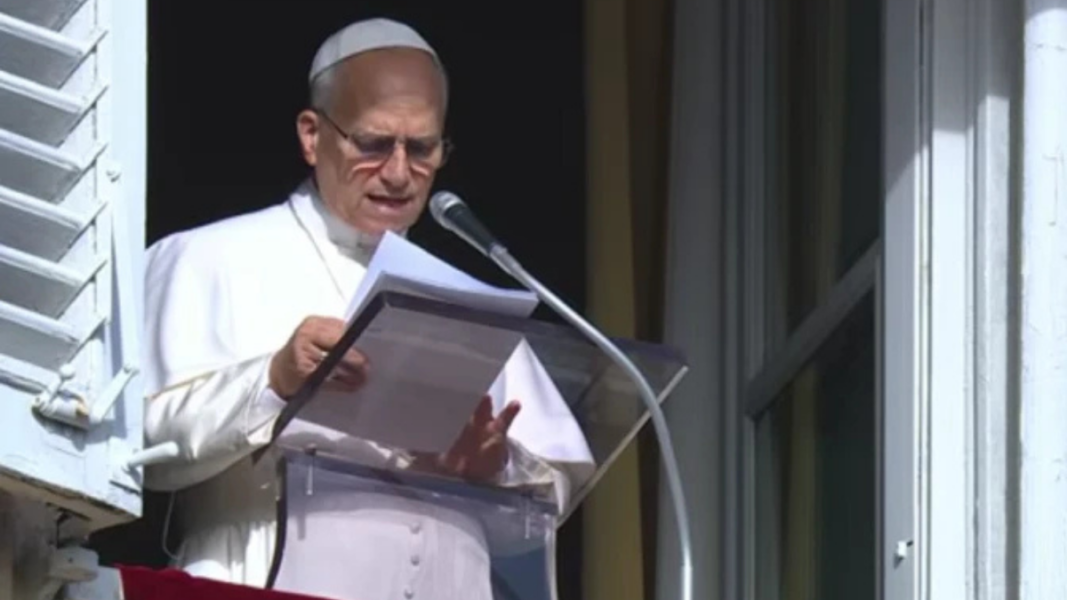
Pope Leo XIV centered his Angelus reflection this Sunday, August 2, on the Gospel episode of the multiplication of the loaves, presented as a sign of God’s providence and a call to combat indifference toward those who lack what is necessary. The Pope warned against “accumulation and waste,” which he defined as two manifestations of the same “sickness of the soul”: the greed that makes one forget those who suffer hunger, thirst, or the consequences of war.
From the window of the Apostolic Palace, before the faithful gathered in St. Peter’s Square, the Pontiff recalled that Christ not only responds to material needs but also satisfies “the thirst for truth and life” of humanity. Starting from the Eucharist, he urged that charity be translated into everyday gestures of fraternity, even during rest and vacation time.
After the Marian prayer, Pope Leo XIV specifically referred to the situation in Ceuta, which he described as “alarming,” and asked for the intercession of Our Lady of Africa so that solutions “of peace, stability, and justice” may be found. The Pope also renewed his call for an end to wars, remembered the most vulnerable victims of conflicts, and evoked the Pardon of Assisi, granted to Saint Francis by Honorius III in 1216.
Below are the words of Pope Leo XIV before and after the Angelus.
Dear brothers and sisters: Happy Sunday!
When the Gospel is proclaimed, we often hear the account of the signs performed by Jesus. These are gestures that manifest His special self-giving for us, that is, the salvation He brings to the world. The Lord presents Himself as the One who gives meaning to life, freeing it from evil and sin.
Christ, by giving sight to the blind and hearing to the deaf, not only performs wondrous deeds but also announces to all that the Kingdom of God is near. That is why today’s Gospel (Mt 14:13-21) bears witness that Jesus does not limit Himself to restoring the senses to those who lack them, but also makes our senses taste. To the deaf who hear again, the Lord directs the Good News so that they may listen; to the blind who see once more, He shows the splendid work of redemption being accomplished in them. Likewise, Jesus feeds those who are hungry. The episode of the multiplication of the loaves signifies that the encounter with the Lord is an experience that nourishes us. In the desert, that is, in the place of our needs, Christ is the bread of life. With Him, what is essential abounds: “They all ate and were satisfied,” and twelve baskets full were left over (v. 20). This number shows that the Lord’s gift is universal and that His providence toward us never fails.
Dear brothers and sisters, Christ truly satisfies humanity’s hunger, our hunger for truth and life. At the same time, His gesture teaches us that nothing is lost when it is shared. Accumulation and waste, on the other hand, are two sides of the same evil: greed. This sickness of the soul causes one to lose one’s senses because it intoxicates with riches, to the point of forgetting those who cry out from hunger and thirst. And thus, before the opulence of things that decay, there are the outstretched hands of those who have nothing to eat, the destroyed homes of those who have no peace.
In the desert of war and arrogance, we see with what kindness the Lord, “raising His eyes to heaven,” “said the blessing,” “broke the loaves and gave them” to the disciples to distribute to the people (cf. v. 19). In this miracle of charity, we recognize the typical actions of Jesus, which find their culmination in the Last Supper, where the Son of God gives us His very life as our brother in humanity. As we savor the grace of the Eucharist, let us commit ourselves to witnessing its beauty in our daily gestures, beginning with the blessing of the table, when we share bread with family and friends. In the company of Jesus, vacations too can become a time of serene fraternity, including those beside us who are in need.
Let us therefore ask the Virgin Mary, our caring Mother, to help us grow in charity, so that no one may lack daily bread.
After the Angelus
Dear brothers and sisters,
I continue to follow with concern the alarming situation in Ceuta, asking God, through the intercession of Our Lady of Africa, that solutions of peace, stability, and justice may be found.
Let us continue to pray for peace, that wars in the world may cease and diplomatic solutions to conflicts may be found. Let us remember all the victims of hostilities, especially the weakest and most defenseless: children, the elderly, and the sick. May the Lord console those who suffer and bless the work of those who bring help and comfort.
These days the “Pardon of Assisi” is being celebrated. Saint Francis obtained this indulgence from Pope Honorius III in 1216, inspired, while praying in the Portiuncula, by a vision of Jesus and Mary surrounded by angels. Let us thank the Lord for this great gift and treasure it, especially in the eighth centenary of the Poverello of Assisi’s “Transitus,” who died precisely in the Portiuncula on October 3, 1226.
I greet all of you, Romans and pilgrims from various countries: in particular the young people from the parishes of Saccolongo and Creola (Padua), those from the parish of San Giovanni Bosco in Altamura, and the boys from the Pastoral Collaboration of Castelfranco Veneto, accompanied by their priests and animators.
I wish you all a happy Sunday!