


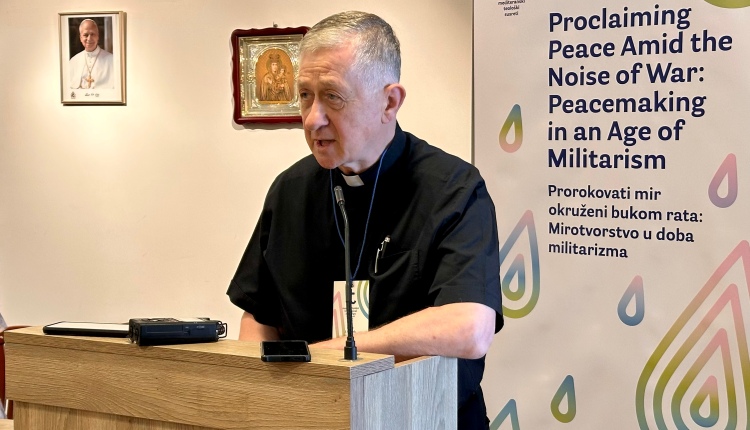
Cardinal Blase Cupich believes that disputes surrounding the traditional liturgy undermine the Church’s ability to be heard on issues such as war, peace, or climate change. In his view, the problem does not lie solely in the existence of these differences, but in the fact that they become “so public and so pronounced” that they diminish the Church’s credibility before society.
He made this statement in an interview with the German portal Katholisch.de, in which the Archbishop of Chicago defended the synodality promoted by Pope Francis, advocated deepening the path opened by the Second Vatican Council, and placed the climate crisis and peace among the Church’s main priorities for the next decade.
When asked whether debates such as the one over the so-called “Old Mass” are secondary compared to the major crises of today’s world, Cupich answered affirmatively. Nevertheless, he added that these controversies have consequences that go beyond the liturgical sphere.
“The forces within the Church that continue to tear apart unity will have consequences for the Church’s voice on these other issues,” he stated. To explain this approach, he added: “The Church is not an exclusive club. People will say to us: ‘Why should they pay attention to us if there is so much discord and division in your own house?’”
“We must not allow these internal disputes to become so public and so pronounced that they reduce the effectiveness of our voice on these other issues.”
In his response, the cardinal does not present the damage these disputes may cause to the Church’s internal life as the main consequence, but rather the effect they have, in his judgment, on the Church’s ability to intervene credibly in public debate.
Vatican II, climate, and peace: his three priorities
When asked about the Church’s three priorities for the next decade, Cupich placed first the continuation of the path of renewal begun by the Second Vatican Council.
Second, he pointed to the climate crisis and highlighted the role of the encyclical Laudato si’ in enabling the Church to continue exercising a “prophetic voice” in the face of global warming, rising sea levels, and extreme weather events.
As a third priority, he emphasized peace, recalling words of Leo XIV in which the Pontiff warned that “war seems to have become fashionable.” In that context, the cardinal criticized the contemporary use of the just-war doctrine and maintained that it was born to limit recourse to war, not to justify it. “One does not begin with war. One begins with peace as the first option,” he stated, insisting that armed conflict can only be considered when all possible avenues of dialogue have been exhausted.
A more synodal and decentralized Church
A large part of the conversation also revolved around synodality. Cupich attributed resistance to this process to the fear that the Church might depart from tradition by addressing the issues of today’s world through dialogue, although he defended that this path must be walked with trust in the action of the Holy Spirit and in the sensus fidelium of the baptized.
As he explained, synodality seeks to awaken a greater sense of co-responsibility among the faithful so that the Church’s mission does not depend exclusively on the hierarchy.
The Archbishop of Chicago also defended greater decentralization, recalling that decisions should be made, whenever possible, at the level closest to the faithful, in accordance with the principle of subsidiarity, but without breaking communion with the universal Church.
When asked about the possibility that some episcopal conferences might advance along paths different from the rest of the Church, he replied that the decisive criterion must always be unity. “Unity is the first note of the Church,” he stated, although he clarified that “unity does not mean uniformity,” citing as an example the diversity of languages and cultural expressions present in the liturgy.
The authentic unity of the Church
From the earliest centuries of Christianity, the unity of the Church was never understood as the mere absence of visible conflicts, but as communion in the truth. St. Paul did not conceal the divisions of the Corinthian community but publicly corrected them (cf. 1 Cor 1:10-13), and the Church Fathers insisted that unity can only be built on the faith received from the Apostles. When Tertullian recorded the pagans’ admiration—“See how they love one another!” (Apologeticum, 39)—he was not describing a Church without tensions, but a community whose charity sprang from fidelity to Christ. Likewise, Jesus’ priestly prayer (“that they may all be one… so that the world may believe,” Jn 17:21) presents unity as the fruit of revealed truth and communion with Him, not merely the absence of public controversies. In that context, Cupich’s words raise a fundamental question: whether the Church’s credibility depends primarily on keeping its divisions from becoming too visible or on confronting those differences with fidelity to the truth it is called to safeguard.