


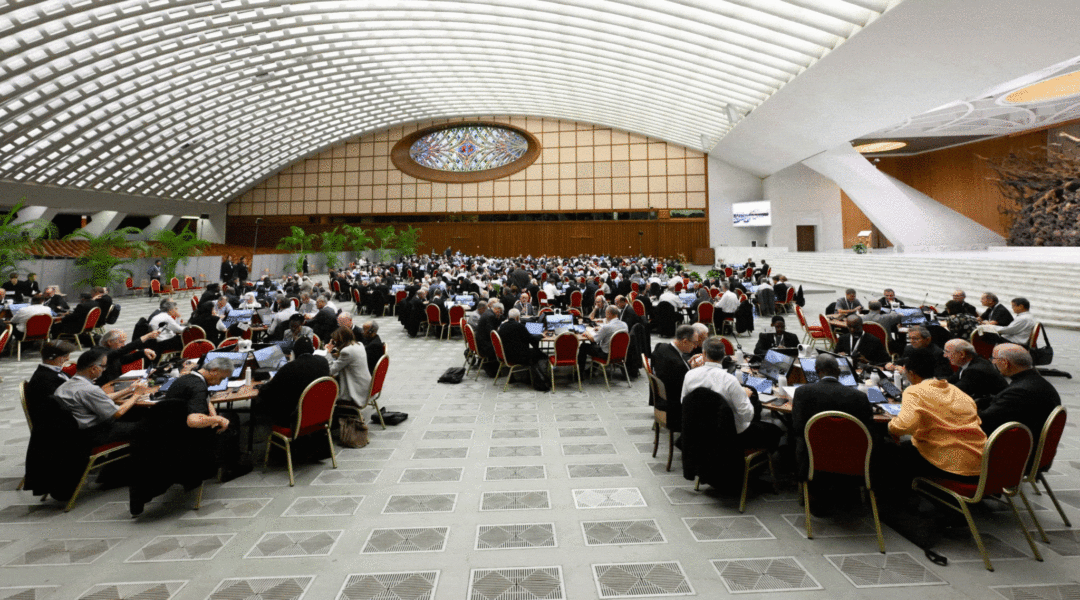
A synod is (was) by definition an event: it was convened, celebrated, and closed. That is how it was for twenty centuries. The Synod on Synodality concluded in October 2024. Its Final Document was delivered. The matter, one might think, is settled.
But it is not. The closed Synod was followed by an “implementation phase” (2025-2028). Implementation is now followed by an “evaluation of the implementation”: diocesan assemblies in the first half of 2027, assemblies of the Episcopal Conferences in the second half, continental assemblies in 2028, and an “ecclesial assembly” at the Vatican in October 2028. And in case anyone still hoped that would be the end of it, the Notes warn: “the path does not conclude, but opens to a new phase.” Among the criteria for selecting assembly members is, in black and white, that they “be available to sustain the process beyond 2028.”
In other words: today we are recruiting the personnel for a process whose object, mandate, and end no one knows, because it does not exist. The Synod has discovered perpetual motion. We will evaluate the implementation, then implement the evaluation, then evaluate the implementation of the evaluation. This is not a caricature: it is, literally, the official calendar.
What is all this, juridically speaking? Nothing
Here lies the scandal. The reader may ask: what canonical nature does a “diocesan evaluation assembly” have? And a “synodal team”? And an “ecclesial assembly” at the Vatican—note: ecclesial, not episcopal—scheduled for 2028?
The answer is: none. They do not appear in the Code of Canon Law. They are not a diocesan synod (canons 460-468), which has regulated convocation, composition, and effects. They are not a particular council. They are not presbyteral or pastoral councils, which do exist in law and whose “propositive and consultative” function the document itself acknowledges in passing, only to immediately link them with “synodal teams” that exist in no canon. We are faced with a complete institutional architecture—diocesan, national, and continental teams, registered in a Roman database via an email address, synodus@synod.va—built entirely outside the Church’s law.
And this is no oversight. It is the method. What has no juridical nature has no defined competencies, no enforceable responsibility, and no channel for appeal. A canonical diocesan synod obliges the bishop to precise procedures; a “synodal team” obliges nothing and answers to no one, and precisely for that reason it can do everything: convene, filter, draft, synthesize, and send to Rome “the voice of the People of God.” Informality is not a flaw in the system: it is its competitive advantage. What cannot be governed by decree is governed by process, because a decree would have to be grounded in law and signed.
Canon law exists, it is worth recalling, to protect. It protects the faithful against arbitrariness, the parish priest against the diocesan apparatus, the bishop against pressures, and the entire Church against the whim of passing majorities. Replacing law with “facilitation” is not a pastoral liberation: it leaves everyone exposed to whoever controls the process.
The People of God, already filtered
And who controls the process? The Notes explain it candidly. The assemblies are not to “represent a diocese”—God forbid representation, which has rules—but to ensure “persons knowledgeable about the ongoing processes and capable of interpreting them.” Translation: militants of the method. The list is drawn up by the synodal team, whose entry requirement is “knowledge of the Final Document” and “direct experience of the synodal dynamics.” The circle is perfect: a committee of converts selects an assembly of converts that will evaluate the conversion, and whose conclusion—drafted in advance in a “narrative account” that the assembly members receive in order to “make it their own”—will rise to Rome as the spontaneous fruit of listening.
Even the question is rigged. The official “guiding question” reads: “What concrete face of a missionary synodal Church and what new paths of synodality are emerging in our community?” A question that presupposes the answer. There is no box to reply: none. It is not contemplated that a diocese might conclude that five years of meetings have produced folders, facilitators, and fatigue. The questionnaire admits only gratitude.
And in a detail that is worth a treatise, the Notes ask for “special attention to the participation of parish priests.” Read slowly: a special effort must be made to ensure that the priests who have the care of souls take part. The men who baptize, hear confessions, bury the dead, and sustain the real life of the Church are, in this device, a peripheral group whose presence must be procured, while the ordinary faithful appear only as a quarry of “testimonies” that others will select. An assembly-based Church, yes, but of hand-picked assembly members.
The bishop with the function of a notary
In this scheme, the successor of the Apostles is reduced to an attesting officer. The document assigns him the verbs “convene,” “accompany,” “recognize,” and “validate.” If he disagrees with the text presented by his team, he does not correct it: he “refers it back to the team, explaining the reasons for his observations,” like someone submitting comments to a commission. He who by divine right has the power to teach and govern his Church appears here as an instance of approval for what is produced by a structure that neither the law recognizes nor he has been able to configure freely, because the criteria for composition already came from Rome.
The defenders of the invention will reply, as always, that everything is consultative, that nothing touches doctrine, and that the bishop retains the last word. Formally, true. But real power does not lie in the last word but in the penultimate: in who drafts the synthesis, who chooses those who speak, who formulates the question, and who administers the calendar. And that power has been transferred, without law, without vote, and without term, to a bureaucracy of listening that has declared itself permanent.
Twenty centuries of canon law attempting to answer a question—how authority is exercised and limited in the Church—replaced by group dynamics with a facilitator. That is, juridically, infinite synodality: not a reform, because reforms are written in canons and can be read, complied with, and appealed. It is the dissolution of governance into process. And processes, unlike laws, are not repealed: they are renewed.