


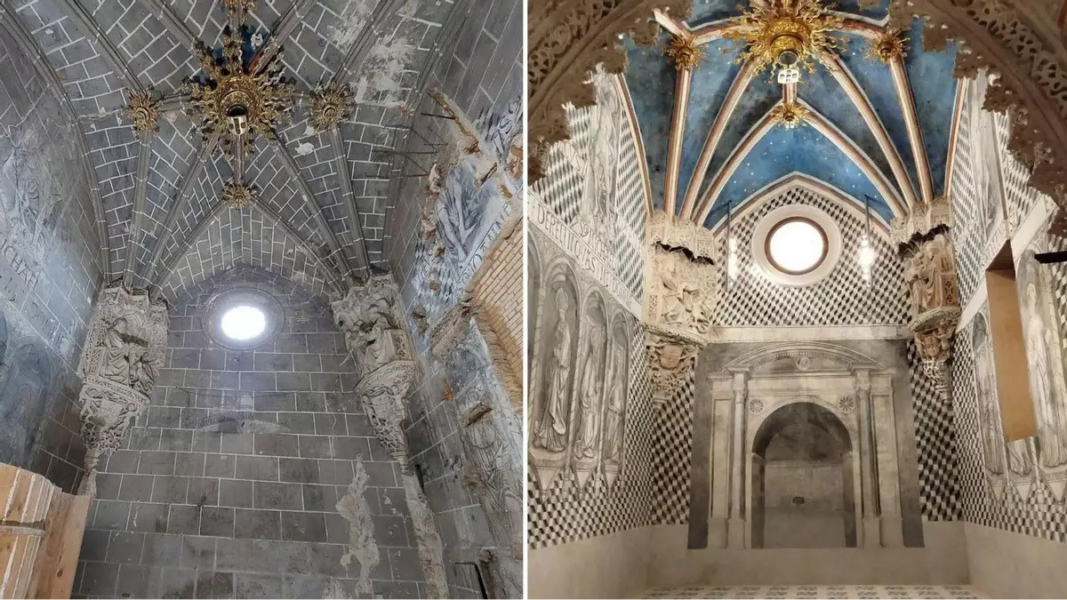
Gothic and Renaissance paintings that had remained hidden since the 19th century have come to light again in Tarazona Cathedral thanks to the comprehensive restoration of the Santiago Chapel. The intervention, promoted by the Provincial Council of Zaragoza, involved an investment of 304,000 euros and made it possible to recover an important pictorial ensemble that had remained concealed for more than a century.
The project marks a new milestone in the recovery of Tarazona Cathedral, one of Spain’s most distinctive cathedrals due to its combination of Gothic, Mudéjar, and Renaissance elements. Following the chapel’s restoration, the next step will be to return the Gothic altarpiece of Saint James the Apostle to its original location, where it has been dismantled for over forty years.
A pictorial ensemble recovered after more than a century
The Santiago Chapel, built at the end of the 15th century, preserved beneath a layer of gray paint applied in the 19th century an important decorative program executed in tempera between the 15th and 16th centuries. The removal of this coating has allowed the recovery of grisaille paintings and mural scenes that had remained hidden ever since.
The paintings correspond to two distinct periods. On two of the walls are 15th-century Gothic representations, including those of Saint Michael and Saint John the Baptist, while the north wall preserves 16th-century Renaissance decoration that, according to specialists, was executed after the altarpiece of Saint James was moved, when that wall was left exposed.
The restoration was carried out by a specialized team that manually removed, millimeter by millimeter, the layer of paint concealing the original decoration, allowing the recovery of an artistic ensemble of notable historical value. According to Heraldo de Aragón, the work brought to light paintings whose quality had remained virtually unknown for generations.
The altarpiece of Saint James will return to its original location
With the work on the chapel completed, the Provincial Council of Zaragoza will undertake the restoration of the Gothic altarpiece of Saint James the Apostle, a work by painter Pedro Díaz de Oviedo dated 1497.
The ensemble, made of gilded and polychrome wood, has been dismantled and stored for more than four decades. During that time it has suffered significant deterioration, especially from the action of xylophagous insects, as well as material losses and structural damage. To date, only the titular image and one of the panels had been restored.
The intervention, tendered with a budget of 83,000 euros, will include a technical study of the work, cleaning of the polychromy, consolidation of the structure, definitive elimination of xylophagous insects, and reintegration of damaged areas before reinstalling the altarpiece on the eastern wall of the chapel.
Recovery of Tarazona Cathedral continues
The restoration of the Santiago Chapel adds to the interventions carried out in recent years at the cathedral, including the recovery of the Purification Chapel and its altarpiece. A future intervention is also planned for the Saint Vincent Ferrer Chapel.
With these actions, the process of recovering the artistic heritage of Tarazona Cathedral continues, returning to public view works that for decades remained hidden or displaced from their original locations.