


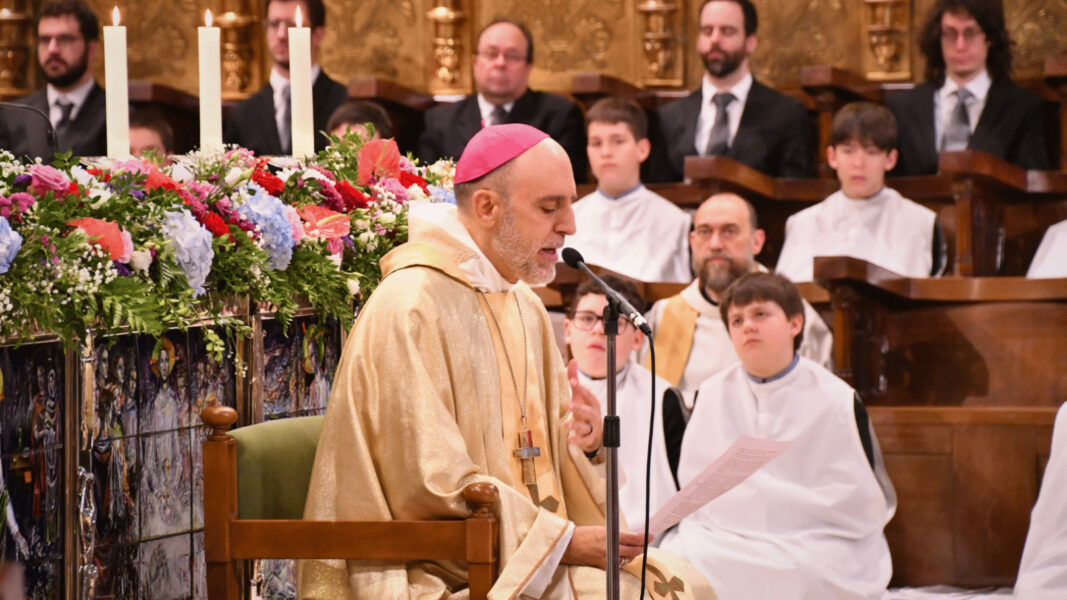
The controversy sparked by the proposal of the German Episcopal Conference to allow laypeople to deliver the homily during the celebration of Mass found a definitive response from Rome when the Dicastery for Divine Worship rejected the request and recalled that the homily belongs to the ministry of the bishop, the presbyter, or the deacon because it is part of the liturgical action itself. In this context, the Sunday letter of the bishop of Sant Feliu de Llobregat (Barcelona), Xabier Gómez García, is of particular interest, as he explains the theological and pastoral reasons for this practice and emphasizes that it does not stem from an undervaluation of the role of the laity in the life of the Church.
«Who should preach the homily?» is the title of the reflection published by the prelate for this Sunday. In it, he begins with a question he considers common among the faithful and warns that certain issues may seem like mere prohibitions when viewed solely from a legal standpoint. «There are issues that, when explained only from the norm, may sound like a prohibition; but, when read from the sacramental dimension of the Church, they reveal a profound pedagogy», he writes.
It is not a matter of distrust toward the laity
The bishop begins by rejecting one of the most common interpretations of this discipline. Reserving the homily for ordained ministers does not mean distrusting the laity or questioning their mission within the Church.
On the contrary, he recalls that the Second Vatican Council rediscovered the baptismal dignity of the entire People of God and the missionary vocation of every Christian. «Without the laity, the Church would be less evangelical, less incarnate, and less missionary», he affirms.
However, he adds that the Eucharistic celebration has its own character that requires understanding the homily within the context of the liturgical action as a whole.
The homily is part of the liturgical action
In his letter, Gómez explains that the Eucharist «is not just any gathering», but «the foundational sacrament where the Church manifests itself as the Body of Christ». Therefore, the proclamation of the Word, the altar, the ordained minister, the assembly, and the Eucharist form a single sacramental reality.
From this perspective, he maintains that the homily cannot be understood as «a talk, a brief catechesis, or a biblical commentary». It is an integral part of the celebration itself, through which Christ continues to speak to his people before sacramentally giving himself in the Eucharist.
For this reason, the Church entrusts the homily to the bishop, the priest, or the deacon, who have received through the sacrament of Holy Orders the mission to teach, sanctify, and preside over the ecclesial community.
The laity can indeed proclaim the Word in other contexts
The bishop clearly distinguishes the homily from other forms of preaching that may be entrusted to the lay faithful.
Thus, he recalls that men and women who are properly prepared may proclaim the Gospel and offer a reflection during a Liturgy of the Word, a vigil, a communal prayer, or a formation gathering. These interventions, he explains, fully express the baptismal mission of the laity, although «they do not replace the homily at Mass».
Gómez concludes by inviting us to understand this distribution of ministries not as a limitation, but as a richness for the life of the Church. «It is not about limiting the Spirit, but about respecting the beauty of the signs. When each ministry serves from the gift received, the whole Church speaks better of Christ», he writes.