


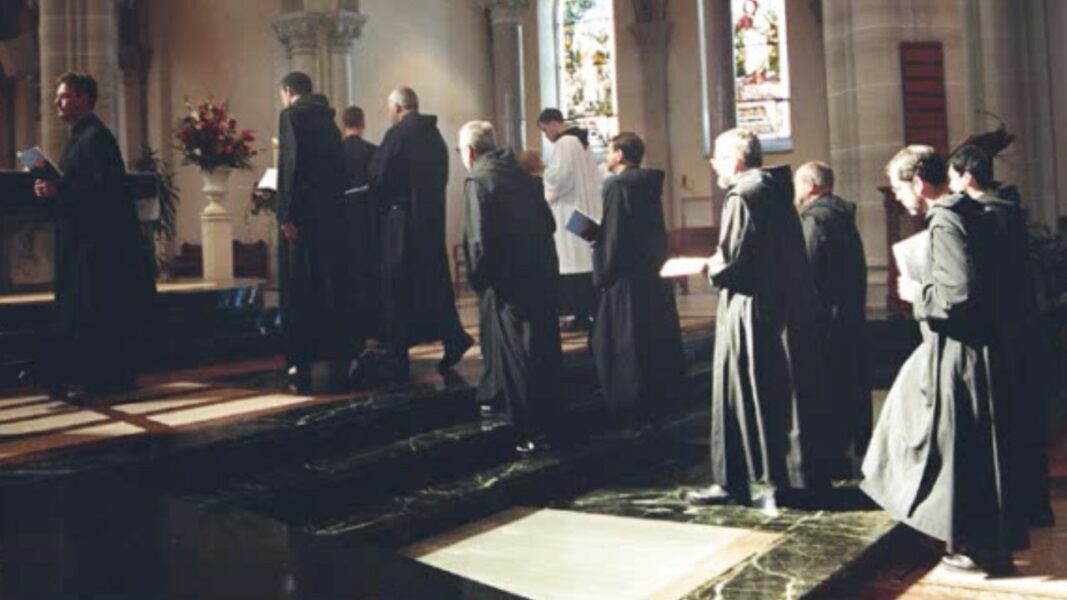
The contemplative monastic life in France —as well as in much of Europe— is undergoing one of the greatest transformations in its recent history. Monasteries with centuries of existence are closing their doors, entire communities are being forced to merge with others, and emblematic buildings are changing hands due to the lack of vocations. In just two decades, nearly a third of French contemplative monasteries have disappeared.
However, amid this landscape emerges a striking and unexpected fact: none of the monasteries that in 2007 still preserved the office entirely in Latin have closed. This is confirmed by the research of sociologist Isabelle Jonveaux, reported by the French magazine La Vie.
The study, to be published in a scientific journal specializing in urban planning and the reuse of religious heritage, is based on the catalog compiled by the Foundation of Monasteries in 2007. From that baseline, Jonveaux and her team verified which communities still existed in 2026 and which had closed or announced their closure. The result offers, for the first time, a comprehensive overview of a phenomenon that until now could only be tracked through isolated news reports about monastery closures.
A decline that is accelerating
The data confirm the magnitude of the crisis. Around 30% of French contemplative monasteries have closed or announced their closure during the period analyzed.
Female communities have been the most affected: 32% of the nuns’ monasteries have disappeared, compared to 21% of the male monasteries. Jonveaux explains that historically France had many more female foundations —249 compared to 56 male ones in 2007— but she also points to profound sociological changes. While for centuries religious life offered many women a path to education and emancipation, today those who knock on a monastery’s door usually have a very different profile, making certain forms of communal life less attractive.
The pace of closures has also accelerated significantly. Until 2015, there were normally fewer than four closures per year. Today the average is around ten per year.
In 2026 alone, three emblematic communities have announced their closure: the Trappist abbey of La Grande Trappe de Soligny, in the Norman department of Orne; the Carmel of Compiègne, located in Jonquières, in the department of Oise, north of Paris; and the abbey of Notre-Dame du Port-du-Salut, in the department of Mayenne, in western France.
Carmelites and Poor Clares, the hardest-hit orders
The research also shows that not all religious families are experiencing the crisis with the same intensity.
The Carmels top the list, with 40% closures in twenty years: 34 of the 85 monasteries existing in 2007 have disappeared. The situation is almost identical among the Poor Clares, who have lost 40.4% of their communities.
Among the Trappists the percentage reaches 36.4%, while the Visitandines register 30%.
By contrast, the Benedictines —combining male and female communities— show a reduction of 17.9%, and the contemplative Dominicans barely reach 7.7%, making them the religious family that has best resisted the decline.
According to Jonveaux, the greatest difficulties affect orders with especially strict enclosure, such as Carmelites and Trappists, or those whose charism is today less comprehensible to much of society, such as Visitandines and Poor Clares.
The surprising Latin data
The most striking aspect of the study appears when comparing monasteries according to the language used in the choral office.
In 2007 there were 244 monasteries that prayed the office entirely in French. Of these, 84 have closed or announced their closure, representing 34%.
Among the 36 communities that used both French and Latin, seven disappeared, or 19%.
By contrast, none of the 23 monasteries that maintained the office exclusively in Latin have closed.
Although the sample sizes are very different and liturgical language alone does not constitute an explanation for the phenomenon, the researcher herself acknowledges that it is a particularly significant indicator.
For Jonveaux, the communities that continue to attract vocations today usually share a very defined stance toward secularization. Among abbots and abbesses there even circulates a well-known joke about communities that still recruit successfully: the rule of the «three G’s»: grégorien, grille et guimpe —Gregorian chant, enclosure grille, and traditional wimple—.
The sociologist also observes an apparently paradoxical phenomenon. Many of the communities that are strictest in observing enclosure are also those with the greatest presence on the Internet and social media, connecting with young people who wish to live a clearly defined Catholic identity.
What happens when a monastery closes?
In approximately half of the cases, communities end up merging with another monastery of the same order. In others, the religious disperse among different communities, enter assisted-living residences, or even return to civilian life.
The buildings also follow very diverse paths. According to the cases identified by Jonveaux, 27.7% pass into the hands of another religious community, usually of more recent foundation. 21.3% are allocated to social projects; 12.8% are acquired by public administrations; 10.6% house other religious projects; 6.4% become educational centers; 6% become private housing; 4.3% host cultural initiatives; 2.1% are reused for another monastic project, and another 2.1% are eventually converted into a hotel.
Jonveaux highlights one final paradox. While monasteries continue to arouse considerable interest among those seeking spiritual retreats or a more austere way of life closer to nature, that appeal hardly translates into new vocations. And amid this general decline, one fact remains hard to overlook: during the last two decades, none of the French monasteries that preserved the office entirely in Latin have closed their doors.