


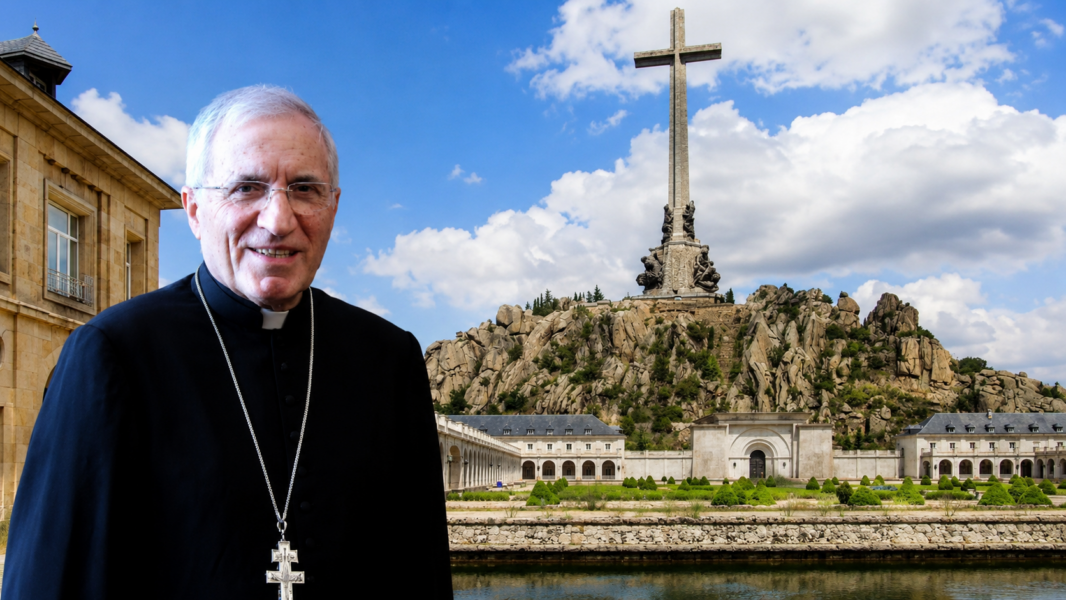
Cardinal Antonio María Rouco Varela believes that the Valley of the Fallen does not need a new “resignification,” since its current meaning is that of a basilica where “prayers are offered for all” those who fell in the Civil War. In the second part of an interview given to El Debate, the archbishop emeritus of Madrid maintains that the monument has been experienced for decades as “a place of reconciliation” and links the debate about its future to the laws on historical memory and democratic memory.
Just weeks away from turning 90, the prelate also endorses the recent words of the president of the Spanish Episcopal Conference, Bishop Luis Argüello, on the need to proclaim the truth even when it is uncomfortable, and expresses his confidence that Leo XIV will address the question of the statutes of Opus Dei with a style of governance marked by understanding and respect for the law of the Church.
“We have always experienced the Valley of the Fallen as a place of reconciliation”
Asked about the future of the Valley of the Fallen, the archbishop emeritus of Madrid states that the laws on historical memory and democratic memory pose serious difficulties because, in his view, they reopen a division that Spanish society had managed to overcome during the Transition.
The former archbishop of Madrid recalls that reconciliation was one of the pillars of the political process begun after the death of Francisco Franco and points out that, even before that period, in his experience as a seminarian, professor and priest, he did not perceive a daily division between Spaniards of one side or the other.
“What cannot be done is to return once again to a divided national collective memory. That is not responsible. Each person has their own memory,” he affirms.
From that perspective, Msgr. Rouco maintains that the Valley of the Fallen has already acquired, for years, a meaning different from the one it had at the time of its construction.
“We have always experienced the Valley of the Fallen as a place of reconciliation where prayers are offered for all those who died in the war. It is already detached from the concrete elements of the years in which it was built.”
Therefore, the prelate rejects the idea of a new “resignification” of the monumental complex.
“Does the Valley of the Fallen need to be resignified? It is a basilica where people pray. That’s it. But of course, it is a consequence of the Law on Historical Memory and Democratic Memory.”
“The truth must be told, even if it costs”
During the interview given to El Debate, the cardinal also refers to the controversy sparked by the statements of the president of the Spanish Episcopal Conference, Bishop Luis Argüello, who quoted Saint Augustine in saying that “when a State forgets ethics it becomes a band of thieves.”
The Galician prelate recalls having heard the same idea in an intervention by then-Cardinal Joseph Ratzinger during an event held in Speyer Cathedral, Germany, and defends that it is part of the bishops’ mission to proclaim the truth even when doing so provokes misunderstanding or criticism.
“In the exercise of the Magisterium of the Word by the bishop and the Episcopal Conference of bishops, the truth must be told, and it must be proclaimed. It may cost something, it may cost you… It has always cost.”
The former president of the Spanish Episcopal Conference adds that the proclamation of the Gospel has always met with opposition and recalls that, although today it does not imply martyrdom of blood, it still means facing offensive comments or aggressive responses.
Confidence in Leo XIV regarding Opus Dei
Also asked about the revision of the statutes of Opus Dei, the Galician cardinal acknowledges that he does not have information on the specific status of the work in the Vatican, but expresses his confidence in the way Leo XIV proceeds.
In Msgr. Rouco’s view, the Pope emphasizes understanding, charity and pastoral accompaniment, so he believes he will resolve this issue without causing unnecessary wounds.
“I believe the Holy Father will act without wounding. There is no need to wound.”
The archbishop emeritus concludes by stressing that synodality cannot be interpreted in a way that blurs “the constitutional elements of the Church by divine right” and recalls that the exercise of ecclesiastical authority must always be carried out in accordance with canon law and divine law.