


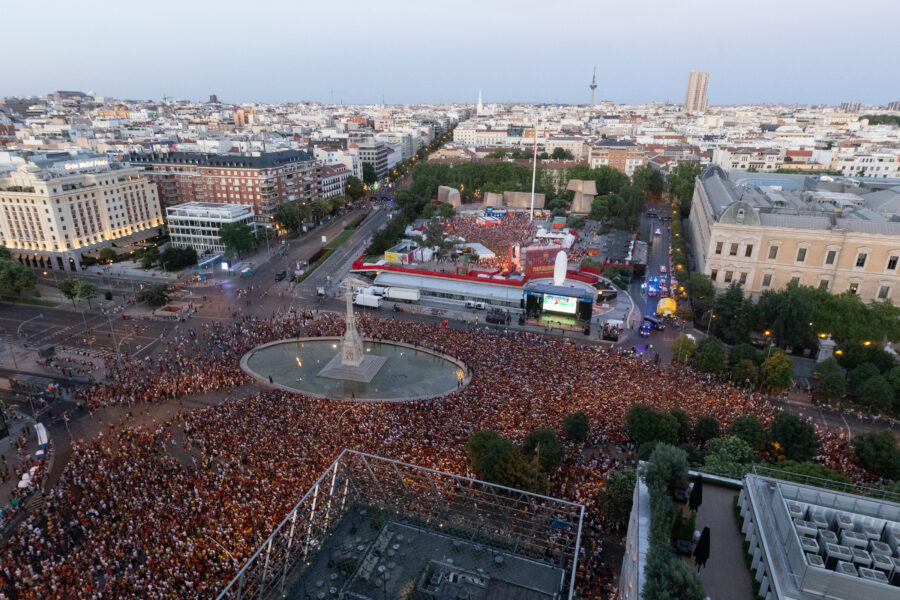
The numbers are the numbers: the celebration of the World Cup brought two million people together in the streets of Madrid, while the Mass celebrated by Leo XIV in Cibeles, barely a month earlier and in the same setting, gathered between 1.1 and 1.5 million faithful. Likewise, the World Cup final drew more than 1.5 billion people in front of the screen, roughly ten times more than the live broadcast from St. Peter’s after a papal election. If we accept the comparison, football crushes the Catholic Church in numbers, and there is no drama in acknowledging it, because the figure contains a lesson that is worth not forgetting.
If the Church’s mission is propped up by mass success, the Church has defeat guaranteed in advance, because football will always fill larger stadiums, with more expensive tickets and far fewer demands on those who attend. No one leaves a party down the Castellana with the obligation to change their life, whereas the Gospel calls for conversion. A conversion that is not measured in attendance figures and does not fit into the reports of the Government Delegation. Competing with spectacle on the terrain of spectacle is accepting a match that is lost before the opening whistle, and losing it moreover by having given up playing the only one that truly matters.
None of this is pessimism, nor the disdain of a grump toward the crowds that packed Cibeles, Recoletos and the Castellana in June. That more than a million people took part in a Mass and the procession of the Blessed Sacrament right in the center of one of Europe’s most secularized capitals is an immense good that would be foolish to deny. Large gatherings have their legitimate place in the life of the Church: they awaken the lukewarm, summon the scattered and make visible a faith that society had given up for dead. But they are means, never ends, and their true value lies not in the figure published by the newspapers the next day, but in how many of those who filled the streets that morning later stepped into a confessional.
Because the battle of Catholics is not fought in the squares but in souls, and it is won or lost in every confessional where a sinner recovers grace, at every altar where the Holy Sacrifice of the Mass is renewed, in every church open in mid-afternoon with the tabernacle lit and a priest available. That is the arithmetic that counts in heaven, a silent arithmetic that advances one by one, that does not call press conferences or generate headlines, and yet is the only one for which the Church exists and the only one by which her fidelity will be judged.
Mass events are therefore welcome, but only in the service of the real end of the faith and of the Church, which is none other than to save our soul and help us live and die in the grace of God. When they serve that end, a million attendees is a blessing from heaven; when they become a thermometer of success and an argument for ecclesial marketing, they are a trap that will end up measuring us with the wrong yardstick. The national team filled the streets more, it is true, and let whoever wants celebrate it—there are reasons. But no goal, not even Ferran Torres’s in the 106th minute of the final, has opened the gates of heaven to anyone.