


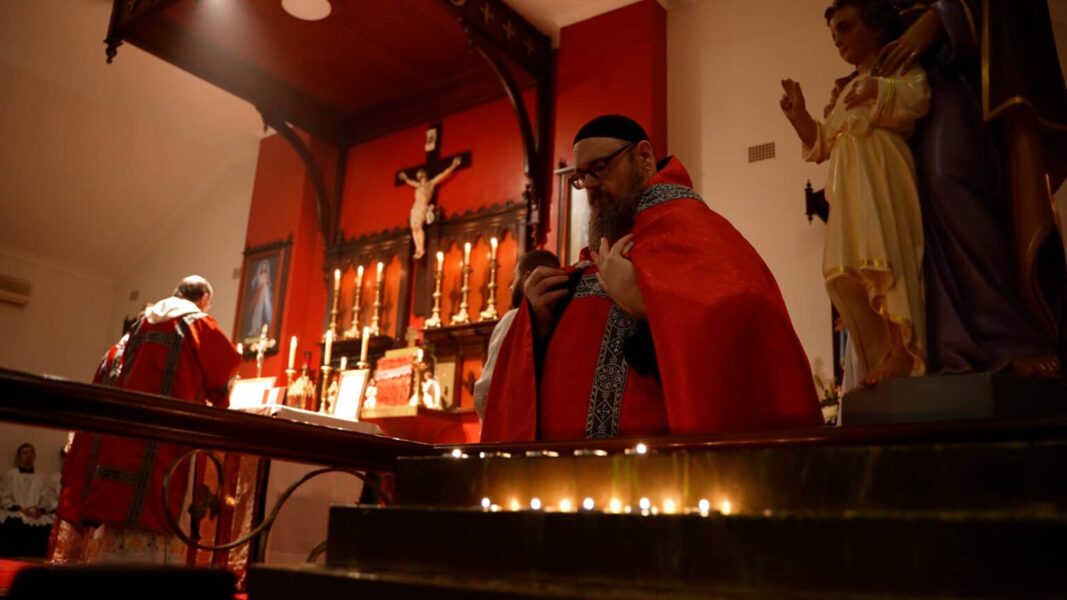
The Croatian Catholic community in Australia celebrated a solemn Mass according to the Croatian Glagolitic rite on July 1 at St. Michael’s parish in Belfield (Sydney). The celebration brought together hundreds of faithful from across the country and revived one of the most distinctive liturgical traditions of the Latin Church.
The liturgy, held on the feast of the Most Precious Blood of Christ, was presided over by Father Mateusz Markiewicz of the Institute of the Good Shepherd (IBP), assisted by Dominican prior Laurie Foote from Adelaide and Carmelite brother Jerome Voštan of the Order of Carmel, who traveled from Perth.
An ancient variant of the Roman rite in a Slavic language
The Glagolitic liturgy is one of the most distinctive traditions of the Latin Church. Its origins date back to the evangelization of the Slavic peoples by Saints Cyril and Methodius in the ninth century. Although Latin was the proper liturgical language of the West, the popes granted Croatian Catholics the privilege of celebrating the Roman rite in Old Church Slavonic using the Glagolitic alphabet, developed for the evangelization of the Slavic peoples.
Thanks to this privilege, Croatian faithful preserved the Roman liturgy in their own sacred language for centuries, passing the tradition from generation to generation while remaining fully part of the Latin Church.
For this celebration, the so-called Misal Vajs was used—the last printed edition of the Glagolitic missal, published in 1927. The copy was brought from the Croatian Catholic chaplaincy in Clifton Hill, Melbourne, along with the altar cards prepared for the occasion.
“It is not a relic of the past”
One of the organizers, Ante Cutuk, explained that the goal was to show that this liturgical tradition remains a living reality and not merely a museum piece.
“The Glagolitic Mass is one of the most distinctive treasures of Croatian Catholic heritage,” he stated.
He explained that this liturgy reminds Croatian Catholics that their ancestors preserved the faith “through their own sacred language, their chant, and their customs,” while always remaining in full communion with the Catholic Church.
“Bringing it to Sydney has shown that this ancient liturgy is neither dead nor a mere object of nostalgia; it continues to move people and strengthen their faith,” he added.
Cutuk also emphasized that Croatian identity cannot be understood solely through culture or nationality, but also through the Catholic faith, which has shaped the history of the Croatian people for centuries.
International-scale preparation
The celebration gathered hundreds of Croatian Catholics from various Australian states and even from abroad. Preparation required several weeks of work to coordinate the choir, altar servers, and the rubrics specific to this liturgical tradition.
For this purpose, Branko Lovrinov and Danijel Uremović traveled from Zagreb to assist with the organization and lead the weekly rehearsals leading up to the celebration.
Cutuk highlighted the atmosphere during the ceremony, which included priests, young people, families, choir members, and numerous faithful from different generations.
“It was beautiful to see Croatian Catholics of all ages united for the same purpose. Seeing the church full, hearing Old Church Slavonic and traditional chant, and knowing that people had come from other states and even from abroad made the celebration truly historic,” he noted.
The organizer concluded by expressing his hope that the revival of this tradition will continue and help keep alive one of the most distinctive liturgical heritages preserved by the Latin Church.