


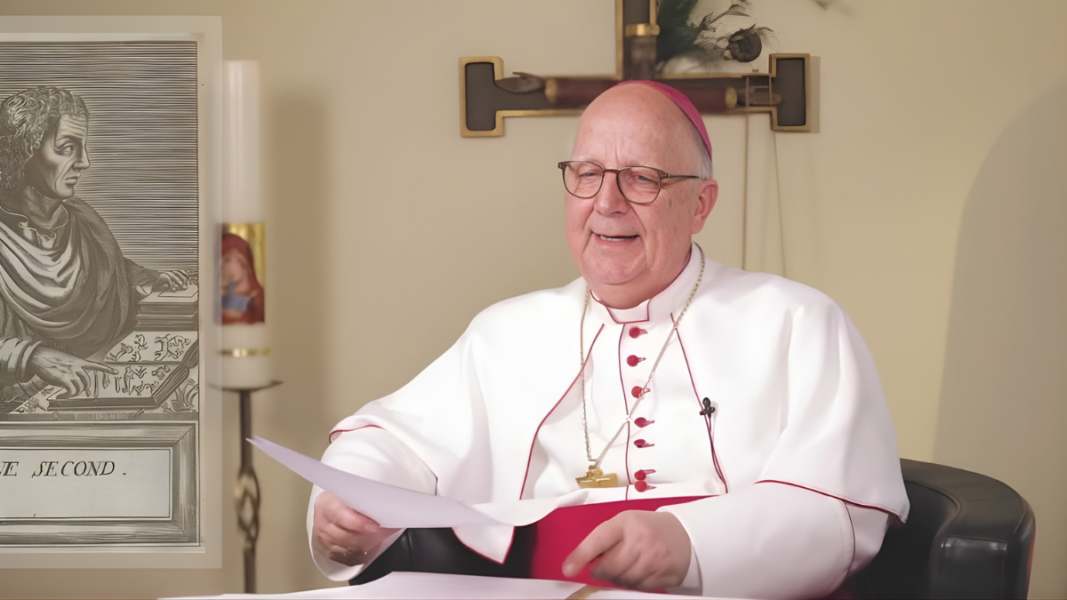
Auxiliary Bishop Emeritus of Chur (Switzerland), Marian Eleganti, has rejected the ideological categories frequently used to classify the faithful within the Church and has defended that “one is either Catholic or one is not.” He makes this claim in an article published in LifeSiteNews on the occasion of the launch of the new lay movement that seeks to reclaim Catholic identity in accordance with the Church’s Magisterium.
For the Swiss prelate, terms such as “conservative Catholic,” “progressive Catholic,” “reformist,” “traditionalist,” or even the expression “different Catholics,” used by the President of the German Bishops’ Conference, Bishop Georg Bätzing, reflect a mistaken view of Catholic identity.
“One is Catholic or one is not. There is no third possibility,” Eleganti states, maintaining that the new movement is born to “restore awareness” of what it means to be Catholic “in accordance with the faith of the Church.”
The Magisterium, criterion of the Catholic faith
The bishop emphasizes that the authority to define what it means to be Catholic does not belong to particular initiatives or ecclesial currents, but to the Church’s Magisterium, authentically expressed in the Catechism.
“It is the Magisterium that correctly interprets the faith, not those who proclaim: ‘We are the Church!’” he writes, rejecting the idea that doctrine can be redefined from ideological positions or by majorities within the ecclesial community.
In this regard, he maintains that the faith of the Church is the criterion that identifies a Catholic and that doctrinal deviations should be called by their proper name. “Instead of speaking of a different way of being Catholic, it would be more accurate to say: ‘He is no longer Catholic!’” he asserts.
“Catholic” needs no adjectives
Eleganti considers that adding qualifiers to the word “Catholic” ultimately distorts its meaning. To illustrate this, he uses the comparison of food that appears intact but is already spoiled inside.
In his view, expressions such as “progressive Catholic” or “conservative Catholic” reveal distorted or incomplete interpretations of the faith. “What ‘Catholic’ means in the full sense of the word needs no further clarification,” he states, also recalling Christ’s words: “Let your yes be yes and your no be no.”
The bishop insists that orthodoxy and orthopraxis form an inseparable unity and that the Church must offer clear teaching without ambiguities.
One single faith for the whole Church
The prelate also rejects the idea that there are different national ways of understanding Catholicism. According to him, legitimate diversity belongs only to the sphere of rites and liturgical traditions, but not to the content of the faith.
“The faith of the Church in Germany is not different from that of Africa,” he writes, recalling that the depositum fidei, the deposit of faith, remains unchanged and is faithfully transmitted by the Magisterium from generation to generation.
Along the same lines, he presents Saint Peter as the rock on which the Church stands, in contrast to “the shifting sands” of changing opinions.
Criticism of those who want to redefine doctrine
In the final part of his reflection, Eleganti directs his criticism at those who wish to preserve Catholic identity while promoting doctrinal or moral changes that, in his judgment, are incompatible with the Church’s teaching.
He maintains that these groups seek to modify the faith from within under expressions such as “adapting it to the times” or living it in a “contemporary” way, without openly acknowledging that they are departing from the content of Catholic doctrine.
In response, he concludes with a call to give voice to those who wish to live the faith of the Church in its entirety: “We will no longer participate in that confusion and will give voice to Catholics who are simply Catholic. That is what it is about: either one is, or one is not.”