


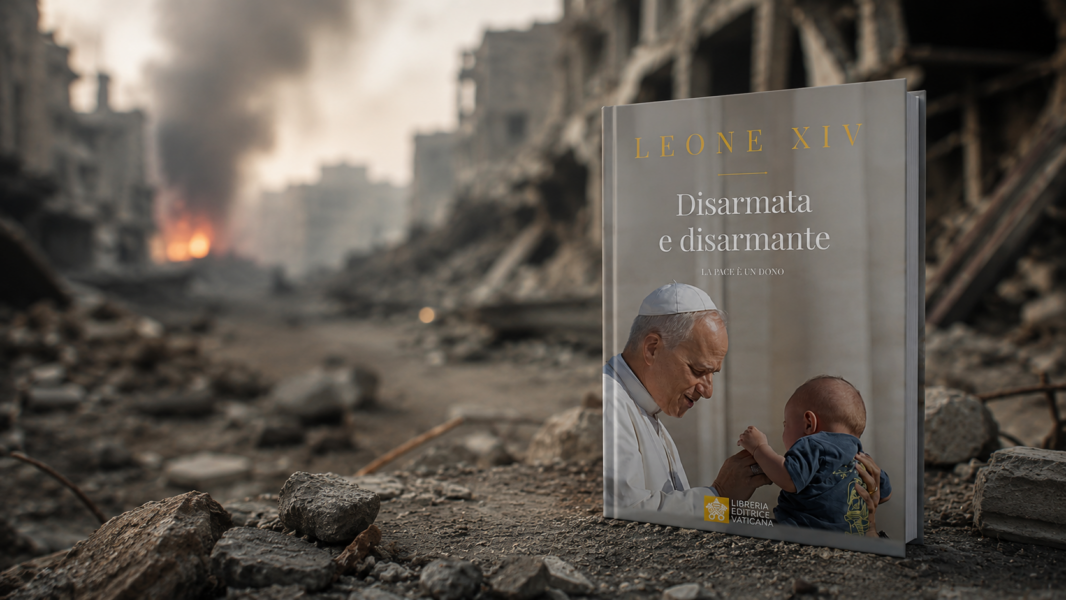
Pope Leo XIV has published this Tuesday his first anthology dedicated to peace and disarmament, a volume that brings together several of his interventions since the beginning of his pontificate and includes an unpublished text in which the Pope cites the American singer-songwriter and poet Bob Dylan to denounce the new arms race, which “today frightens and terrifies.”
The book, titled Disarmed and Disarming. Peace Is a Gift, has been edited by Alessandro Banfi and published, for the time being only in Italian, by the Vatican Publishing House. The work collects speeches and messages delivered by Pope Leo XIV since his election on May 8, 2025, and opens with an unpublished reflection signed by the Pontiff on June 19.
The Pope maintains that peace cannot depend on the balance of terror or on the accumulation of armaments. “It is not nuclear weapons that generate peace, but disarmament,” he states.
Bob Dylan and the nuclear threat
To express his rejection of the atomic bomb, Pope Leo XIV cites Bob Dylan, the first musician awarded the Nobel Prize in Literature.
“As the singer-songwriter and poet Bob Dylan wrote, addressing the atomic bomb figuratively in one of his poems: ‘I hate you because man created you, and man possesses and controls you,’” the Pontiff writes.
The reference comes from Go Away You Bomb, a 1963 text in which Dylan denounces the destructive capacity of weapons created and controlled by man.
Pope Leo XIV uses those verses to warn about an arms race that, after several decades of nuclear de-escalation, is once again spreading fear.
“That truth, which seemed indisputable in recent decades—during which we witnessed nuclear de-escalation—has been clouded by an arms race that today frightens and terrifies,” he notes.
In the Pope’s view, the combination of international rearmament, technological development, and cyber dominance forces a radical question: “Must the human species continue to inhabit the Earth?”
The Pontiff especially warns against the possibility of delegating to automatic systems decisions capable of causing the death of entire populations.
“A world in which machines, no matter how sophisticated and fast, decided to bomb defenseless people would be truly terrifying,” he writes.
Peace as a gift and a responsibility
The book takes its title from the first greeting of the risen Christ to the apostles: “Peace be with you.”
Pope Leo XIV recalls that this peace was not offered “lightly,” for the glorified body of Christ still bore the wounds of the Passion. “Jesus Christ suffered injustice, disarmed and disarming, and rose again,” he states.
From this image, the Pope presents peace as a gift from God that also demands personal responsibility.
“Peace begins with me. It begins with us,” he affirms, before warning that the habit of judging, accusing, and condemning others ultimately generates indifference and hatred.
The Pontiff maintains that it is not enough to demand peace from international leaders if it does not begin to be lived in family relationships, in homes, in cities, and in workplaces.
“Peace is built with small daily gestures: a smile given, an offense forgiven, a kind word,” he writes.
More than one hundred states involved in wars
Pope Leo XIV notes that 103 states are currently involved, in some way, in armed conflicts.
In the text he expressly mentions the wars in Ukraine, the Middle East, Sudan, Myanmar, Yemen, and the Democratic Republic of the Congo.
The Pope also takes up the expression “World War III in pieces,” used by Francis to describe a situation of widespread violence and the multiplication of war fronts.
Against those who justify war as an instrument to achieve peace, Pope Leo XIV recalls the consequences of Hiroshima and Nagasaki and the warning of Saint John Paul II, who described war as an “adventure of no return.”
He also cites the appeal of Saint Paul VI before the United Nations in 1965: “Never again war, never again war! Peace, peace must guide the destiny of peoples and of all humanity!”
The conscience of a single man
Another episode included in the introduction is that of Soviet officer Stanislav Petrov, who on September 26, 1983, decided not to report as real an alert that erroneously indicated the launch of U.S. missiles against the Soviet Union.
Petrov suspected it was a system failure and prevented a possible nuclear response.
“The conscience of a single man can be worth as much as the entire world,” Pope Leo XIV affirms.
For the Pope, this case demonstrates that peace does not depend solely on treaties or decisions by great leaders, but also on men and women capable of following their conscience in decisive moments.
Witnesses of peace
The anthology also recalls several figures who promoted peace through attention to the poor, diplomacy, and resistance to corruption.
Among them are Blessed Floribert Bwana Chui and the Servants of God Giorgio La Pira and Dorothy Day.
Pope Leo XIV presents them as examples of a peace that needs both known and unknown witnesses, willing to turn charity and personal sacrifice into a concrete response to violence.
The volume concludes with a call to Christian hope and with an exhortation from Pius XI: “Let us thank God for making us live in difficult times. Now, no one is allowed to be mediocre.”
“May God guide us on the paths of nonviolence. May believers and people of good will never cease to act as artisans of peace. May each one make peace the cause of their life,” Pope Leo XIV writes.