


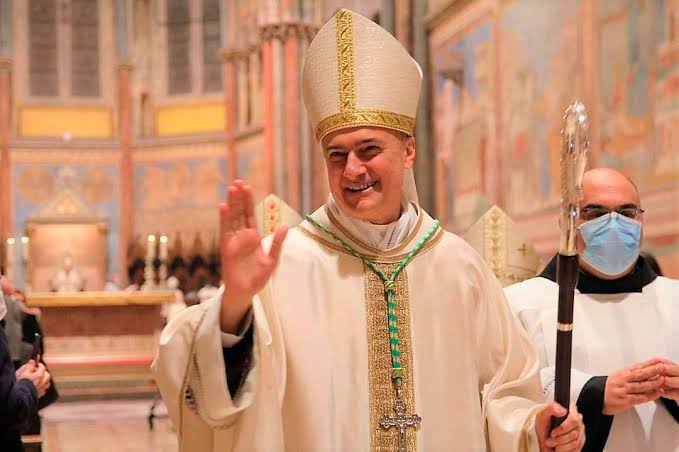
Cardinal Mauro Gambetti could leave St. Peter’s Basilica this summer and be sent to the Archdiocese of Chieti-Vasto, a far less prominent post than that of archpriest of the main church of Christendom. The move, still not officially confirmed, would be seen in Rome as a step down after a tenure marked by repeated profanations, clashes with the canons, and controversial administrative decisions.
According to an investigation by AdVaticanum based on Vatican sources, Gambetti would leave his post in the coming months to succeed Archbishop Bruno Forte, who has already exceeded the usual retirement age. Although Chieti is a metropolitan see, it has not traditionally been a cardinalatial one and carries far less institutional weight than St. Peter’s.
People close to the cardinal say he is exhausted after five years at the head of the basilica and that leaving Rome could be beneficial for him. “He doesn’t like being in the spotlight,” one source noted.
When Leo XIV provisionally confirmed several heads of the Curia and Vatican institutions, Gambetti reportedly received an extension of only six months, a detail that fueled speculation about his future.
Three profanations at the Altar of the Confession
Gambetti’s time at St. Peter’s has been marked by several attacks on the Altar of the Confession, located beneath Bernini’s baldachin and above the tomb of the Apostle.
In June 2023, a man stripped on the altar and displayed a message on his back about the war in Ukraine. Two years later, in February 2025, another individual knocked over six candlesticks and removed part of the altar cloth before being subdued by security.
The most serious incident occurred in October of that same year, when a man climbed onto the altar in front of hundreds of visitors, stripped, and attempted to urinate on it.
Some of these acts required penitential rites of reparation presided over by Gambetti himself. However, their repetition caused growing unease over the lack of security at the heart of the Vatican basilica.
These cases were reportedly accompanied by other Eucharistic profanations, irreverent behavior during Masses, and security lapses that called into question the management of the basilica’s staff.
The controversial hospitality project on the terraces
One of the issues that most damaged Gambetti’s position was the plan to expand the small refreshment point on the basilica’s terraces.
The initiative sparked a campaign of opposition and several petitions addressed to the Secretariat of State, signed by thousands of people, denouncing the commercialization of one of the most important sacred spaces in the Catholic world.
The Vatican sought to downplay the controversy by stating that no actual restaurant would be installed, but rather a space to offer prepared food and improve services for pilgrims and tourists. The project also included an exhibition area dedicated to the history of the basilica.
The explanations did not prevent Gambetti from being associated with a proposal that many considered inappropriate for St. Peter’s and indicative of a management style too focused on commercial criteria.
A reform against the canons
External criticism was compounded by conflict with the Chapter of St. Peter’s, which for centuries has been responsible for the basilica’s liturgical and pastoral life.
Gambetti pushed through a centralizing reform that transferred much of the Chapter’s economic and administrative responsibilities to the Fabric of St. Peter’s. These included the Treasury Museum, the sale of religious objects, and staff under the canons’ authority.
The reforms were presented as a way to reduce costs, avoid duplication, and increase transparency. The canons, however, saw them as a hollowing out of their functions, a loss of autonomy, and an attack on centuries-old traditions.
One source summarized the discontent by saying that Gambetti had prioritized “liberal efficiency” over tradition. Another described him as “more of an engineer than a politician,” unable to manage the internal resistance of a Chapter accustomed to the Vatican’s complex dynamics.
Some defenders of the cardinal acknowledge that the canons exaggerated certain criticisms, but admit that Gambetti’s lack of political skill ultimately worsened the conflict.
The plastic chairs of St. Peter’s
Even minor decisions ended up becoming symbols of the clash between the cardinal’s management and the basilica’s traditional identity.
Several canons formally protested the replacement of the old metal chairs with transparent plastic seats. They argued that the new furniture clashed with the dignity and historic character of the church.
Gambetti defended the decision, claiming that the old chairs damaged the marble floor and forced the Fabric of St. Peter’s to spend more than a million dollars a year replacing deteriorated slabs. The new seats reportedly cost around 200,000 dollars.
For his critics, however, the issue was not merely economic. The replacement reflected a way of governing St. Peter’s that sacrificed tradition and beauty in the name of functionality.
The burden of Enzo Fortunato
Gambetti’s position was also reportedly weakened by the trust he placed in Franciscan Enzo Fortunato, a collaborator from his time at the Sacred Convent of Assisi.
Fortunato gained a prominent role in the administration of St. Peter’s and in organizing the World Day of Children, an initiative promoted during the pontificate of Francis. His management drew internal criticism over financial issues, lack of transparency, and the use of non-Vatican entities to channel funds.
According to the sources consulted, a significant amount of money was reportedly wasted during the organization of the event. Part of the income and sponsorships passed through Italian associations outside Vatican financial structures, raising doubts about the traceability of the funds.
On one occasion, Fortunato responded to questions about the accounts by referring them to the financial officers: “That, ask accounting. I’m not good at that.”
He was also criticized for frequently filming inside Vatican City, broadcasting images of Francis during his illness, and treating some employees disrespectfully.
The rejection of Fortunato ultimately harmed Gambetti directly, as many saw him as Fortunato’s main protector. According to the sources, the Franciscan reportedly later tried to distance himself from the cardinal and even maneuver against him when his position began to weaken.
Fortunato could also soon leave his current post as head of special projects linked to the basilica.
A step down
Gambetti’s possible departure would thus combine several factors: personal exhaustion, loss of confidence, repeated profanations, clashes with the canons, and poor decisions in the choice of collaborators.
If his transfer to Chieti-Vasto is confirmed, the cardinal would leave St. Peter’s after five years in which the basilica has become associated with security failures, internal tensions, and a management style more focused on administrative reorganization than on preserving the sacred and traditional character of the church.
The departure would not formally constitute a sanction, but it could hardly be interpreted as a promotion.