


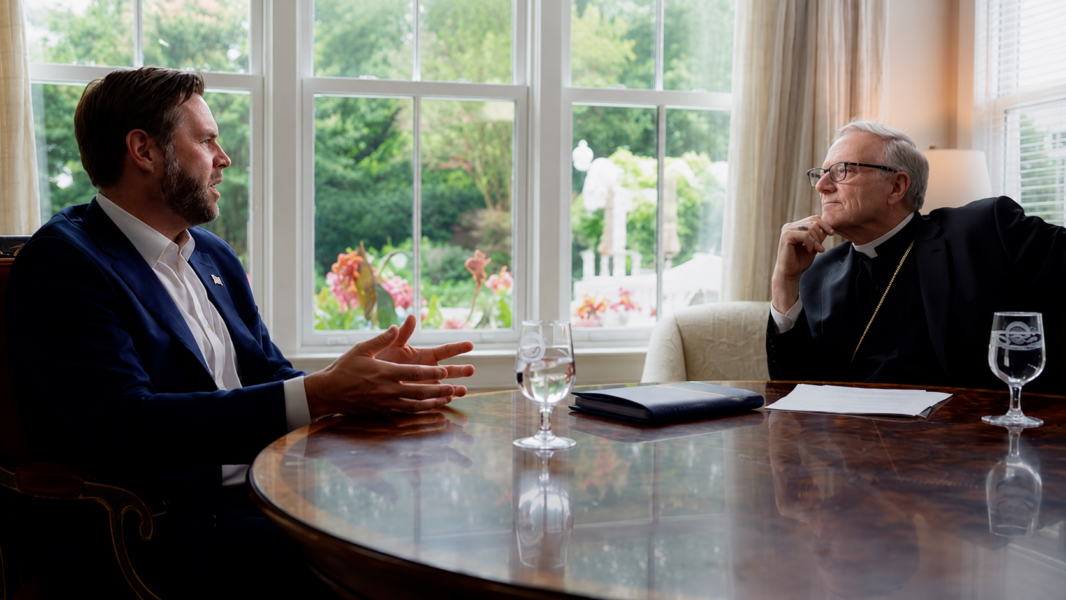
The Vice President of the United States, J. D. Vance, has defended that the Christian faith must permeate all areas of public life and has called for a more decisive presence of the Church in the cultural and political debate. He did so during an extensive conversation with American Bishop Robert Barron, in which he reviewed his conversion to Catholicism, the intellectual influence of St. Augustine and René Girard, the Church’s social doctrine, immigration, artificial intelligence, the legacy of Pope Francis, the expectations raised by Leo XIV, and his own life of prayer.
The interview confirms a line of thought that Vance has been developing since the publication of his spiritual memoirs, Communion: Finding My Way Back to Faith: Catholicism is not for him a private element of his biography, but the intellectual framework from which he interprets the economy, politics, culture, technology, and public life. “If Jesus Christ is truly the Son of God, then He has something to say about every part of our life,” he stated, rejecting the idea that religion should be limited only to matters of worship or personal morality.
St. Augustine and an intellectual conversion
Much of the conversation revolved around the figure of St. Augustine, whose name Vance chose when he was received into the Catholic Church. The Vice President explained that, although the Confessions impressed him deeply, it was above all The City of God that began to dismantle the prejudices he held during his atheist period.
He recalled that during his university years he assumed, like many young people in his circle, that religion belonged to the realm of the irrational and that the great intellectual answers were to be found in the new atheism. However, the thought of the Bishop of Hippo completely changed that perception.
“It was clear that I was in the presence of an extraordinary intellect,” he explained, emphasizing that Augustine was one of the first figures who forced him to reconsider the relationship between reason and faith.
Barron then returned to one of the central theses of The City of God: every society ends up worshipping something. For both men, that intuition remains fully relevant today.
“Every society has a theology, even if it considers itself completely secular,” Vance replied. In his view, when a culture turns money, prestige, or power into absolutes, it ends up corrupting itself from within, just as happened with the elites of the Roman Empire described by St. Augustine.
The Vice President also recalled that this reflection on the destiny of the West had already marked some of the pages of Communion, where he maintains that Western societies cannot be sustained solely on abstract political principles, but need to preserve the cultural and spiritual foundations that gave them their origin.
The idolatry of success and René Girard
Vance acknowledged that for years he himself fell into the logic of personal success.
His time at Yale led him to discover an environment where academic and professional prestige constituted the true measure of a person’s worth. The question was not about family, children, or community, but about the university one came from, salary, or credentials.
“I worshipped success,” he admitted.
However, he clarified that the problem is not ambition itself, but turning social recognition into the ultimate criterion of existence. This constant search for approval ends up turning the person into a “slave” to the opinion of others.
Barron linked this reflection to St. Thomas Aquinas, recalling that the Angelic Doctor identified wealth, pleasure, power, and honor as the great substitutes for God.
Another of Vance’s great intellectual references is the French philosopher René Girard. The Vice President explained that he discovered his thought thanks to entrepreneur Peter Thiel and stated that the theory of mimetic desire allowed him to understand many contemporary social dynamics.
According to him, people tend to desire what others desire, a phenomenon that social media has multiplied to unprecedented extremes.
“Social media has accelerated mimetic desire,” he noted, lamenting that this dynamic ends up fueling permanent rivalries, public confrontations, and digital lynching campaigns.
Barron fully agreed and maintained that platforms like X or Facebook have become the perfect stage for the mechanism described by Girard: desire, rivalry, accusation, and division.
Social doctrine as the foundation of his political thought
One of the most extensive sections of the interview was devoted to the Church’s social doctrine. It was not an occasional reference. In various public appearances and recent interviews, Vance has presented Rerum novarum as one of the intellectual pillars from which he interprets issues such as the economy, industry, work, the role of the State, or technological challenges.
The Vice President explained that Leo XIII’s encyclical impressed him because it offers an alternative both to the class conflict of Marxism and to economic individualism. In his view, it starts from a principle that remains fully valid: recognizing that tensions may exist between workers and owners, but that the solution does not consist in fueling confrontation, but in promoting forms of cooperation oriented toward the common good.
Barron recalled that Catholic social doctrine has never fully fit into either the schemes of the political left or right, precisely because it simultaneously upholds the defense of private property and the principle of the universal destination of goods.
The American bishop also evoked a teaching of St. Thomas Aquinas and Leo XIII: once one’s own and family needs are met, the rest of one’s goods have a universal destination and must be oriented toward the service of those most in need.
Vance acknowledged that this balance is especially demanding for someone with governmental responsibilities and stated that the Church’s social teachings constantly require reviewing one’s own political decisions rather than offering simple answers.
The conversation then turned to a critique of reducing all politics to economic indicators.
As an example, he mentioned the argument that abortion would favor greater incorporation of women into the labor market.
“If that is our argument, then we have made an idol of the economy,” he stated. “The economy exists to serve the human person, not the person to serve the economy.”
He also questioned an exclusively financial vision of economic development, pointing out that decisions that appear rational in the short term—such as the offshoring of strategic industries—can end up seriously weakening a nation decades later.
Immigration: moral principles and political application
Immigration occupied another of the central moments of the interview.
Unlike other public interventions in which he had developed arguments of a more theological nature, Vance addressed this issue from a primarily institutional perspective. He acknowledged that Catholic doctrine requires treating every immigrant with dignity, but he also recalled that it recognizes the right of nations to protect their borders.
In his view, the key is to maintain a permanent dialogue between the Church and political leaders, avoiding turning any disagreement into an ideological confrontation.
“Every time the Pope criticizes a migration policy, it is interpreted as if he hated the Trump Administration,” he lamented. “Perhaps he is simply doing what corresponds to his mission: offering moral teaching. Then it is up to us to try to apply it.”
Barron agreed that the role of bishops is to recall the great moral principles, while it is up to rulers to discern their concrete application in complex situations.
Francis, Leo XIV, and a Church that speaks with clarity
Far from offering a frontal critique of the previous pontificate, Vance again acknowledged that one of Pope Francis’s greatest virtues was precisely provoking conversations that forced deeper reflection on difficult issues.
“Sometimes he said things I did not fully agree with, but he managed to open a dialogue,” he explained.
He also recalled that, after his meeting with Francis shortly before the Pontiff’s death, he held conversations with Cardinal Pietro Parolin and Archbishop Paul Gallagher. From that experience, he maintained that the Church must not limit itself to formulating general principles, but must offer more concrete guidelines capable of addressing the cultural and political challenges of the moment.
Barron, for his part, lamented that a large part of the Western Church has lost the confidence to intervene in public life with the same clarity as figures such as Fulton Sheen, Thomas Merton, or Reinhold Niebuhr.
Vance shared that diagnosis and stated that the United States needs “a morally and spiritually more assertive Church,” capable of proclaiming the Gospel clearly without fear of entering into dialogue with contemporary culture.
Referring to Leo XIV, he expressed his hope that the new Pontiff would precisely foster that encounter between the Church and the contemporary world.
“He understands American culture better than any other Pope in history,” he assured. “He is a brilliant man, deeply holy, and Augustinian.”
His confidence in Leo XIV is also linked to the expectation of a magisterium capable of addressing the great cultural and social debates of the moment with greater clarity and concreteness.
Artificial intelligence and human relationships
Artificial intelligence also emerged as one of the great cultural challenges of our time.
Vance warned that new technologies raise not only economic or labor issues, but also deeply human ones. He expressed concern about the impact that artificial intelligence and digital environments can have on personal relationships, especially among young people, fostering isolation and making it difficult to create real bonds.
In that context, he defended that the Church should actively participate in the debate on artificial intelligence and valued Leo XIV’s contribution in addressing the anthropological challenges posed by this technology, emphasizing that the experience accumulated by the Church over two thousand years can offer solid criteria for facing a technological revolution that directly affects the understanding of the human person.
Daily prayer
The interview concluded on a much more personal note.
Vance confessed that he is still learning to persevere in prayer and explained that he tries to pray a decade of the Rosary every morning and another before going to sleep, as well as praying with his children whenever family and work obligations allow.
He acknowledged that, after his years of atheism, he had to relearn even how to pray, which is why he especially encourages those returning to the faith not to be discouraged when prayer proves difficult.
“You don’t have to be perfect. It’s enough to start and persevere,” he stated. He added that one of the invocations he repeats most during the day is: “Jesus, I trust in You.”
Barron closed the conversation by recalling a well-known teaching of St. Josemaría Escrivá: “The moment you say to God ‘I don’t know how to pray,’ you are already praying,” a phrase that served as the conclusion to a conversation marked by the shared conviction that the Christian faith cannot be reduced to the private sphere, but is called to illuminate all personal, social, and political life.