


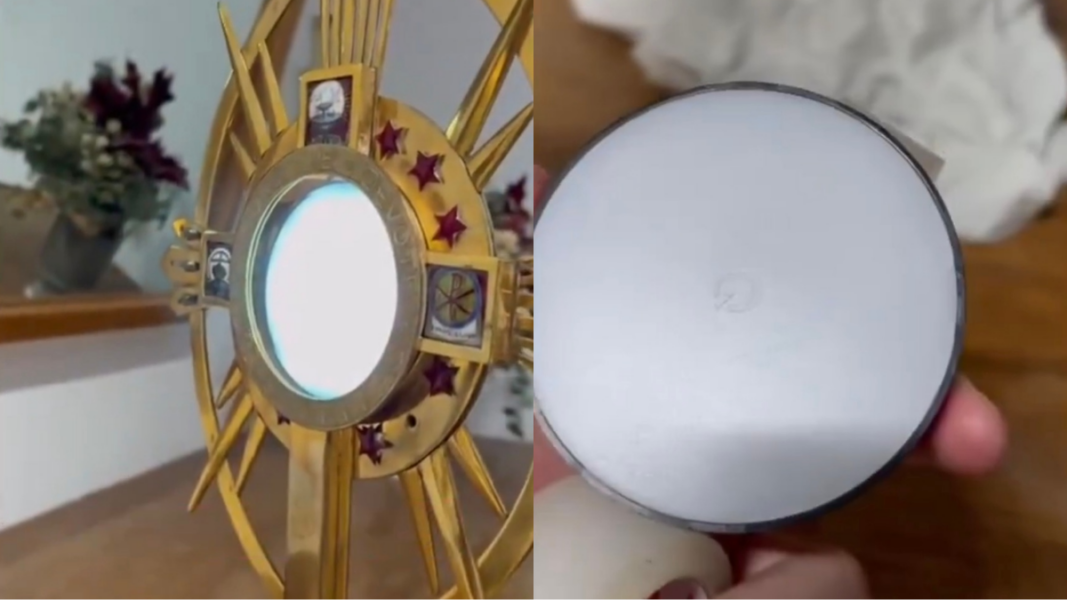
A sacristan from Madrid has publicly denounced that, during Eucharistic Adoration, a small lamp would have been placed behind the consecrated Host and the whole set fixed with adhesive tape to produce a “more artistic” visual effect, and that the Sacred Host was even completely replaced by a round spotlight inside the monstrance, without actually exposing the Lord during the Adoration. In a video shared on social media by Betania TV, the church worker shows the device and maintains that the practice is not only an improper liturgical innovation, but also a possible profanation of the Eucharist.
According to his testimony, the priest in charge would have asked him to stick the light directly onto the lunette—the circular piece that holds the Sacred Host inside the monstrance—because placing it outside the glass did not produce the desired aesthetic effect.
“As if the Lord needed a light to shine”
The sacristan recounts that he found the monstrance stored together with the mechanism used to illuminate the Host. While showing the small lamp, he criticizes the treatment of the Eucharist as a stage prop.
“It looks more artistic; it seems the Lord is shining. As if the Lord needed light to shine,” he states in the recording.
According to his account, on previous occasions the light had been attached outside the monstrance, without touching the lunette. However, he claims that this time he was asked to place it inside because otherwise “it doesn’t look artistic.”
The whistleblower insists that the Sacred Host used was consecrated and was exposed in the place of worship. He also mentions another occasion on which, allegedly, a flag was used as part of the setting for a Eucharistic prayer.
The Eucharist turned into stage scenery
The issue is not whether a light produces a more or less attractive visual effect. The problem is the mentality that turns the altar, the monstrance, and the Eucharist itself into materials available for the celebrant’s creativity.
The liturgy is not a theatrical performance or an artistic installation. Nor does it belong to the priest, the pastoral team, or whoever organizes the event. The Church receives and safeguards a form of worship whose center is Christ, not the need to surprise attendees with visual effects, ambient music, or stage resources.
Even if the adhesive tape did not touch the Host directly, fixing a lamp to the lunette to artificially enhance its appearance reveals a worrying loss of the sense of the sacred. The monstrance is not a support for experiments, and the Sacred Host cannot be subordinated to an aesthetic composition.
It would be even more serious if the adhesive or any foreign object had come into direct contact with a consecrated Host. In that case, it would no longer be a mere ceremonial extravagance, but an action objectively incompatible with the care and reverence demanded by the Blessed Sacrament.
“Do not use Christ”
“Enough of using the Eucharist as propaganda. It is Christ you are using,” the sacristan declared.
He adds, addressing the priests directly: “Do not use Christ. Adore Him, glorify Him, but do not use Him for your own purpose or for sentimentalities. Christ is greater than all that.”
His protest points to a problem that goes far beyond this particular celebration. For years, under the argument of making the liturgy more “close,” “creative,” or “attractive,” elements foreign to worship have been introduced that end up shifting attention from the mystery being celebrated to the originality of those who organize it.
When the main concern is that the Eucharist “looks artistic,” something essential has already been lost. Liturgical beauty does not arise from attaching lights to a monstrance, projecting images, or turning the sanctuary into a stage. It arises from celebrating with faith, obedience, and reverence what the Church has received.
The Eucharist does not need artifices to show the presence of Christ. Much less does it need to be manipulated to adapt to the aesthetic sensibility of a celebrant. Where adoration is replaced by stagecraft, the liturgy ceases to lead toward God and begins to revolve around those who seek to reinvent it.