


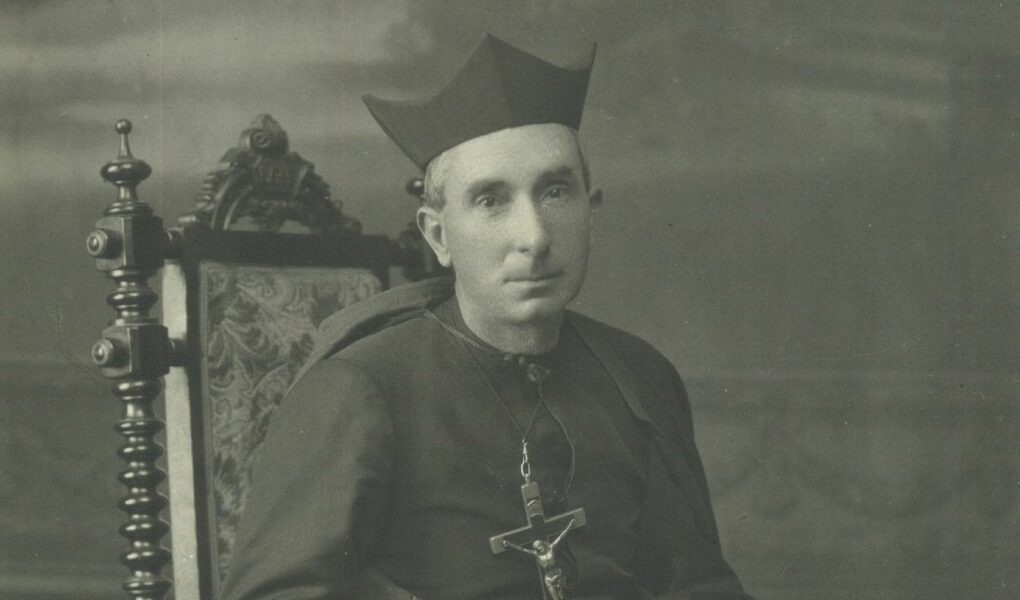
His death plunged Málaga into mourning on July 18, 1926. That morning, a piece of news no one wanted to believe spread from mouth to mouth: “Father Arnaiz has died.” The Jesuit of the poor, the tireless missionary, the priest who seemed to belong to everyone, had just surrendered his soul to God. Málaga knew it had not simply lost a priest: it had lost a father.
Worn out: that is how Blessed Tiburcio Arnaiz died exactly one hundred years ago today—not defeated by illness, but consumed by love that gives itself without measure. He arrived exhausted in heaven because he had run out of strength on earth. Today, when so much is said about pastoral plans, synodalities, structures, and projects while faith grows ever scarcer, Father Arnaiz reminds us of something infinitely simpler: the Church changes the world when there are saints.
Born in Valladolid in 1865, he was orphaned as a child. After several years as a diocesan priest in two villages, at the age of thirty-seven—when others seek stability—he gave up everything to enter the Society of Jesus. That decision bewildered many. He never regretted it. From then on, he would no longer live for himself.
He found in Málaga the vast field of his vocation. Its streets and humble neighborhoods, its forgotten villages, the scattered farmsteads in the Andalusian hills became his pulpit. He entered the tenement courtyards, the hospitals, the prisons; he traversed that rural Andalusia where thousands of people scarcely received any religious attention. He walked endless kilometers to reconcile with God an old man who had not confessed in decades, to catechize, to console the sick, to bring Jesus Christ where no one else brought Him. He did not understand a bureaucratic priesthood: he preferred to wear out his boots rather than his armchairs. He made himself poor with the poor: he loved them passionately, not out of mere commitment to justice, but because he saw in them the very face of Christ. He never reduced evangelization to a social program: he knew that man needs bread, yes; but he needs even more grace, truth, forgiveness, and hope. It was impossible to keep up with his pace. He preached, heard confessions, organized retreats, wrote letters, cared for the sick, guided souls, promoted schools, and, when the day seemed to be over, spent long hours before the Tabernacle because he drew all his strength from the Eucharist. He did not seek applause; he fled from honors; his only obsession was that Jesus Christ be known and loved. He said that a priest should be “all things to all people,” because one soul is worth more than all the treasures of the world.
From that passion were born the Rural Doctrines, probably the most original evangelizing work in twentieth-century Spain. He understood that one could not wait for the peasants to come to the churches: the Church had to be brought to them. And he did so by forming catechists, establishing schools, fostering small Catholic communities, and awakening a true apostolic springtime in hundreds of Andalusian villages. Providence placed at his side an exceptional woman: María Isabel González del Valle. Intelligent, cultured, deeply contemplative, and extraordinarily effective, she understood from the very first moment Father Arnaiz’s apostolic dream and became his most faithful collaborator. If he was the heart, she was often the hands that made that immense work possible. Together they wrote one of the most beautiful pages of twentieth-century Spanish lay apostolate.
I had the joy of dedicating biographies to each of them. On the occasion of Arnaiz’s beatification in 2018, I published with Editorial San Pablo Father Arnaiz: I Have Hastened to Live, presenting the tireless missionary, passionately in love with the Heart of Jesus. In 2025, on the occasion of the opening of the beatification cause of his great collaborator, I published her biography, I Am in Love with the Lord: María Isabel González del Valle.
Father Arnaiz consumed his health without calculating the endurance of a heart incapable of rest: “I have hastened to live; I have worked as much as I could; now the Lord will gather me in.” In July 1926 he returned exhausted from a mission. His body could take no more. The man who had spent his life walking the roads for Christ was fading quickly in the Jesuit residence in Málaga. The news spread throughout the city. So many people kept coming to inquire about his condition that the Jesuits had to post the daily medical bulletin to inform the crowd. Meanwhile, the Church of the Sacred Heart remained filled with the faithful praying for the one who had taught so many precisely how to pray. He, with complete peace, did not speak of his sufferings: only of heaven, of the Heart of Jesus, of the Virgin. At one point, contemplating his body worn out by so many years of giving, he uttered the phrase that sums up an entire life: “I have hastened to live.” It was not the haste of activism but of love; the haste of one who knows that time is short and souls are waiting. In Málaga no one doubted that a saint was dying. When he breathed his last on the morning of July 18, 1926, the news shook the city. For hours, thousands of people filed past his body to bid him a final farewell. The funeral became a solemn procession, an impressive manifestation of gratitude. Years later, when he was beatified in 2018, the Church merely confirmed what Málaga had long proclaimed with its heart.
Father Arnaiz is more relevant than ever today, when we live in a society tired of words and in need of witnesses. There are too many commentators on the Gospel and too few men consumed by it. When we are so concerned with structures, statistics, and strategies, Father Arnaiz reminds us that the great Christian revolution is still holiness. He needed no social media, no spotlights, no image campaigns. A crucifix, a breviary, a confessional, endless roads, and a heart that did not know how to say no to God were enough for him. That is why, one hundred years later, he continues to speak to us. And he continues to ask us the same question: Are we hastening to love?
The best tribute we can pay Father Arnaiz today is not to commemorate his centenary but to ask ourselves whether we too are spending our lives. For there is a very sad way to reach the end: to preserve oneself too much. And there is another, infinitely more beautiful way: to arrive, as he did, with empty hands because everything has been given; with tired feet because much has been walked; with a consumed heart because much has been loved.
One hundred years ago Málaga wept for a saint; today the Church needs to learn from him once again. The world does not wait for functionaries of the sacred but for witnesses; not administrators but apostles; not settled Christians but men and women who have, like Father Arnaiz, the holy haste to spend themselves for Jesus Christ before night falls.
Blessed Tiburcio Arnaiz, apostle of Málaga, priest of the Heart of Jesus, pray for Spain, for our priests, and for all: that we may spend our lives in the beautiful adventure of winning souls for Christ.
Those who wish to delve even deeper into his figure will also find on my YouTube channel a series of lectures, interviews, and talks about Father Arnaiz: