


When Freedom Raises a Guillotine
Their blood continues to speak, like Abel’s, not to demand vengeance, but to unmask the mythical lie of their age.
On the evening of July 17, 1794, sixteen women crossed Paris in a cart of the condemned on their way to the guillotine. They carried no weapons; they had not conspired, set fire to palaces, or shed blood. They were eleven choir nuns, three lay sisters, and two extern sisters of the Discalced Carmel. Their crime was to have continued being what they were: religious, spouses of Jesus Christ, daughters of Saint Teresa, women consecrated to prayer.
The Revolution that had promised freedom condemned them for exercising it. Those who proclaimed the rights of man denied them the right to belong to God. Those who were to overthrow tyrannies raised a guillotine to cut off the heads of defenseless women who prayed. They did not die from a cruel accident of history but because “freedom” separated from truth hates everything it cannot dominate. They were victims of three diabolical deceptions: freedom turned into dogma, equality that admits only men identical before the State, universal fraternity that excludes anyone who dares to claim it in Jesus Christ, the only Elder Brother, Son of the eternal Father.
The Carmel Confronts the New Religion
The monastery of the Annunciation of Compiègne had been founded in 1641 as one of the first French fruits of the Teresian reform. For a century and a half its inhabitants lived a hidden existence, regulated by the bell, the Holy Mass, and the slow succession of the liturgical hours. But the Revolution could not tolerate that life, not because the nuns posed a political threat, but because they constituted a theological contradiction. In a society that was beginning to declare that man belongs only to himself, they affirmed with their silence that the highest freedom consists in belonging entirely to God. In a world that deified autonomous will, they professed obedience when the Revolution abolished religious vows, considering them contrary to its “freedom.” Yet the Carmelites knew that no one is freer than the one who freely surrenders her life for love.
In 1790 the contemplative orders were suppressed. In September 1792 the nuns were expelled from the convent and the community dispersed into small groups in several houses in Compiègne, but continued to live, as far as possible, their schedule of prayer, silence, and fraternity. They took away the monastery, but not the Carmel; they snatched the habit, but not the consecration. Persecution could close convents, but not enclose grace; if it dissolved communities by decree, it could not revoke their vocation; if it declared their vows nonexistent in the State registers, it would not succeed in erasing them from those sixteen hearts in which God had received them.
“Fanatics” of the Sacred Heart
The Carmelites of Compiègne also died for their devotion to the Sacred Heart of Jesus. They were not executed solely for possessing pious images, nor was the revolutionary process formally reduced to a condemnation of the cult of the Heart of Christ: they were condemned for their fidelity to religious life, for their adherence to the Church, for their practical rejection of dechristianization, and for what the tribunal called “fanaticism.” But among the evidence used against them were precisely testimonies of their devotion to the Sacred Hearts of Jesus and Mary. They were sentenced for their “fanaticism” linked to that devotion and for their connection with legitimate authority. The accusation is revealing: the Heart of Jesus was particularly intolerable to the new revolutionary religion. It was not just another devotion, but the proclamation that the center of the world is not the human will, but the love of God made flesh; that humanity is not saved by building political paradises, but by allowing itself to be redeemed by a pierced Heart; that above assemblies, committees, and constitutions stands the reign of Jesus Christ. While the Revolution sought to remake man, the Sacred Heart reminded that man needed to be redeemed; if the Revolution sought to impose salvation through politics, the Heart of Christ offered salvation by grace. The Revolution demanded total adherence to an idea, and the Carmelites had already surrendered their totality to a Person. That is why they were “fanatics.” They were given the most beautiful praise! They were “fanatics,” yes, if fanaticism meant not admitting that any human power could take the place of God. Fanatics of meekness, reparation, adoration, and love; fanatics of a Heart that, forgiving, had allowed itself to be pierced by all.
The Offering
In 1792, when persecution was becoming increasingly threatening, the prioress, Mother Teresa of Saint Augustine, proposed to the community an act of offering to God as a holocaust so that peace might be restored to the Church and to France. Not all were able to accept it immediately: some felt fear, and this makes their martyrdom more human, more Christian, and greater. For the martyr is not the one who feels no fear but the one who, feeling it, allows charity to be stronger than fear. Grace does not destroy fragility: it takes it by the hand and leads it where it alone would never have reached.
Those women did not romantically toy with the idea of dying: they knew what the guillotine was; they had seen how the Revolution devoured its own children; they knew the carts of the condemned, the insults, the sound of the blade, the common graves. Therefore their offering was not a pious fantasy, but a priestly act, for, though they were not ministerial priests, they lived to the extreme the oblation dimension that belongs to every Christian life, each making of herself a living host. And God, who needs no blood, but accepts the love that surrenders, took their prayer seriously.
A Trial Against God
The nuns were arrested in June 1794. Transferred to Paris, they appeared on July 17 before the Revolutionary Tribunal. The trial was summary; the sentence, decided in advance. When the word “fanaticism” was used against them, Sister Henrietta of Jesus asked the accuser to explain what it meant. The response was brutal and illuminating: fanaticism was their adherence to childish beliefs and ridiculous religious practices. Then Sister Henrietta understood that the sentence did not punish a political crime, but faith, and told her sisters they should rejoice, because they were going to die for their holy religion and for their fidelity to the Catholic Church. The language of the tribunal had dispelled any doubt: they were not killing them as conspirators, but as believers. In reality, that day sixteen Carmelites were not judged: the right of God to be loved above the State was judged, the possibility that there might exist on earth an interior space that power cannot occupy, the freedom of the Christian conscience. And, as always happens when an absolute power judges God, it ended by condemning man.
The Cart, a “Processional” Step
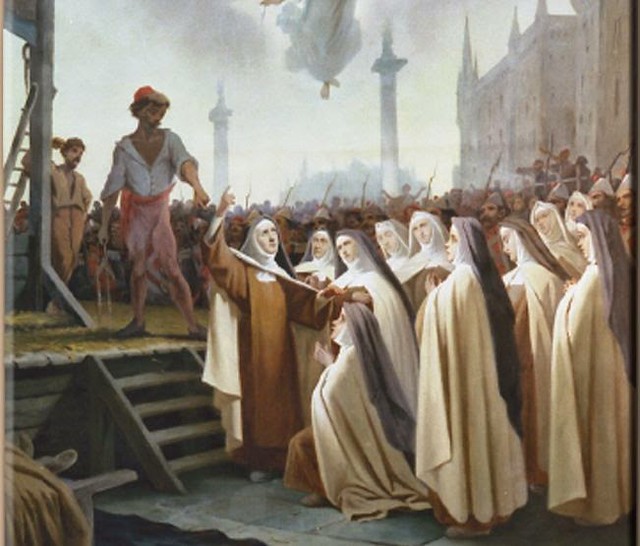
As they set out toward the scaffold, the Carmelites did not organize a protest, shout slogans, or respond to hatred with hatred. They sang. The cart of the condemned became a monastic choir, and the road to the Place du Trône Renversé became a liturgical procession. Power had wanted to reduce them to silence, and they responded with music, transforming their public, ignominious degradation into divine office. Those defeated women showed all of Paris the beauty of a community that died as it had lived: united and singing the Miserere, the Salve Regina, and, at the foot of the scaffold, the Veni Creator Spiritus. Thus they went to the scaffold: praying and singing, renewing their consecration, one after another, before their prioress. Before ascending, each nun knelt before Mother Teresa of Saint Augustine, asked permission to die, and renewed her obedience. Then she kissed a small image of the Virgin and surrendered herself to the executioner.
The youngest, Sister Constance, was among the first. Her twenty-nine years advanced with joy, like one going to a feast. The prioress wished to die last, like a mother who accompanies all her daughters to the door and crosses it only after making sure none remain behind. Sixteen times the blade fell. Sixteen voices were silenced. Silence resounded in the square when the crowd realized it had just witnessed something holy.
Bernanos: Fear Visited by Grace
Providence wished to prolong the story of Compiègne through literature and music.
In 1931, Gertrud von Le Fort published “The Last on the Scaffold,” freely inspired by the martyrs. She introduced the fictional character of Blanche de la Force, a young woman dominated by fear. Years later, Georges Bernanos was commissioned to write the dialogues for a film based on that work. The cinematic project did not go forward at the time, but the text appeared posthumously under the title “Dialogues of the Carmelites.” Francis Poulenc later turned it into one of the most intense religious operas of the twentieth century, premiered in 1957.
Bernanos did not merely adapt a historical epic; he penetrated the Christian mystery of fear with a profoundly Catholic intuition: grace does not always remove fear; sometimes it transfigures it. There are people called to give God not a natural strength they possess, but a weakness that He redeems. Blanche is not a saint because she is brave, but because, after fleeing, trembling, and believing herself unworthy, she arrives at the hour grace had awaited. Christian freedom does not consist in having no fear, but in fear not having the last word. Faced with the pagan hero, who masters his destiny by the strength of his character, the Christian martyr receives a strength that is not his own. He does not ascend the scaffold to prove he is superior to others: he ascends sustained by Another. That is why Bernanos’s Carmelites are not statues: they argue, doubt, tremble, contradict themselves. And yet, in the final hour, all their poverties are assumed in the communion of saints.
The final scene, popularized by Poulenc, offers an extraordinary theological intuition: the voices disappear one by one at the sharp blow of the guillotine, but the song is not destroyed; it thins, purifies, ascends. It seems death conquers each singer, yet it does not succeed in conquering the song. The Church is precisely that: a song that traverses the centuries even as those who intone it fall.
The Guillotined Women, on the Altars
The process of beatification opened at the end of the nineteenth century. The Carmelites of Compiègne were beatified by Saint Pius X on May 27, 1906, as the first martyrs of the French Revolution solemnly recognized by the Church. France was then experiencing a new wave of militant laicism. The Law of Separation of Church and State had been passed in 1905. Religious congregations were being expelled, communities dispersed, and ecclesiastical goods seized again. Saint Pius X raised to the altars nuns expelled by a revolution precisely when other French nuns were again experiencing exile. It was not a political gesture, but a prophetic affirmation: ideologies change names, soften their vocabulary, replace the guillotine with administrative decree, but the temptation to expel God from public life remains.
In beatifying them, the Church was not canonizing a monarchical option or a historical nostalgia. It recognized that no law can declare illegitimate total surrender to God; that martyrdom is the supreme act of religious freedom; and that those women, considered useless by revolutionary society, had performed one of the most fruitful acts in the spiritual history of France.
On December 18, 2024, Pope Francis decided to extend to the universal Church the cult of Blessed Teresa of Saint Augustine and her fifteen companions, inscribing them in the catalogue of saints through equipollent canonization—an exceptional form that does not require a new miracle process because it recognizes an ancient, stable, and widespread cult, the constant reputation of sanctity, and the historical and doctrinal solidity of the cause.
Hidden nuns, erased by the Revolution, thrown into a common grave in the cemetery of Picpus, were proposed as saints to the whole Church. If the Revolution wished to deprive them even of individual burial, the Church gave them an eternal name; if the world counted them among the enemies of the people, the Church inscribed them in the book of saints.
After the Canonization, the Empty Convent
In 2026 there was a painful epilogue: on April 21 the bishop of Beauvais announced the closure of the Carmelite community of Compiègne, established since 1992 in Jonquières. The diocesan communiqué explained the reasons: the advanced age of the nuns, the decrease in their number, the absence of new vocations, and the impossibility of finding reinforcements from other monasteries. The departure of the sisters would take place progressively. A painful paradox: while the whole world was rediscovering the Carmelites of Compiègne; while the Church was canonizing them; while theaters continued to stage their martyrdom and Poulenc’s music moved believers and non-believers alike; the Carmel that guarded their memory was left empty because there are no young women willing to succeed those heroines. We applaud their heroism, but today’s France has ceased to engender the spiritual conditions in which a similar vocation can be born. The eldest daughter of the Church preserves or restores cathedrals, organizes sacred concerts, and turns monasteries into cultural heritage, but Christianity does not survive as heritage. A church without faithful ends up being a museum; a monastery without vocations ends up being an archive; a tradition no longer chosen by anyone becomes a memory.
The closure of the Carmel of Compiègne is, therefore, more than a conventual reorganization. It is a question addressed to Europe. What has happened in a land capable of producing Saint Bernard, Saint Louis, Saint Joan of Arc, Saint Vincent de Paul, Saint Margaret Mary, the Curé of Ars, Saint Thérèse, and the martyrs of Compiègne, that now it is so difficult to find six, eight, or ten young women willing to surrender their lives to God in silence?
It would be unjust to claim that France absolutely lacks vocations or Christian vitality. There are some, and there exist fresh and fruitful communities, like another Carmel, the once aging one of Alençon, which years ago opted for the traditional liturgy and was populated by young people from the four corners of the earth. But the closure of a Carmel as symbolic as that of Compiègne reveals a deep wound: a civilization can continue to admire the fruits of faith after having uprooted its roots.
False Freedoms
What do the Carmelites of Compiègne teach us today? Above all, that not every freedom liberates.
The Revolution spoke of freedom while prohibiting religious vows, not tolerating that a woman choose to obey, live in enclosure, keep chastity, and belong to Jesus Christ. The new society claimed the right to decide which options could be called free and which had to be annulled for the good of those who had chosen them. It is a very modern temptation to invoke freedom to uproot man from every bond that has not been fabricated by himself. The rupture with nature, with tradition, with family, with history, and even with one’s own body is presented as liberation. But, paradoxically, the more absolute autonomy is proclaimed, the more powers multiply that claim to define what we must think, what words we may pronounce, what convictions are admissible, and what public presence may be granted to faith.
False freedom begins by saying: “You do not need God.” It continues by affirming: “You must not speak of God.” And it ends by decreeing: “We will not allow you to live as if God existed.” It does not always arrive with a guillotine; sometimes it comes with a smile, a cultural campaign, professional exclusion, a permanent caricature, or a law drafted with impeccable words. But the logic is the same when power ceases to protect religious freedom and begins to grant believers a conditional permission to exist.
The Carmelites remind us that freedom does not consist in lacking bonds, but in being able to love the good without coercion. They had freely chosen enclosure, and the Revolution wanted to “liberate” them by forcing them to abandon what they loved. What deprived them of freedom was not the vow, but the State that declared the vow null. The grille was not their prison: it was the ideology that could not bear to see them behind the grille.
The Fruitfulness of the Useless
The martyrs of Compiègne also teach the immense value of lives the world considers useless. Those nuns did not administer hospitals, direct universities, publish newspapers, or participate in public debates. They prayed. And for the utilitarian mentality of the Revolution, praying was doing nothing. Yet when France was bleeding, it was they who offered their lives for peace.
The contemplative seems not to intervene in history, but touches the secret source on which history depends. He does not first change structures; he presents himself before God with the suffering of the world in his hands. He does not produce measurable results; he allows grace to continue descending upon a humanity that does not even know it needs it.
Ten days after the death of the Carmelites, Robespierre fell and the Terror ended. A historical causality between the two events cannot be proven, nor does faith need to turn chronology into a mathematical proof, but the Christian can contemplate in that proximity a mysterious correspondence: they had asked for peace and offered their lives; a few days later, the machinery of the Terror began to devour those who operated it and lost its dominion. Prayer is not magic, nor is the offering a mechanism. But God also governs history through hidden lives that surrender themselves for others.
Dying Together
There is still a teaching especially necessary for our time: the Carmelites did not die in isolation but in community. Modernity exalts the solitary hero; Christianity contemplates a communion.
The strongest sustained the weakest, the elderly encouraged the young, the prioress received the renewed profession of her daughters; each one heard how the voices of the others fell silent and knew that her turn would soon come. They did not all possess the same temperament nor feel identical courage, but they shared a vocation, a rule, a table, a choir, a Mother, and a Spouse. Martyrdom was the last conventual recreation; the square, their choir; the guillotine, their definitive door of enclosure; heaven, their eternal cell.
Faced with a culture that fragments us, encloses us in individual identities, and leaves us alone before suffering, they show that holiness also consists in allowing oneself to be carried by the faith of the brothers when one’s own falters.
Perhaps some ascended the scaffold because she had seen the previous one ascend, or could sing because she heard the others singing. Thus the Church lives. Thus it has traversed persecutions. Thus it remains when everything seems to collapse: one voice sustains another until all merge in the same song.
The Heart Against the Blade
The definitive contrast is not established between some nuns and some revolutionaries, but between two symbols: the Heart and the guillotine. The latter represents power that simplifies by eliminating. When a human reality does not fit into the ideology, it is cut; when a voice bothers, it is silenced; if a conscience does not submit, it is suppressed.
The Heart of Jesus represents the opposite. It does not eliminate the sinner: it bears him; it does not cut off the enemy’s head: it allows itself to be crowned with thorns; it does not shed another’s blood: it gives its own; it does not save by destroying but by allowing itself to be destroyed. If the Revolution offered to regenerate France through the death of the guilty, Christ had regenerated the world by dying for the guilty.
The Carmelites chose the Heart and therefore could walk toward the blade without inwardly becoming what killed them. They did not hate their executioners nor ask God to punish Paris: they offered themselves for France.
Such is the difference between the martyr and the fanatic: the latter kills for his idea; the former dies for love. The fanatic sacrifices others; the martyr offers himself; the first needs enemies; the second intercedes for those who destroy him.
They were called fanatics of the Sacred Heart, but precisely because they belonged to that Heart, they did not become fanatics of ideology.
What do the Carmelites of Compiègne ask of us today? Not the aesthetic admiration of being moved by Bernanos or shaken by Poulenc. It is not enough to visit Picpus, venerate their relics, or lament the closure of the convent. They ask us what freedom we are willing to defend and whether the Sacred Heart is for us a pleasant image or the true King and center of our life; whether we still believe in the fruitfulness of contemplative prayer and whether our families are capable of giving sons and daughters to God; whether we want vocations or only feel nostalgia when they disappear. And above all, they ask us what we will sing when our hour comes. Because we are all walking toward a scaffold, even if it has no blade and does not rise in a square. Death awaits every man. The question is not whether we will ascend, but how we will ascend: clinging to ourselves or surrendered; in solitude or within the communion of the Church; cursing or singing.
Those women had rehearsed their final song for years. Every divine office, every Gloria Patri, every Salve Regina, every act of obedience, and every silence of the Carmel had prepared the afternoon of July 17. No one improvises martyrdom: one learns to die by learning each day to surrender.
The Song Has Not Ended
The convent remains empty. The sisters depart. Silence will settle in the corridors of Jonquières. It may seem that the Revolution, two centuries later, has achieved what it could not with the guillotine: to extinguish the Carmel of Compiègne. But it is not so. The historical community was dispersed in 1792 and annihilated in 1794. Yet it has never been so alive as now that the whole Church pronounces the name of those saints. The Carmel does not depend solely on walls; the same fire can be kindled in another place, in another young woman, in another community, in another country. The blood of the martyrs does not automatically guarantee vocations, but it claims them, implores them, and makes them possible.
Perhaps the closure of the convent is also a call. The holy Carmelites, newly inscribed in the universal catalogue of the Church, do not want us only to contemplate their glory, but to ask on our knees for a rebirth. Perhaps their canonization is not the solemn closure of a history, but the beginning of a new mission.
France does not need only to preserve the memory of its Carmelites: it needs to engender them again. Europe does not need only to admire its martyrs but to recover the faith for which it was worth dying. And the Church does not need to long for heroic times but Catholics convinced that Jesus Christ still deserves total surrender.
When the last head fell, the executioner believed the song had ended, but he was mistaken. The song passed from the square to heaven, from heaven to the Church, from the Church to Bernanos, from Bernanos to Poulenc, from Poulenc to the theaters of the world, and from these to the heart of those who, even without faith, perceive that those women possessed a freedom their executioners never understood.
The guillotine made noise for a few seconds; the Veni Creator has been resounding for more than two centuries. And it will continue to do so as long as there is on earth a single soul willing to say to Christ: “my life is yours; my freedom consists in belonging to you; my heart rests within yours.” Then the blade of the guillotine may fall, but it will not conquer.