


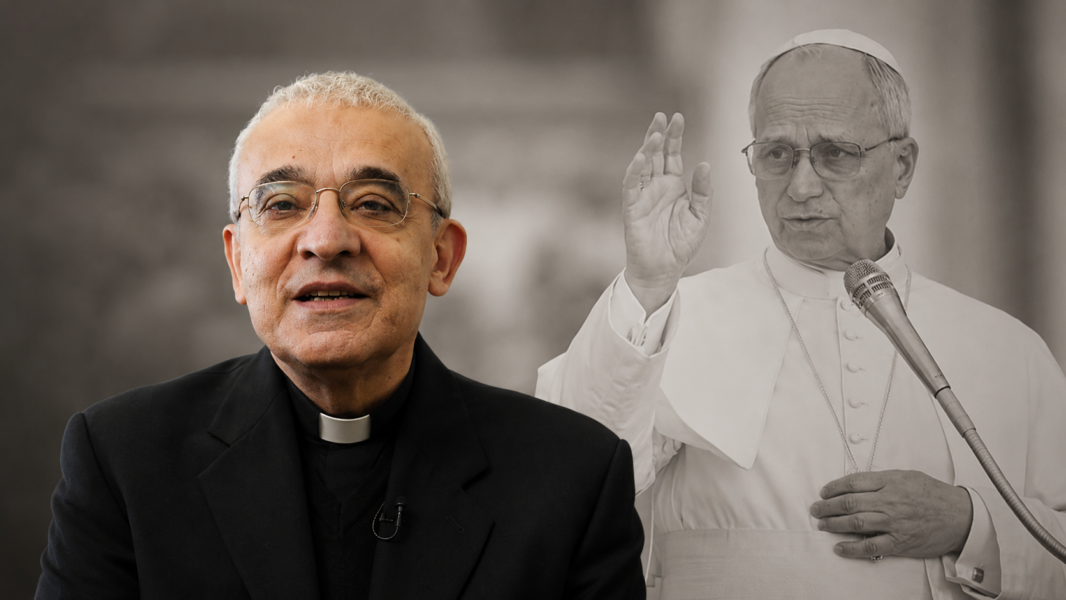
The Prefect of the Dicastery for Bishops, Archbishop Filippo Iannone, has granted his first major interview since Cardinal Robert Francis Prevost was elected Pope and he assumed leadership of the Vatican body responsible for preparing a large part of the episcopal appointments worldwide. In a conversation with the Croatian weekly Glas Koncila, the prelate offers a broad explanation of how the Dicastery operates, the criteria guiding the selection of new bishops, and some of the challenges facing the episcopal ministry today. He also reveals that Rome receives letters from the faithful denouncing problems in dioceses and admits that an increasing number of priests are declining appointments as bishops.
“We continue the line set by Cardinal Prevost at the time”
One of the most striking aspects of the interview is Iannone’s reference to his relationship with Leo XIV. The Prefect recalls that he has succeeded precisely the man who now occupies the Chair of Peter and acknowledges that this continuity makes his work easier.
“I have succeeded the Holy Father in this task. He carried out this service for some years before me. That means he gave the Dicastery a certain orientation, and I feel favored in the sense that, by continuing the line that Cardinal Prevost, as Prefect, had indicated at the time, I can move forward with greater ease.” He also adds that he holds regular meetings with the Pope to deal with the Dicastery’s affairs.
The body that prepares episcopal appointments
Iannone explains that the Dicastery’s work goes far beyond drawing up shortlists of candidates that the Pontiff later examines.
“The Dicastery for Bishops handles everything concerning the erection, life, and activity of dioceses, the identification of candidates for the episcopate who will be presented to the Pope for appointment, and also the ministry of bishops in their dioceses,” he notes.
The Prefect stresses that this work is never carried out in isolation but in close collaboration with other dicasteries of the Roman Curia and, especially, with the apostolic nuncios, “who know the reality of the local Churches well.”
“I receive many letters from the faithful around the world”
Far from the image of a Curia detached from the Church’s everyday life, Iannone assures that many of the faithful turn directly to the Dicastery when they believe serious problems exist in their dioceses.
“I receive many letters from ordinary faithful around the world pointing out problems in the life of a diocese. They address the Dicastery, and we assess whether what they say is well-founded or the result of misunderstandings. If it is well-founded, we try to address the problem in order to restore serenity to the life of the community.”
The Prefect recalls that the same supervisory work also existed in the Dicastery for Legislative Texts, which he headed before taking on his current responsibility, when the faithful appealed to Rome believing that certain provisions of their bishops did not conform to the universal law of the Church.
The profile of the bishop sought by Leo XIV
Asked about the model of bishop that currently inspires appointments, Iannone explains that Leo XIV personally conveys the Church’s pastoral priorities to the prelates.
“When he meets with bishops, the Pope points out the priorities the Church faces today: evangelization, care for creation… On other occasions he recalls the fundamental characteristics a bishop must have: care for the interior life, prayer, welcoming others, availability for collaboration, and attention to the least.”
Nevertheless, he sums up this entire ideal in a simple phrase: “The figure, the essential model for the bishop, is always and at all times Christ, the Good Shepherd.”
“The bishop is father of the entire community”
One of the Prefect’s most insistent messages revolves around the bishop’s responsibility as a principle of unity within the particular Church.
Recalling Leo XIV’s words to ecclesial movements, he warns that “every group, every movement in the Church must see itself not as the whole, but as part of a body that is the diocesan community and then the universal community.”
For Iannone, the plurality of charisms is fruitful only when it remains united to communion.
“Within the diocesan community, different people and groups can act, and that diversity is a richness when it is joined to concern for unity. If diversity closes in on itself, it becomes an evil and harms the Church.”
That is why he concludes: “The one who must foster these relationships and, when necessary, correct those who depart from this model is the bishop. The bishop is father of the entire community. The capacity to be so is certainly one of the most important requirements for a candidate to the episcopal ministry.”
“There are priests who do not accept”
The interview also leaves a significant observation about the current reality of the episcopate.
Asked about priests who decline an appointment when Rome proposes a diocese to them, Iannone responds clearly: “Yes; I had heard about it before, today I can say I experience it.”
Far from attributing this phenomenon solely to the abuse crisis, he considers it a response to a much deeper transformation.
“The responsibilities of a bishop have increased. Life has become much more complex: the life of dioceses, the life and ministry of the priests for whom a bishop is responsible, the lack of vocations… There are priests who do not accept, and that is a fact.”
He then invites people to abandon the idea that the episcopate is simply an honor.
“Sometimes little thought is given to the fact that the bishop is also a human being; he has his limits like any of us. He can go through moments of discouragement and difficulties in relationships. If someone makes a mistake or holds debatable positions, it is legitimate to criticize him; but we must not stop at criticism alone—we must be willing to help and, above all, to pray for bishops.”
“Applying political categories to the Church is misleading”
Iannone also devotes part of the interview to the relationship between authority, participation, and synodality.
To those who interpret the Church’s life with categories proper to politics, he responds unambiguously: “Applying to the Church categories that belong to the world of politics is misleading. The Church has a different nature.”
That does not mean, he clarifies, excluding the co-responsibility of the faithful. On the contrary, he recalls the teaching of the Second Vatican Council according to which every baptized person participates in the Church’s mission and has the right—and in some cases even the duty—to express concerns to pastors through the bodies provided for by canon law.
“Synodality is not a demand”
In the final part of the interview, the Prefect also offers a concise definition of synodality.
“Synodality is not a demand,” he states. “It means feeling part of a whole and assuming the responsibility that entails.”
He adds that “it is not only the bishop who must bear the weight of the diocese; all the faithful must feel responsible for it.” In his view, the more deeply a person lives their faith and participates in the life of the Church, the more authority their voice acquires, because they speak “from within” the community and not as a mere external observer.
“In necessary things, unity”
Finally, addressing the relationship between the universal Church and the particular Churches, Iannone returns to the teaching of the Second Vatican Council to recall that a local Church can only be called fully Church when it remains in communion with the others and with the Successor of Peter.
As a permanent criterion he proposes the well-known maxim attributed to Saint Augustine: “In necessary things, unity; in doubtful things, freedom; in all things, charity.” A principle which, he maintains, makes it possible to harmonize respect for local traditions with the unity of faith, Church discipline, and sacramental life.