


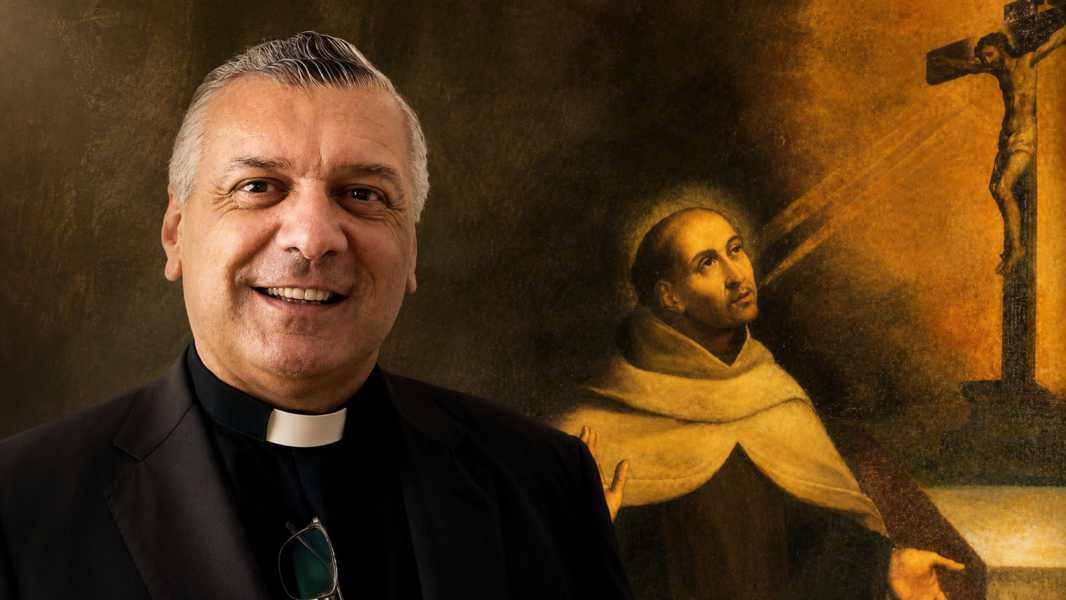
On the occasion of the Sanjuanist Jubilee Year, which commemorates the third centenary of the canonization of Saint John of the Cross and the first centenary of his proclamation as Doctor of the Church, Monsignor Alberto José González Chaves has granted an interview to María Rabell García for El Debate, in which he reflects on the enduring relevance of the Mystical Doctor’s thought and maintains that the great spiritual crisis of our time is not so much a lack of faith as a scarcity of hope.
According to González Chaves, the teaching of Saint John of the Cross remains profoundly relevant because it places at its center the universal call to holiness. “God wishes to give Himself entirely to man, and man will only be fully happy when he allows himself to be entirely possessed by God,” he affirms, recalling that the Mystical Doctor did not write for a minority of contemplatives, but to teach “the way of union with God, which is the vocation of every baptized person.”
“We hope little from God”
González Chaves considers that the commonly used expression—“Hope reaches as far as it hopes”—is incomplete, since Saint John of the Cross spoke of “hope of heaven,” that is, a hope oriented entirely toward God.
As he explains, contemporary man has reduced hope to optimism or to the expectation that everything will turn out well. However, the saint’s doctrine points in a very different direction: hope reaches its greatest fullness when human supports disappear and the soul learns to abandon itself completely in God.
“Perhaps the greatest spiritual drama of our time is not the lack of faith, but the smallness of our hope: we pray little because we hope little,” the theologian maintains.
A spirituality centered on God
During the interview, González Chaves contrasts the teaching of Saint John of the Cross with certain current pastoral trends which, in his view, run the risk of focusing excessively on human activity.
Against a spirituality based on “doing many things for God,” the saint proposes the path of interior detachment and the action of grace. “We accumulate activities; he speaks of emptiness. We seek to control; he teaches us to abandon ourselves,” he summarizes.
Along the same lines, he recalls that holiness does not consist simply in moral improvement, but in allowing oneself to be transformed by the love of God, a transformation that requires freedom from one’s own attachments.
The “Dark Night” is not a failure
Regarding the interpretation of the “Dark Night,” one of the best-known teachings of Saint John of the Cross, González Chaves maintains that today there is a tendency to identify the spiritual life with inner well-being, so that dryness or the absence of consolations is interpreted as failure. In response, he recalls that for the Carmelite saint, spiritual purification is part of the ordinary path toward union with God.
“We should not be afraid when God seems to be silent. Often He is silent because He is working more deeply than ever,” he affirms.
In his judgment, contemporary man fears this experience because he has lost the supernatural meaning of suffering and seeks a spirituality that is “always luminous, emotionally satisfying, and psychologically comfortable,” whereas Saint John of the Cross teaches that the path to union with God necessarily passes through purification and configuration with Christ.
A teacher for the present
Throughout the interview, the priest insists that the figure of Saint John of the Cross does not belong solely to the history of spirituality, but offers answers to very current questions such as hope, suffering, interior freedom, or the search for God.
For González Chaves, the Doctor of the Church continues to remind Christians that the goal of the spiritual life is not a comfortable existence free of difficulties, but full union with God, the horizon to which every baptized person is called.