


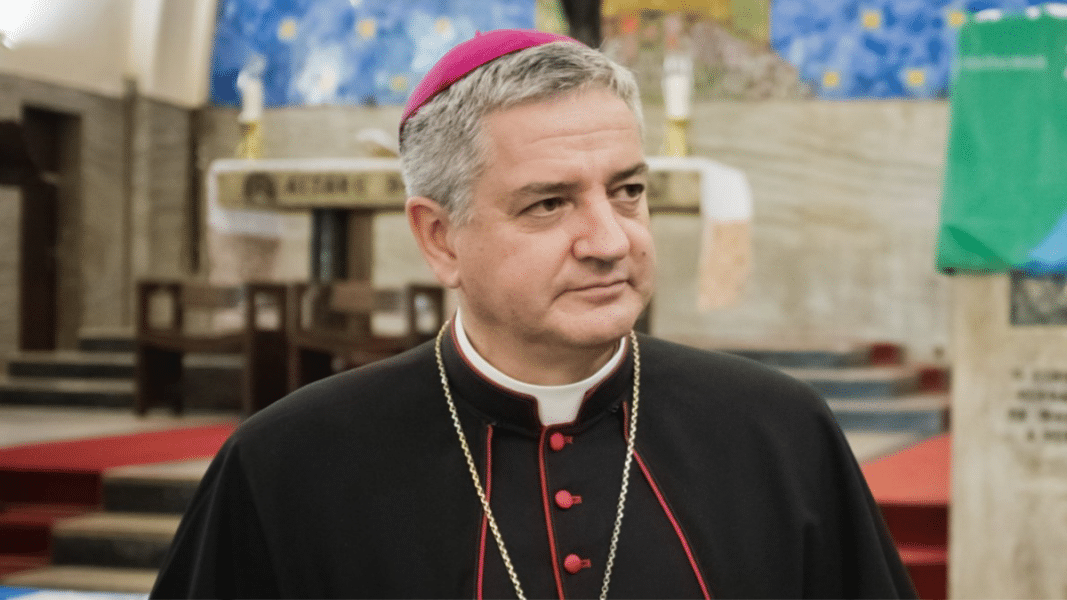
Before the upcoming vote on the euthanasia bill in the French National Assembly, scheduled for this July 15, the Bishop of Bayonne, Lescar and Oloron, Bishop Marc Aillet, has issued a serious warning to Catholic parliamentarians who support the initiative. In an interview given to France Catholique, the prelate maintains that a favorable vote on a law authorizing the deliberate causing of death constitutes a grave contradiction with the Catholic faith and carries spiritual consequences.
«Catholic parliamentarians who have voted for this bill must weigh its consequences. If they are aware of this inconsistency, they will no longer be able to receive communion,» the bishop states, inviting the deputies to carry out «a sincere examination of conscience» before casting their vote.
«A profound contradiction with the faith»
Bishop Aillet emphasizes that the rejection of euthanasia is not based solely on a religious conviction, but also on natural law, the foundation of respect for all human life. Therefore, he considers that a deputy who declares himself Catholic and at the same time supports legislation allowing the killing of a patient «objectively places himself in opposition to a constant teaching of the Church.»
The bishop also recalls that the instruction Samaritanus Bonus, published by the then Congregation for the Doctrine of the Faith, reaffirms that euthanasia constitutes «an intrinsically evil act, regardless of the circumstances.»
True compassion comes through caring, not eliminating
In response to those who present euthanasia as an act of humanity, Aillet distinguishes between authentic compassion and what Saint John Paul II called «false mercy.»
In his view, a truly fraternal society responds to suffering by developing palliative care, psychological, family, and spiritual accompaniment, rather than offering death as a solution. He also denounces that the public debate is conditioned by «an intense media bombardment influenced by powerful lobbies,» which, in his opinion, contributes to clouding consciences.
Spiritual accompaniment and Christian funeral rites
Asked about people who request euthanasia, the bishop recalls that suicide remains objectively contrary to the will of God, although he insists that each situation requires concrete pastoral discernment.
The priest, he explains, must help the person to regain hope, be reconciled with God, and renounce their intention to end their life. Regarding the celebration of Christian funerals, he notes that each case must be studied with prudence, taking into account, among other aspects, the possible existence of signs of repentance before death, always avoiding giving the impression that the Church approves of euthanasia.
Defense of conscientious objection
The prelate also expresses his concern about the situation of healthcare professionals, who could be forced to participate in euthanasia procedures despite having chosen their profession to «heal, relieve, and accompany.»
For this reason, he calls for the conscience clause to be fully guaranteed and also defends the right of Catholic hospitals and healthcare centers to refuse to apply the future law. «A truly democratic society cannot require institutions founded on unconditional respect for life to act against their most fundamental convictions,» he maintains.
Hope in light of the visit of Leo XIV
In the final part of the interview, Aillet refers to the upcoming visit of Leo XIV to France, whose motto will be «That the world may have life.» Although he acknowledges that the law could be approved before the Pontiff’s arrival, he affirms that this does not eliminate the duty of Christians to continue bearing witness.
The bishop hopes that the Pope will strongly recall «the inalienable dignity of all human life,» encourage families, healthcare workers, and volunteers who accompany the sick and elderly, and, above all, renew the hope of the faithful. «A society weakens when it presents death as a solution. Christ came that men may have life and have it in abundance,» he concludes.