


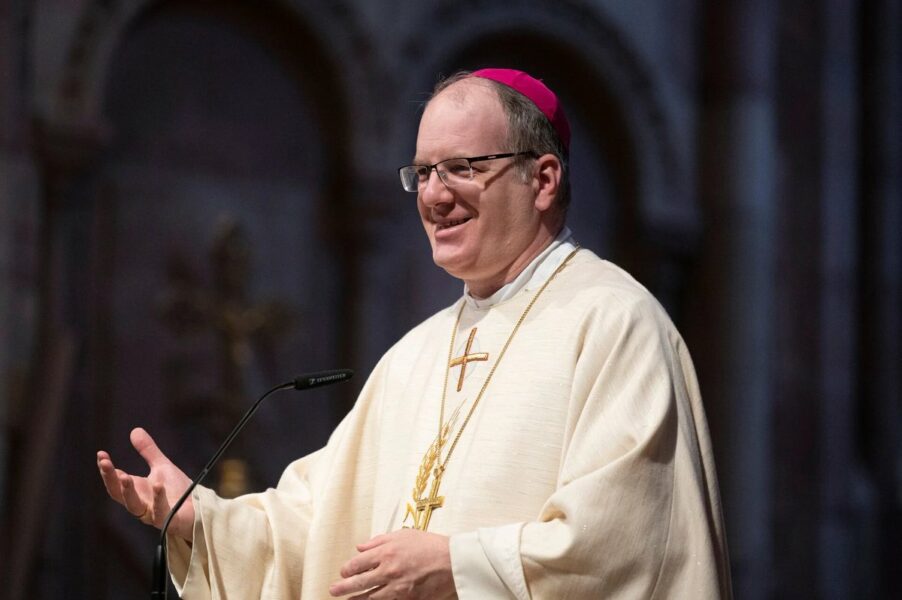
Less than a week after Pope Leo XIV appointed him bishop of Eichstätt, Bishop Christian Würtz has suggested that the debate on mandatory priestly celibacy will continue to occupy the Church in the coming years. The German prelate believes that any eventual modification of this discipline requires careful consideration of both what could be lost and the possible benefits of a change.
In an interview given to the Bavarian public broadcaster (Bayerischer Rundfunk), Würtz was asked about a possible relaxation of mandatory celibacy for priests. “One must weigh very carefully what we lose if we give up mandatory celibacy and what we gain. Without a doubt, it will be an issue that will intensely occupy us again in the future,” he replied.
Unity as a priority
During the interview, the new bishop also referred to the German Synodal Way. In his view, one of the bishop’s main responsibilities is to preserve the unity of the Church.
“A bishop has, above all, the task of being a servant of unity. It is important not to get lost in struggles between different factions, but always to ask what unites us and what is truly central,” he stated.
Regarding synodality, he defended the importance of listening to different positions before forming a judgment. “One must ask what drives the other opinion and what its theological reasons are,” he noted. He added that he understands his episcopal ministry as a service of dialogue to discern the will of God.
Würtz also maintained that “the Church must always reform itself” and added that “if we remain motionless and nothing changes, that also does not move the Church forward.”
Asked about the differences between his position and that of his predecessor, Bishop Gregor Maria Hanke, he replied that although he voted differently on some occasions during the Synodal Way, he does not consider there to be fundamental discrepancies between them.
A closely watched profile
On July 7, Leo XIV appointed Christian Würtz as the new bishop of Eichstätt, ending more than a year of vacancy following the resignation of Bishop Gregor Maria Hanke.
During his time as auxiliary bishop of Freiburg, Würtz actively participated in the assemblies of the German Synodal Way. In them, he voted in favor of several documents related to the reevaluation of homosexuality, the so-called “gender diversity,” and the introduction of blessing ceremonies for same-sex couples.
More recently, as head of priestly formation in the Archdiocese of Freiburg, he received the nine theology students who symbolically submitted an application to enter the seminary to demand women’s access to the priesthood. After the meeting, he recalled that the Church’s current doctrine does not allow the priestly ordination of women, although he valued the dialogue held with the students.
The statements now known constitute the first from the new bishop of Eichstätt on one of the issues that continues to be part of the ecclesial debate in Germany, just days after assuming the governance of the diocese by appointment of Leo XIV.