


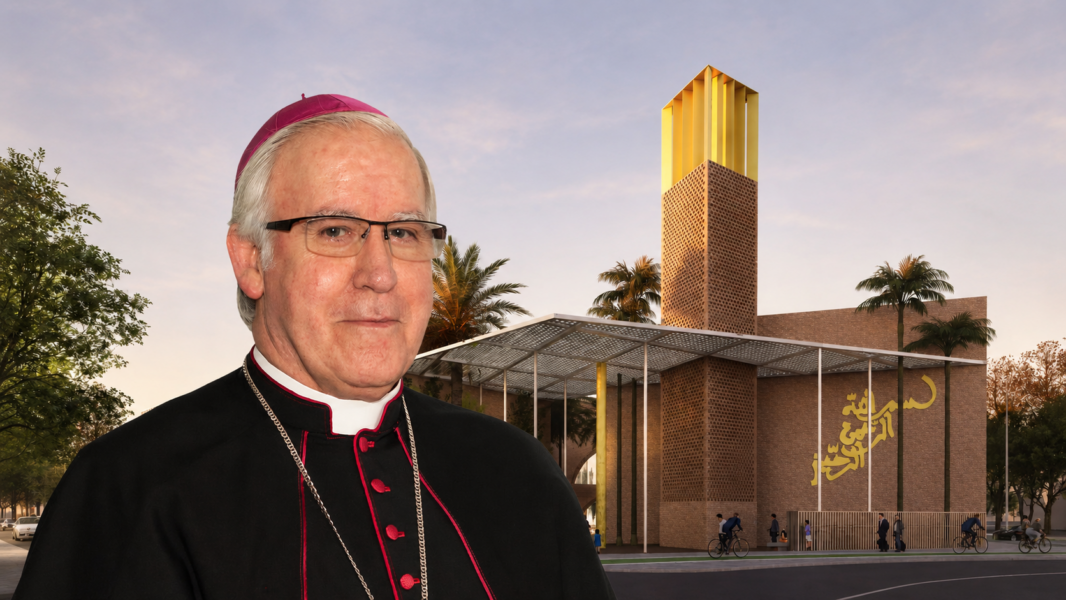
The Archbishop of Seville, Monsignor José Ángel Saiz Meneses, has refrained from commenting on the project to build a mosque in the Polígono Sur and has placed the issue within the context of the right to religious freedom recognized by civil legislation and by the doctrine of the Church.
Asked about this matter last Friday, following the presentation of the Archdiocese’s financial information for the 2025 fiscal year, the prelate described the issue as a “sensitive matter” and stated that, in his view, “two elements must be taken into account: rights and freedoms.”
He then developed his response by drawing on three successive references. First, he cited Article 18 of the Universal Declaration of Human Rights, which recognizes the right to freedom of thought, conscience, and religion, as well as the possibility of publicly manifesting one’s beliefs. —It is worth recalling that the Holy See did not participate in the approval of this text in 1948, as it was not then a member of the United Nations, although subsequent papal teaching has invoked it on various occasions as a reference in matters of human dignity and religious freedom.—
The Archbishop then appealed to Article 16 of the Spanish Constitution, which guarantees “the ideological, religious, and worship freedom of individuals and communities, with no other limitation on their manifestations than what is necessary for the maintenance of public order protected by law.”
Finally, he cited the conciliar declaration Dignitatis humanae, from the Second Vatican Council, to recall that “the protection and promotion of the inviolable rights of man is an essential duty of every civil authority” and that it is the responsibility of public authorities to safeguard religious freedom through just laws and to facilitate the necessary conditions for its exercise.
In conclusion, Saiz Meneses specified that the exercise of these rights must be carried out “in accordance with state, regional, and local legislation and in accordance with the municipal regulations of each city.”
The Archbishop’s statements come as the administrative processing of the project promoted by the Fundación Mezquita de Sevilla to build an Islamic complex in the Polígono Sur continues. The City Council has postponed the granting of the building permit in order to obtain new technical and legal reports following the objections submitted by Vox.
The municipal group maintains that the primary intended use of the building would be as a place of worship rather than a sociocultural center, which, in its view, could have implications for its urban planning compatibility. The Fundación Mezquita de Sevilla rejects this interpretation, maintains that the project complies with current regulations, and argues that the permit should be granted in accordance with the law.
During his intervention, the Archbishop made no assessment of the specific project or of the objections raised in the urban planning procedure, limiting himself to outlining the legal and doctrinal framework that, in his view, should govern the exercise of religious freedom.