


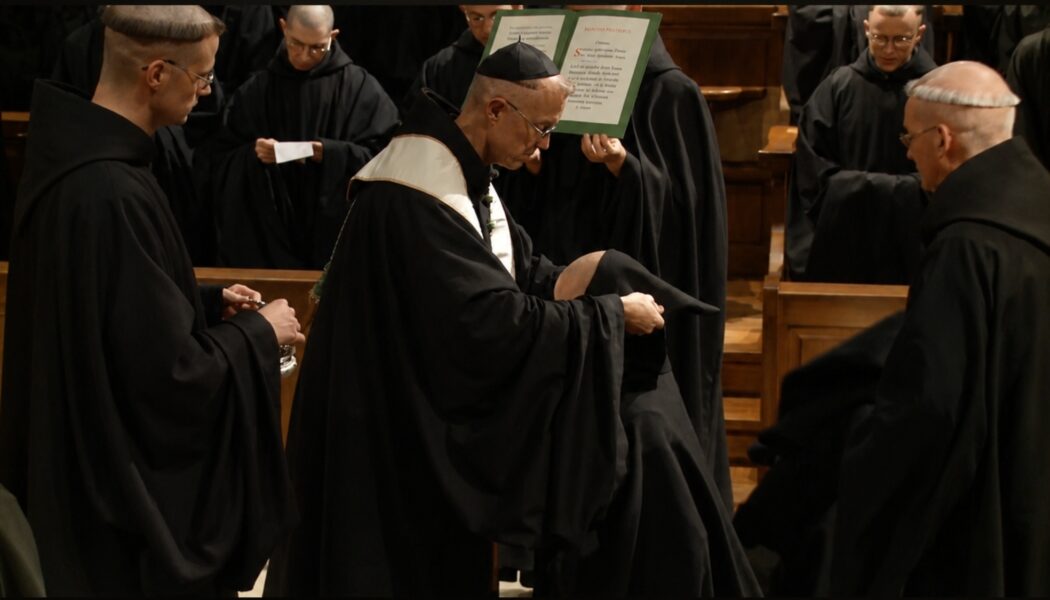
Twelve monks from Sainte-Madeleine du Barroux officially settle this Saturday in the Angevin monastery abandoned by the Trappists in November, ensuring the continuity of nearly a thousand years of monastic life.
This Saturday, July 11, the Abbey of Notre-Dame de Bellefontaine, in the French region of Les Mauges (Anjou), officially welcomes a new monastic community: twelve monks from the Abbey of Sainte-Madeleine du Barroux, one of the most thriving Benedictine monasteries in France and a reference for traditional liturgy.
The arrival of the monks from Le Barroux ends months of uncertainty about the future of the monastery. On November 13, 2025, the last Trappists left Bellefontaine, closing more than two centuries of uninterrupted presence. The progressive aging of the community made its continuity unviable, and their departure was experienced with great emotion throughout the region, where many feared that the void would take years to fill.
Nearly a thousand years of prayer
The installation of the Benedictines is much more than the simple replacement of one community by another: it marks the return of the sons of Saint Benedict to a monastery whose origins date back to the early twelfth century. As early as around 1010, hermits lived in this valley of Les Mauges, and in the Middle Ages Bellefontaine became an abbey of notable importance. In 1305, Bertrand de Got, Archbishop of Bordeaux, learned there of his election to the papacy—under the name of Clement V—and gifted the monastery an image of the Virgin that is still preserved today in the abbey church.
Over the centuries, various monastic families succeeded one another on the site—Benedictines, Cistercians, Fuliens, and finally Trappists—but always under the same spiritual tradition: the Rule of Saint Benedict. After the destruction of the French Revolution, monastic life was reborn in 1816 thanks to Father Urbain Guillet, who established a Trappist community there. During the nineteenth century, that community experienced remarkable growth, founded several monasteries—including one in the United States as early as 1880—and made Bellefontaine a place of spiritual retreat cherished by generations of the faithful.
“Following the signs of heaven”
The community now called to take up the torch is that of the Abbey of Sainte-Madeleine du Barroux, founded in 1978 by Dom Gérard Calvet and today home to some sixty-five monks, a vitality uncommon in the French monastic landscape that has enabled it to send twelve religious to Anjou to establish this new foundation.
For Dom Louis-Marie, Abbot of Le Barroux, the decision is above all the fruit of spiritual discernment: “From the beginning, it has been about following the signs of heaven and the signs of the Lord,” he confides. And he recalls the continuity between both communities: “The Trappists are Benedictines. We too are Benedictines.”
Faithful to the traditional liturgy celebrated according to the liturgical books of 1962, the monks of Le Barroux nevertheless emphasize that their vocation is above all prayer: “We are men of prayer, and that is our principal work. We are not warriors, we are not politicians, we are not influencers. We live in enclosure, with the natural radiance of an abbey that prays,” explains Dom Louis-Marie.
A sign of hope for French monasticism
The significance of this installation extends beyond the borders of Anjou. More than three centuries after the departure of the Benedictines in 1642, and two centuries after the arrival of the Trappists, the Benedictine tradition regains its place in this valley where monastic prayer has risen to heaven for nearly a millennium.
At a time when so many religious communities struggle to ensure their continuity, Bellefontaine offers a sign of hope for French monasticism: where traditional liturgy and fidelity to the Rule flourish, vocations follow.