


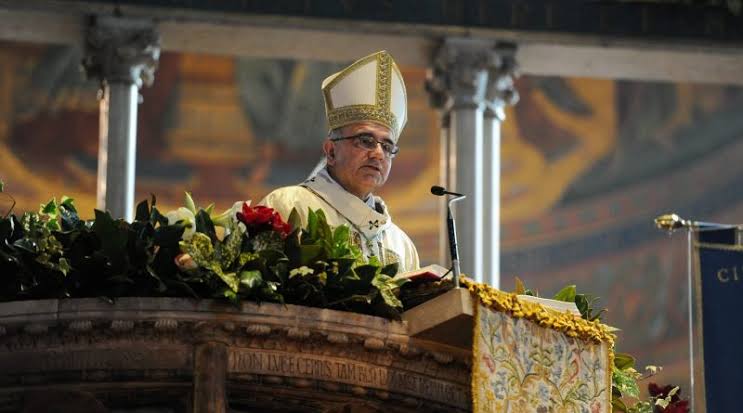
The statements of the archbishop-abbot of Modena-Nonantola and bishop of Carpi, Monsignor Erio Castellucci, have opened a new controversy regarding the liturgy and the ministerial priesthood. In an interview granted to Notizie Carpi, the prelate raised the possibility of a “co-presidency” of the Eucharist between a priest and a woman, a formula unknown both to the liturgical tradition of the Church and to canon law and the Magisterium.
“While women cannot access the ordained ministry, and therefore neither the diaconate, one could imagine a shared presidency of the Eucharist: a woman would preside over the Liturgy of the Word and a priest would preside over the Eucharistic liturgy. It would be a prophecy of co-presidency,” Castellucci stated.
The proposal introduces a concept nonexistent in Catholic liturgical doctrine. The Church has never contemplated a “co-presidency” of the Mass nor does it understand the Liturgy of the Word and the Eucharistic liturgy as two autonomous celebrations that could be presided over by different persons. The Eucharist constitutes a single act of worship whose president is the priest or the bishop, who acts in persona Christi.
A proposal foreign to the discipline of the Church
Although the lay faithful—men and women—may exercise various ministries during the celebration, such as proclaiming the readings (except the Gospel), directing the singing, or performing other instituted liturgical services, the presidency of the Mass belongs exclusively to the ordained minister.
Therefore, the terminology used by Castellucci goes beyond a simple broadening of lay participation. By speaking of “co-presidency,” he introduces a category that does not exist in the liturgical books or in the Code of Canon Law and that directly affects the Catholic understanding of the ministerial priesthood and the very nature of the Eucharist.
A debate already resolved by the Magisterium
The archbishop’s statements come at a time when certain ecclesial sectors continue to call for an expansion of the sacramental role of women in the Church. However, the Magisterium has set precise limits on this issue.
In the apostolic letter Ordinatio Sacerdotalis, Saint John Paul II declared that “the Church has no authority whatsoever to confer priestly ordination on women.” Likewise, the various commissions established during recent pontificates to study the possible female diaconate have not resulted in any modification of ecclesiastical discipline.
In this context, the proposal of a “co-presidency” of the Mass raises doctrinal questions that go beyond a mere pastoral initiative, as it affects essential elements of the Eucharistic celebration defined by the constant tradition of the Church.
Awaiting clarification
To date, neither the Dicastery for the Doctrine of the Faith nor the Dicastery for Divine Worship and the Discipline of the Sacraments has commented on Castellucci’s statements.
Meanwhile, the Italian archbishop’s initiative once again highlights the tensions existing between certain pastoral proposals promoted in some ecclesial circles and the liturgical and sacramental doctrine consistently maintained by the Church. It remains to be seen whether the Holy See deems it appropriate to issue a public clarification on a proposal that, by its formulation, has no precedent in Catholic liturgical tradition.