


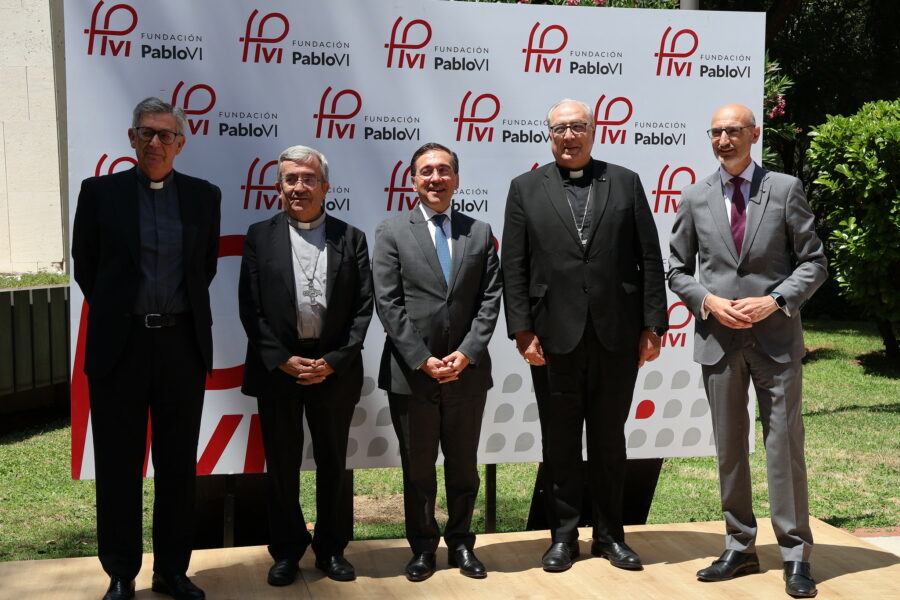
For three days, the Spanish Episcopal Conference brought together in Madrid bishops, philosophers, jurists, diplomats, university professors and political leaders to reflect on the crisis of Western democracies, the anthropological deterioration of society and the contribution of the Church’s Social Doctrine to the common good. The programme addressed issues such as the loss of moral foundations, relativism, polarisation, social justice, the role of multilateralism and the challenges of the digital world.
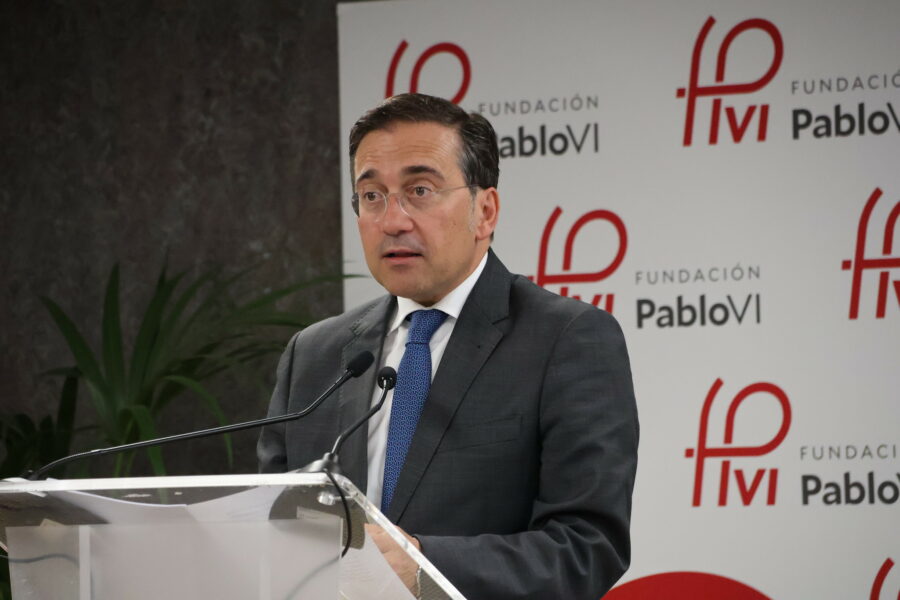
However, the image that closed the Summer School organised by the Spanish Episcopal Conference, the Pontifical University of Salamanca and the Pablo VI Foundation was that of José Manuel Albares, Minister of Foreign Affairs in Pedro Sánchez’s government, delivering the closing address from the same lectern where, minutes earlier, severe criticism had been voiced of the cultural and anthropological direction of the West.
It was not an improvised presence nor the result of institutional protocol. Before giving him the floor, the Secretary General of the Episcopal Conference, Mons. Francisco César García Magán, expressly thanked the minister for his willingness to take part in the closing session. He even revealed that, after a personal meeting with Albares at his home, the minister had accepted the invitation “from the very first moment” and that both he and his team had gone to great lengths to attend the event.
García Magán interpreted that presence as “an appreciation” of the Episcopal Conference’s initiative and went so far as to publicly invite the minister to participate in next year’s edition as well, even joking that he was jumping ahead of the CEE president and the Executive Commission in renewing the invitation.
In any academic or institutional gathering, the closing session represents the final touch and the message with which participants are sent off. In this case, the last word on democracy, human dignity and the international order was not given by a bishop or one of the specialists who had spent three days analysing the crisis of Western civilisation, but by a minister of Pedro Sánchez’s government.
Albares presented the Government’s policy as a humanist-inspired project
Far from limiting himself to institutional remarks, José Manuel Albares used the closing session to defend the main lines of the Executive’s foreign policy.
The minister presented the Government’s international action as a project grounded in democracy, human rights and humanism. “Those are also the values that guide Spain’s humanist foreign policy”, he stated during his speech.
To reinforce this approach, he repeatedly referred to the teaching of Leo XIV. He claimed to share with the Pontiff the idea that technology should be “at the service of people and the common good” and said he also agreed with his defence of a democracy that promotes the effective participation of citizens in the pursuit of the common good.
In this way, the minister linked the Government’s international discourse with some of the principles recently expressed by the Pope, precisely in a forum convened to reflect on the anthropological and moral crisis of Western democracies.
United Nations, feminist foreign policy and the international agenda
The second part of his speech was devoted to defending the Executive’s international role.
Albares upheld the United Nations as the axis of the international order and stated that Spain is “one of the main defenders of multilateralism”, placing the UN “at the centre” of its foreign policy. He even maintained that Spain and the Holy See share “the defence of the values and principles enshrined in the Charter of the United Nations”.
As an example of that strategy, he highlighted the recent International Conference on Feminist Foreign Policy, organised by the Ministry of Foreign Affairs “to continue advancing the defence of the rights of women and girls worldwide”. He added that Spain has increased its funding to United Nations programmes, strengthened its support for international justice mechanisms and aspires to become “a refuge for multilateralism”.
The minister also defended the Government’s migration policy as an action based “on responsibility, but also on humanity and respect for fundamental rights”, while insisting on the need to combat disinformation and regulate the digital space to protect democracy.
Much more than a protocolary gesture
The Summer School, entitled The collapse of democracy. The opportunity for a geopolitics at the service of the human being, spent three days reflecting on the need to recover an authentic conception of the person, strengthen civil society, rebuild democratic culture and address the demographic winter facing Europe.
Ultimately, the closing was reserved for a representative of a Government that has promoted some of the policies most criticised by the Church itself in areas such as abortion, legislation on gender identity or the anthropological transformation promoted by various international bodies.
Closings are never a mere organisational formality. They constitute an institutional decision and project a message.
On this occasion, the final speech of a conference dedicated to reflecting on the moral crisis of Western democracies did not come from the Church’s Social Doctrine, but from a minister who, from a platform organised by the Episcopal Conference, defended the Government’s humanism, the leadership of the United Nations, feminist foreign policy and the Executive’s international action, presenting those positions as convergent with the teaching of Leo XIV.
That photograph can hardly be interpreted as a minor detail. It once again summarises the willingness of part of the Spanish hierarchy to offer institutional recognition to a Government to which it continues to provide spaces of public legitimisation, even in forums conceived to reflect on the cultural and moral crisis of our time.