


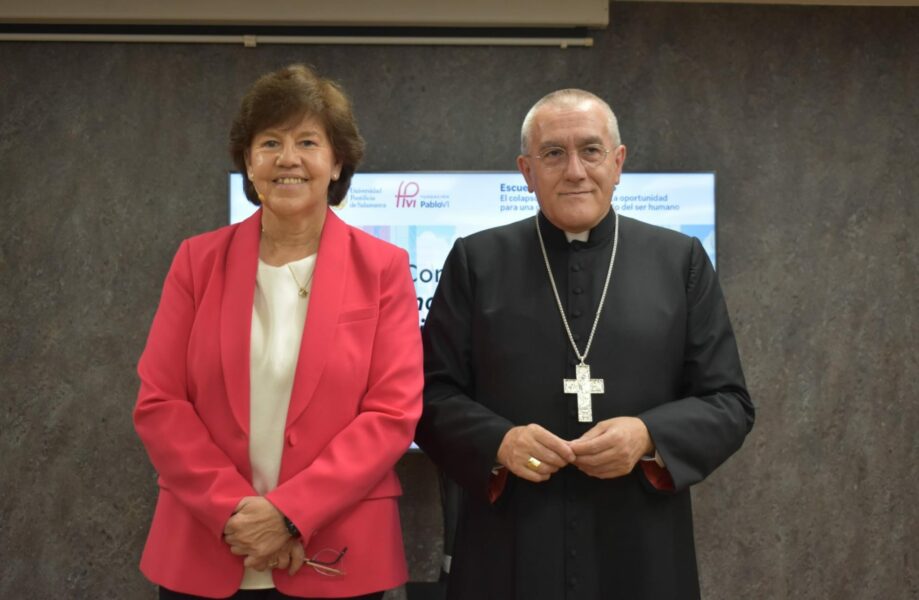
Msgr. Piero Pioppo delivers a lecture at the Summer School of the Episcopal Conference on the moral consensus that fundamentally amends procedural liberalism: without truth about man, democracy remains a “mere formality”.
The Apostolic Nuncio to Spain, Msgr. Piero Pioppo, spoke on 7 July at the Summer School organized by the Spanish Episcopal Conference, the Pablo VI Foundation and the Pontifical University of Salamanca, devoted to “the collapse of democracy.” His lecture, entitled The Moral Consensus as the Foundation of Democratic Society, moves from Cicero to Ratzinger, passes through the Spanish Transition and culminates in the recent address of Leo XIV before the Cortes Generales on 8 June.
Far from offering a generic praise of democracy, the Pope’s representative in Spain made statements of notable doctrinal weight—and clear political implications—on abortion, euthanasia, parents’ educational freedom and the ultimate foundation of every consensus: Jesus Christ.
1. Dignity is not voted on by anyone
The central passage of the lecture places human dignity above any parliamentary majority, drawing on Benedict XVI and his address to the Bundestag:
“Therefore, an authentically just society is built on the recognition of the inviolable dignity of the human person, which precedes the State and is not subject to changeable social consensuses or the shifting majorities of the moment. From this due respect for human dignity follow, among others, the following consequences: justice sets limits to force; power requires legitimacy; the poor belong to the community and the foreigner is welcomed according to his dignity, the latter as part of the rich heritage of the Church’s Social Doctrine that urges the State to attend to the most needy. This was recalled, with breadth of vision, by the Holy Father in several of his addresses during his stay in our Country.”
2. From conception to natural decline: the thrust at abortion and euthanasia laws
Commenting on Leo XIV’s address to the Cortes, the Nuncio reminded Spanish legislators who the first victim is when dignity “is obscured”:
“Consequently, every human life must be recognized and safeguarded from its conception until its natural decline, in every circumstance of its existence. For when this certainty is obscured, the most vulnerable are the first victims and the law loses its deepest meaning: to serve and protect every person. That is why the moral greatness of a nation is shown in its capacity to accompany, protect and love those lives that pass through greater fragility. When this conviction remains alive, law becomes a safeguard for all and a guarantee against the imposition of particular interests and agendas.”
3. Freedom is not choosing, it is adhering to the good
Against the liberal conception of freedom as mere absence of coercion, Pioppo proposed the classical definition, citing Dignitatis humanae:
“Freedom of thought, of conscience and of religion are the pillars on which the contemporary State is built. To be free is not only the absence of coercion or the availability of choices. It is also recognizing the good and adhering to it responsibly. Every free society also requires a just delimitation of public power, so that the freedom of persons, communities and associations is safeguarded.”
4. Parents, not the State, choose their children’s education
Amid the current Spanish educational legislation, the Nuncio underlined—with a quotation from the International Covenant on Civil and Political Rights—a right he described as “primary and inalienable”:
“Many parents place great hopes in educational institutions as valuable allies in the education of their children. This collaboration must always respect the primary and inalienable right of parents to choose the type of education and formation their children receive, in accordance with their own moral, cultural and religious convictions. The values of freedom, equality, solidarity, tolerance, justice or reciprocity would be mere formality without respect for the truth about the human being and the objective values that flow from the dignity of the human person. The State requires a prior moral foundation if it is not to fall into arbitrariness.”
5. The keystone: only Christ reveals the truth about man
The conclusion of the lecture leaves the terrain of shared reason and proclaims without ambiguity the Christological foundation of every possible consensus:
“The keystone of moral consensus, in all areas of human life, those that have been the object of this reflection and those that are complementary to it (forgiveness, tolerance, dialogue, coexistence, etc.) is that the truth about man is revealed only by Jesus Christ and is communicated by his Church: we are and are called to live as children of God and brothers in Christ. A better future depends on the formation and consolidation of moral conscience and on the collaboration of all. Only the Truth makes us free (Jn 8, 32) and it must be sought with a sincere heart. Whoever seeks it, as St Augustine sought it with his restless heart, ends by finding it and, from that encounter with the Truth, the human intellect is enlightened so that we may lay the foundations of an authentic moral consensus as the basis of democratic society.”
The full lecture is published on the Pablo VI Foundation website within the documentation of the I Summer School on “The collapse of democracy. The opportunity of a geopolitics at the service of the human being”.