


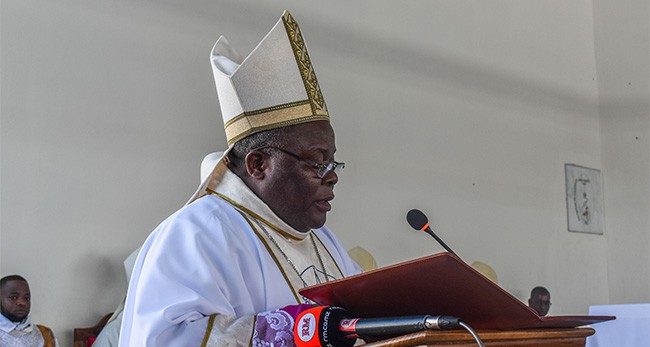
The apostolic administrator of the diocese of Quelimane, Bishop Estêvão Ângelo Fernando, has broken his silence on the investigation into the murder of Bishop Osório Citora Afonso and has denounced the proliferation of leaks and speculation that, in his view, are hindering the clarification of the crime. In a statement released on July 4, the prelate called for respect for the work of the justice system and lamented that certain reports are publicly pointing to individuals without any judicial resolution.
According to The Pillar, Fernando —bishop of the neighboring diocese of Alto Molócuè and appointed apostolic administrator of Quelimane after the murder of Afonso— stated that even he himself has been the target of accusations spread by some media outlets and social networks.
In the note, also signed by the College of Consultors of the diocese, the bishop expresses his «vehement repudiation» of publications that, he denounces, attribute responsibilities, decisions, or behaviors to various individuals «who at times have absolutely nothing to do» with the murder of the bishop.
Fernando also criticized the dissemination of data from an investigation that is still ongoing. In his view, such leaks violate the principle of judicial secrecy, generate an atmosphere of suspicion, and fuel parallel judgments that could harm the progress of the case.
«The Catholic Church defends freedom of the press,» the apostolic administrator states in the communiqué. However, he adds that «freedom without ethics or without respect for the law degenerates into speculation.»
An investigation that has changed course
Bishop Osório Afonso was murdered on June 6 by a gunshot to the chest in his episcopal residence in Quelimane.
Initial reports suggested a possible attack organized from outside. Investigators initially indicated that the perpetrators had scaled the walls of the residence, disabled the security system, and used an AK-M type rifle, a circumstance that gave rise to numerous speculations about a possible crime with political motivations.
The investigation took a turn a few days later, when authorities arrested three people linked to the diocese itself: the then chancellor, Father Adelino Novais Amado, as well as the gardener and the security guard of the episcopal residence.
Since then, the case has generated intense debate both within the Mozambican Church and in the country’s public opinion.
The publications that have fueled the controversy
In recent weeks, the independent Mozambican newspapers Savana and Canal de Moçambique have published various reports based, they claim, on data from the police investigation. Many of these publications have been collected and contextualized by The Pillar.
Among other issues, both media outlets maintain that investigators are currently working with the hypothesis that the murder may be related to internal conflicts that arose in the diocese after the arrival of Osório Afonso as bishop of Quelimane in 2025.
According to these reports, the new bishop had begun a review of the diocese’s economic administration and of various decisions made during the period of vacant see between the resignation of Bishop Hilário Massinga in 2023 and his own appointment.
In that context, on May 31 —just six days before his murder— Osório Afonso signed a broad decree reorganizing the diocesan curia that involved, among other changes, the replacement of the chancellor, Father Adelino Novais Amado. The new officials were to assume their positions precisely on June 6, the day the bishop was murdered.
Hypotheses under investigation
The Pillar emphasizes that the information published by the Mozambican media contains numerous claims that have not been independently verified and that are part of an investigation still underway.
Savana maintains that in recent years there were significant conflicts related to the management of diocesan assets and various canonical and civil proceedings initiated by the previous bishop against several religious sisters for the alleged misappropriation of property belonging to the diocese.
For its part, Canal de Moçambique claims that investigators are examining the possible involvement of the former chancellor in planning the crime, a hypothesis that has not yet been officially confirmed by judicial authorities.
The same newspaper also published information about alleged financial transfers and communications between Father Amado and Bishop Estêvão Ângelo Fernando, a point that the apostolic administrator has implicitly rejected by denouncing that certain publications are implicating him in the case without any judicial conclusions.
The Holy See is closely following the case
The Pillar recalls that the appointment of Fernando as apostolic administrator of Quelimane, immediately after the murder, seems to indicate that the Holy See had no elements that would question his suitability to temporarily assume the governance of the diocese.
The U.S. outlet also notes that last Friday, Leo XIV received in audience the president and vice president of the Episcopal Conference of Mozambique, Archbishops Inácio Saure and João Carlos Hatoa Nunes, as well as the archbishop emeritus of Beira, Claudio Dalla Zuanna. The content of the meeting has not been disclosed, and there were no official comments on whether the murder of Bishop Osório Afonso was part of the discussions.
While the investigation continues and the various hypotheses are still being analyzed by Mozambican authorities, the apostolic administrator of Quelimane has called for avoiding parallel judgments and letting justice determine the responsibilities for one of the crimes that has caused the greatest shock in the African Church in recent years.