


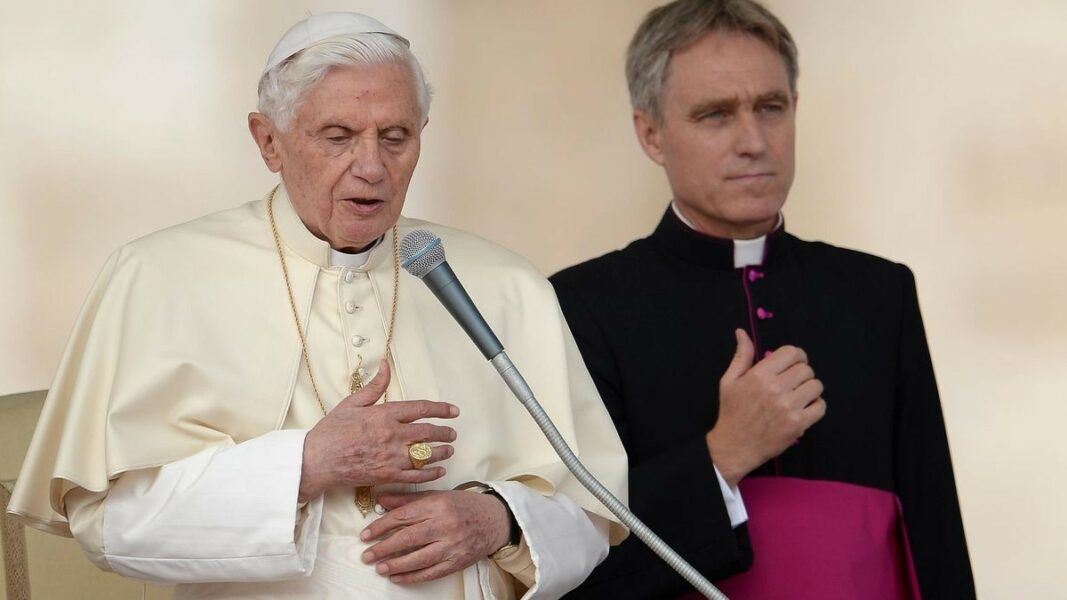
Monsignor Georg Gänswein, personal secretary to Benedict XVI for nearly two decades and currently apostolic nuncio to the Baltic states, has revealed one of the most intimate episodes from the final years of the Pope emeritus’s life: the reaction with which he received Traditionis Custodes, the motu proprio promulgated by Pope Francis in 2021 that restricted the celebration of the traditional liturgy.
In an interview granted to the Italian daily Il Giornale on the occasion of the nineteenth anniversary of Summorum Pontificum, Gänswein states that he himself read the document to Benedict XVI and that he could perceive the profound suffering it caused him.
“I read Traditionis Custodes to him and saw that there was pain in his heart. That was my impression,” the German archbishop affirms. In light of the current situation, he adds that “now is the kairos to remove those prohibitions and overcome the incident represented by that text.”
The purpose of Summorum Pontificum
Gänswein recalls that Benedict XVI promulgated Summorum Pontificum on 7 July 2007 with a very specific objective: to fully recognize a rite that, in his view, “had never been abolished.”
“His goal was to restore its full citizenship in the Church and to re-establish peace in the liturgy,” he explains.
The former papal secretary maintains that Benedict XVI was fully aware of the criticism that decision would provoke among many bishops. Nevertheless, he recalls that the German Pope was accustomed to moving forward when he was convinced that a decision was just, without allowing himself to be deterred by resistance.
Although the document was published in a context marked by efforts at reconciliation with the Priestly Fraternity of Saint Pius X, Gänswein clarifies that this was not its main objective. According to him, Benedict XVI considered that the application of Ecclesia Dei had shortcomings and saw the need to offer a response for the faithful attached to the traditional liturgy within the Church itself.
Convinced that the traditional liturgy would attract young people
The nuncio states that Benedict XVI was “very pleased” with the fruits produced by the liberalization of the traditional Mass. He regarded Summorum Pontificum as the beginning of a process aimed at overcoming the liturgical fracture and placed special trust in the new generations.
“He was convinced that a rite celebrated for so many centuries could not fail to revive,” Gänswein recalls.
As proof of this flourishing, he mentions the steady growth of the Paris-Chartres pilgrimage, one of the main international gatherings linked to the traditional liturgy.
In his view, many of these young people find in the ancient liturgy a genuine source of spiritual life and cannot be identified with positions of rejection toward the Second Vatican Council.
“It is not true that those who have a traditional liturgical sensibility are anti-conciliar. Whoever claims that is driven solely by ideology,” he maintains.
A new call to lift the restrictions
The former secretary of the Pope emeritus concludes by expressing his hope that the Church will open a new chapter on this matter. “I believe that now is the kairos to remove those prohibitions,” he affirms, convinced that the time has come to overcome the restrictions imposed on the celebration of the traditional liturgy.