


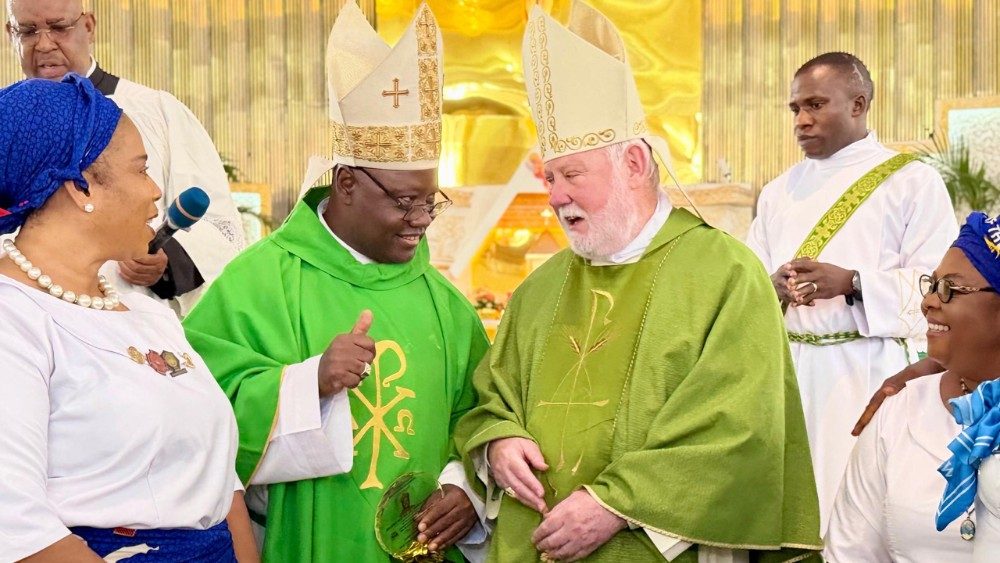
The Secretary of the Holy See for Relations with States and International Organizations, Mons. Paul Richard Gallagher, concludes his official visit to Nigeria on July 7, undertaken on the occasion of the 50th anniversary of the establishment of diplomatic relations between the Holy See and the Federal Republic of Nigeria. The trip has served to strengthen ties between both parties at a particularly delicate moment for one of the countries with the largest Catholic population in Africa, where violence and persecution continue to affect numerous Christian communities.
According to Vatican News, the visit, held between July 2 and 7, included meetings with the country’s main civil and ecclesiastical authorities, as well as various commemorative events marking five decades of diplomatic relations between Abuja and the Holy See.
Meeting with President Bola Tinubu
One of the central moments of the trip was the meeting held by Mons. Gallagher with the President of Nigeria, Bola Ahmed Tinubu, at the Presidential Villa in Abuja.
Also participating in the meeting were the Minister of Foreign Affairs, Bianca Odumegwu Ojukwu, and the President of the Economic Community of West African States (ECOWAS) Commission, Omar Alieu Touray.
After the meeting, President Tinubu told local media that he reiterated to the Holy See representative his government’s commitment to strengthening interreligious dialogue and promoting peace, harmony, and tolerance among the country’s different religious communities.
A Growing Church, Marked by Violence Against Christians
Nigeria currently has more than 30 million Catholics and more than 10,000 priests, making it one of the largest and most dynamic local Churches on the African continent. However, the country remains one of the most dangerous places in the world for Christians, with frequent attacks on communities, kidnappings of priests, and a serious security crisis that particularly affects the central and northern regions of the country.
A report published on June 30 by the Observatory for Religious Freedom in Africa (ORFA) also questions the widely held idea that most of the violence is carried out exclusively by Boko Haram and the Islamic State in West Africa (ISWAP). According to the study, the main responsibility would fall on Fulani ethnic militias.
The report, based on data collected between October 2019 and September 2025, puts the number of people killed during that period at 79,323, of whom more than 42,000 were civilians. Among the identified victims are 22,835 Christians and 10,519 moderate Muslims, although researchers believe the actual number of Christians killed could exceed 28,500 when statistically distributing cases whose religious identity could not be determined.
According to ORFA, Fulani militias would be responsible for 44% of all civilian deaths and 53% of Christian killings, percentages far higher than those attributed jointly to Boko Haram and ISWAP. The study also documents nearly 35,000 civilian kidnappings over six years and warns that numerous Christian communities live under constant threat, especially during the agricultural season, when a large portion of the attacks are concentrated.
A Mass for Fifty Years of Diplomatic Relations
As part of the official program, Mons. Gallagher presided over a solemn Eucharist on Sunday at the pro-cathedral of Our Lady Queen of Nigeria, in the Garki district of Abuja.
The celebration served as thanksgiving for the half-century of diplomatic relations between the Holy See and Nigeria and brought together Church representatives and numerous faithful from the capital.
With this visit, the Holy See has sought to reaffirm its closeness to a Church that continues to grow in the number of faithful and vocations, but which faces serious challenges arising from the violence, insecurity, and persecution suffered by many Christian communities in different regions of the country.