


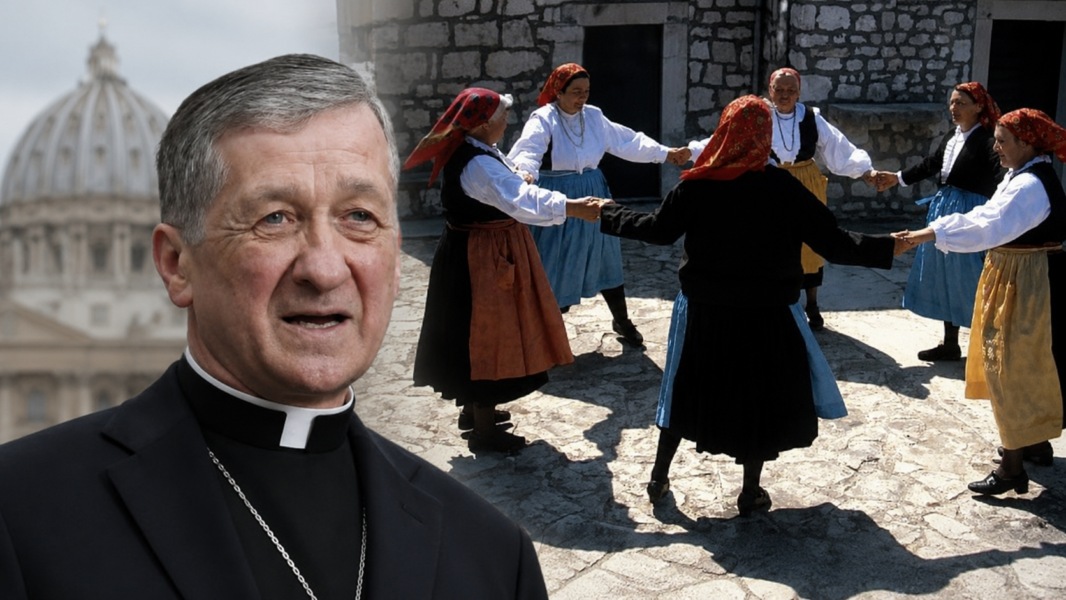
The Archbishop of Chicago maintains that the synodal path must listen to the «divine melody,» remain faithful to Tradition, and avoid becoming an exercise in «rewriting the rules from scratch.»
In a reflection published by Vatican media, the cardinal proposes understanding the Church’s journey as a choreography in which each member moves to the rhythm of the same «divine melody,» in communion with others and without losing sight of the received heritage.
The comparison is not accidental. Cupich begins with a memory from his youth, when he learned to dance the kolo —a traditional Croatian dance whose name means «circle»— during activities organized in his parish. From that experience he develops a reflection on the nature of synodality, understood as a process in which the Christian community learns to «walk together» by listening to the Holy Spirit and to one another.
Listen before acting
For the American cardinal, the main lesson of the dance is that movement never begins in an improvised way. Before taking a step, the dancer listens to the music, internalizes its rhythm, and adapts his movements to the group.
The same logic, he affirms, should characterize the life of the Church. Synodality does not begin with documents, debates, or organizational decisions, but with deep listening, especially to those who remain on the margins of the community.
Whoever stops listening, he maintains, ends up out of step with the rest, just as a dancer loses the beat when ignoring the music.
Authority at the service of communion
Cupich also uses the image of choreography to reflect on the exercise of authority in the Church. In a dance there are different roles, but all are oriented toward enabling the whole to achieve harmony.
From this perspective, he states that leading does not mean imposing oneself on others, but creating the conditions for each person to fully develop their own gifts. The diversity of charisms, far from disappearing, thus finds a way to integrate into a single movement.
Synodality does not mean starting from scratch
One of the most relevant aspects of the reflection is the cardinal’s insistence that the synodal process should not be interpreted as a rupture with the Church’s tradition.
Cupich warns against what he calls the «tyranny of the present,» that is, the temptation to limit ecclesial discernment exclusively to the concerns and sensibilities of each era. In his view, the Church’s dialogue must also include the voice of the saints, of the Fathers and Mothers of the Church, and of the entire received tradition.
For this reason, he expressly maintains that synodality is not an exercise in «rewriting the rules from scratch.» The limits established by Sacred Scripture, the dogmas, and the great councils of history do not constitute, he explains, a prison for pastoral creativity, but rather the framework that guarantees the continuity and identity of the Church through the centuries.
Space for all, without leaving the floor
The cardinal once again turns to the image of dance to explain that a good choreography requires knowing both the available space and its limits. The Church, he affirms, is called to «enlarge the tent,» making room for those who might otherwise be relegated to the margins.
However, he adds that opening space does not mean tearing down the walls of the theater or abandoning the dance floor. True creativity consists in discovering new ways of expressing the enduring truths of the faith within the received framework, not outside it.
He also considers that tensions and disagreements are part of the synodal journey. As happens in a dance, a misstep does not require abandoning the performance, but rather invites correcting the movement, adapting, and continuing to move forward together with others.
More than meetings and documents
In the final part of his reflection, Cupich rejects a conception of synodality reduced to bureaucratic structures, commissions, or the production of documents. The goal, he affirms, is not to complete an administrative procedure, but to continually learn to listen to the «divine melody» in order to offer a common witness to the Gospel.
As a conclusion, he recalls that some Church Fathers used the Greek term perichóresis, literally «a dance around,» to express the mystery of the Most Holy Trinity. From this image he maintains that the Church more fully reflects that mystery the more it learns to live, in his words, «the dance of synodality.»