


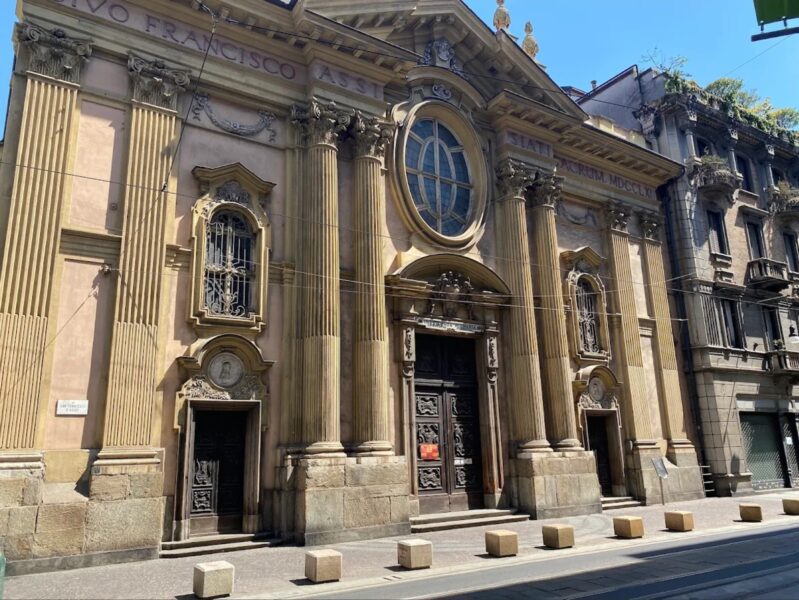
In the heart of Turin, just a few meters from Piazza Castello, stands the Church of San Francesco d’Assisi, a 13th-century temple that safeguarded the Holy Shroud for seven years after its transfer from Chambéry, and which remains to this day an active Catholic church of the Archdiocese of Turin, with regular Mass and worship.
This same temple is now also the stable liturgical seat of the Evangelical Lutheran Community of Turin.
We are not speaking of a one-off ecumenical act, a joint prayer, or a charity concert. The Lutheran community, part of the CELI (Chiesa Evangelica Luterana in Italia), celebrates its Sunday services, its “Holy Supper,” and even Ash Wednesday at San Francesco d’Assisi, with schedules published on its official website. So established is the arrangement that, upon acquiring its new administrative headquarters on Via Modena, the community itself expressly noted that line 19 connects it with “the Church of San Francesco d’Assisi, where we celebrate our services.” The pastor, who arrived from Bavaria in 2022, describes the celebration of the sacraments—the baptism and the Holy Supper—as the heart of his ministry.
The Franciscans, expelled during the suppressions of the 19th century, have long ceased to administer the church, which is now a diocesan church. Current regulations leave no doubt as to who is authorized to permit such use: the ordinary of the place.
All in Order
It is worth emphasizing: none of this is clandestine or irregular. The Directory for the Application of Principles and Norms on Ecumenism (1993) allows in paragraph 137 “to make churches and chapels available to communities of other Christian confessions for reasons of pastoral necessity.” Canon 1210, which reserves sacred places for worship, piety, and religion, is thus qualified: the ordinary may authorize “other uses.” In Switzerland, several bishops have established this by published diocesan decree—based on a text prepared by the Episcopal Conference—allowing Catholic churches to be made available to Old Catholics, Evangelical Reformed, Lutherans, Orthodox, and Anglicans. And the case of Turin is not unique: in Spain, for example, the Anglican chaplaincy of the Costa Blanca celebrates its Sunday service in the Catholic parish of Nuestra Señora de la Merced in Calpe, as advertised in its own media.
Thus, regularly and with published schedules, on an altar consecrated for the Holy Sacrifice of the Mass and with the Eucharist reserved a few meters away, a Lutheran “Holy Supper” that denies transubstantiation and ministerial priesthood is celebrated in a Catholic church in Turin. Let each reader judge for themselves what uses today find accommodation in Catholic churches across Europe, and which do not.