


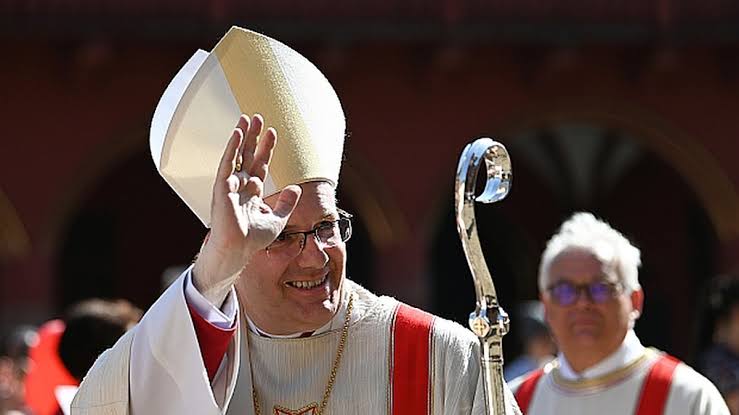
Pope Leo XIV has appointed the former auxiliary bishop of the Archdiocese of Friburgo (Germany), Christian Würtz, as the new bishop of the Diocese of Eichstätt (Bavaria, Germany). At 55 years of age, he succeeds Bishop Gregor Maria Hanke and becomes the youngest diocesan bishop in Germany.
The appointment, announced this Tuesday by the Holy See, ends the period of vacant see that began after Hanke’s early resignation at Pentecost 2025. The official proclamation took place in Eichstätt Cathedral during the feast of Saint Willibald, founder of the diocese.
In his first words after learning of the Pope’s decision, Würtz expressed his gratitude for the trust placed in him. “I am pleased with my new task. I hope to put my experience and abilities at the service of building the Kingdom of God and to walk together with the people of this diocese,” he said.
A canonist with two doctorates
Born in Karlsruhe (Germany) in 1971, Christian Würtz began his university studies in Law before entering the seminary. He holds a doctorate iuris utriusque —in both civil and canon law— and also a doctorate in Theology.
He was ordained a priest in 2006 for the Archdiocese of Friburgo and subsequently held various pastoral, academic, and judicial responsibilities. Among these, he served as a judge of the ecclesiastical tribunal of Friburgo, parish priest, dean of the city, and rector of the archdiocesan seminary, a position from which he directed the formation of future priests.
In 2019, Pope Francis appointed him auxiliary bishop of Friburgo. At 48, he was then the youngest bishop in Germany.
His participation in the Synodal Way
In September 2022, he voted in favor of the document proposing a doctrinal reassessment of homosexuality, which stated that homosexual orientation is not a personal choice and called for greater welcome and integration of homosexual persons in ecclesial life.
In the same assembly, he also supported the text on so-called “gender diversity,” which urged dioceses to review various pastoral and administrative aspects to facilitate the inclusion of transgender and intersex persons.
Months later, in March 2023, he again voted in favor of the document proposing the introduction of blessing ceremonies for same-sex couples and for divorced and remarried persons, one of the most controversial initiatives of the Synodal Way.
Dialogue with the Maria 2.0 movement
Shortly after his episcopal ordination in 2019, Christian Würtz held a meeting with members of the Maria 2.0 movement, which emerged in Germany to demand various reforms in the Church, including women’s access to the priesthood.
After speaking with the protesters, he gave them a personal letter and a ball of red thread as a symbol of dialogue, a gesture that was positively received by the movement’s representatives.
Women’s requests to enter the seminary
More recently, in May 2025, as rector of the Friburgo seminary, he received the symbolic admission applications submitted by nine theology students protesting the reservation of the ministerial priesthood to men.
Würtz described the initiative as “a good sign of the commitment and seriousness with which these women approach their vocation and their path in the Church,” although he noted that he could not admit them due to the Church’s current regulations. He later held a meeting with the students, which both sides described as respectful and constructive.
A historic Bavarian diocese
Today Würtz assumes the Diocese of Eichstätt, a suffragan of the Archdiocese of Bamberg, founded in the mid-8th century and whose patron is Saint Willibald. It currently has 334,517 Catholics, distributed across 253 parishes, organized into 74 pastoral units and eight deaneries.