


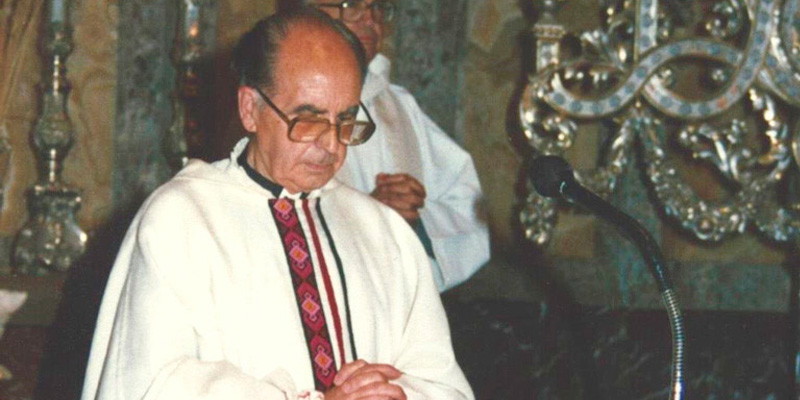
The Archdiocese of Madrid will close this Tuesday the diocesan phase of the canonization cause of the priest Sebastián Gayá, one of the decisive figures in the birth of the Cursillos de Cristiandad, a movement of first proclamation that, since its origins in Mallorca in 1949, has spread across the five continents and has marked the spiritual life of millions of Catholics.
According to the Archdiocese of Madrid, the event will take place at 7:30 p.m. at Colegio San Agustín and will be presided over by Cardinal José Cobo, Archbishop of Madrid. With this step, the investigation carried out in the diocese since the official opening of the cause in September 2022 comes to an end. All documentation will now be sent to the Dicastery for the Causes of Saints, which will study the legal validity of the process and continue its proceedings in Rome.
One of the promoters of a movement present throughout the world
Although the history of the Cursillos de Cristiandad is usually associated with the name of the layman Eduardo Bonnín, Sebastián Gayá played a fundamental role in the birth and consolidation of the movement alongside Bonnín himself and the then Bishop of Mallorca, Mons. Juan Hervás.
As chaplain of the youth of Catholic Action in Mallorca, Gayá participated in the spiritual preparation of the 1948 pilgrimage to Santiago de Compostela. That experience led, a few months later, to the first Cursillo de Cristiandad, held in January 1949 at the monastery of San Honorato, considered the starting point of an evangelizing method focused on fostering a personal encounter with Jesus Christ.
Over the decades, the Cursillos spread to dozens of countries and received the support of various pontiffs. During the First World Ultreya held in Rome in 1966, Saint Paul VI addressed the participants with words that marked the history of the movement: “Cursillistas de Cristiandad, Christ, the Church, and the Pope count on you.” Years later, Saint John Paul II would define the Cursillos as “an instrument raised up by God for the proclamation of the Gospel in our time.”
A life marked by priestly fidelity
Born in Felanitx (Mallorca) in 1913, Sebastián Gayá emigrated as a child with his family to Argentina. There he discovered his priestly vocation and, at just thirteen years old, returned alone to Spain to enter the seminary in Palma, a decision he himself would recall as one of the most difficult moments of his life.
He was ordained a priest in 1937 and dedicated his first years of ministry to youth pastoral work. After the birth of the Cursillos de Cristiandad, his career took a turn in 1957 when he was relieved of his responsibilities in Mallorca and assigned to Madrid.
Far from abandoning the work in which he had participated from its beginnings, he turned that new stage into a silent service to the movement. From the Spanish capital, he worked for decades on the international expansion of the Cursillos and spiritually accompanied countless cursillistas.
In 2005 he received the title of Prelate of Honor of His Holiness. He died on December 23, 2007, at the age of 94, and was buried at the monastery of San Honorato, the very place where the history of the Cursillos had begun almost six decades earlier.
The cause now continues in Rome
The closing of the diocesan phase does not mean the end of the process, but the beginning of the Roman stage. It will be the Dicastery for the Causes of Saints that examines all the documentation collected in Madrid and determines whether Sebastián Gayá can be declared Venerable, the first step toward a possible beatification and canonization.
His cause joins that of Eduardo Bonnín, also open, and once again brings to the forefront the origins of one of the most influential lay evangelization movements to emerge in the Church during the twentieth century.