


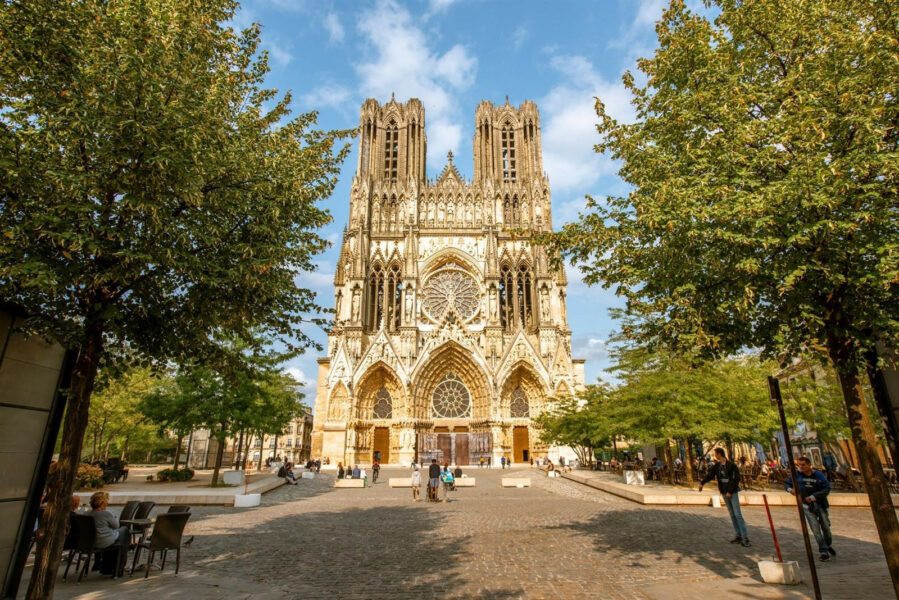
The Church in France is reorganizing its territorial presence to respond to the decline in the number of priests and an increasingly secularized society. The goal is no longer to keep the structure inherited over centuries intact, but to concentrate resources, strengthen small Christian communities, and promote a more itinerant and missionary pastoral approach.
According to the Agencia Fides, this process is especially evident in dioceses such as Reims, where Archbishop Éric de Moulins-Beaufort has driven a profound pastoral reform since 2018 under the motto «En camino para la misión».
Missionary spaces and itinerant teams
The Archdiocese of Reims has created new missionary spaces served by teams made up of priests, deacons, and laypeople. The organization of sacramental life has been adapted to the actual possibilities of the available clergy, setting the locations for Sunday Eucharist celebrations based on existing resources.
Alongside this, a more itinerant model of ministry has been implemented. These teams remain for a period in a specific locality, offering activities adapted to the needs of the place, visiting the sick, accompanying isolated individuals, and reaching out to families who request it.
The aim is to combine welcome with missionary outreach: sustaining Christian life where it still exists and, at the same time, going out to meet those living on the social and spiritual peripheries.
Arras will go from 89 parishes to just 11
The case of Reims is not isolated. The Diocese of Arras has recently announced a major pastoral transformation that will reduce its current 89 parishes to just 11.
The goal of this reorganization is to concentrate available resources, reduce travel, and strengthen local life through small Christian fraternities. It is a direct response to the drop in the number of priests and the difficulty of sustaining the old parish network in a context of greatly reduced religious practice.
France, from a great missionary country to mission territory
The transformation of these dioceses reflects a profound historical shift. During the 19th and 20th centuries, France was one of the major driving forces behind Catholic mission in Africa, Asia, and other territories. Today, however, many French bishops consider that the country itself has once again become mission territory.
The expression is not new. Already in 1943, Henri Godin and Yvan Daniel published the celebrated essay La France, pays de mission?, in which they warned about the de-Christianization of broad sectors of French society. Eight decades later, the diagnosis appears to have intensified.
Currently, barely 2 % of the French regularly attend Sunday Mass, although approximately half of the population still identifies as Catholic. At the same time, in recent years there has been a significant increase in requests for baptism among young people and adults, a phenomenon that shows that secularization has not completely eliminated the religious search.
Rome observes the French experience
In this context falls the recent appointment of Cardinal Jean-Marc Aveline, Archbishop of Marseille, and Bishop Éric de Moulins-Beaufort, Archbishop of Reims, as members of the Dicastery for Evangelization.
The former has developed a reflection shaped by dialogue, migration, and religious pluralism in the Mediterranean. The latter has driven a pastoral reorganization aimed at sustaining the Church’s presence in a diocese affected by the shortage of priests and the decline in religious practice.
Their incorporation into the Vatican dicastery suggests that Leo XIV is looking with interest at the Church in France as one of the laboratories of the new evangelization in Europe. A Church that, after sending missionaries to the world for generations, must now learn to evangelize anew in its own territory.