


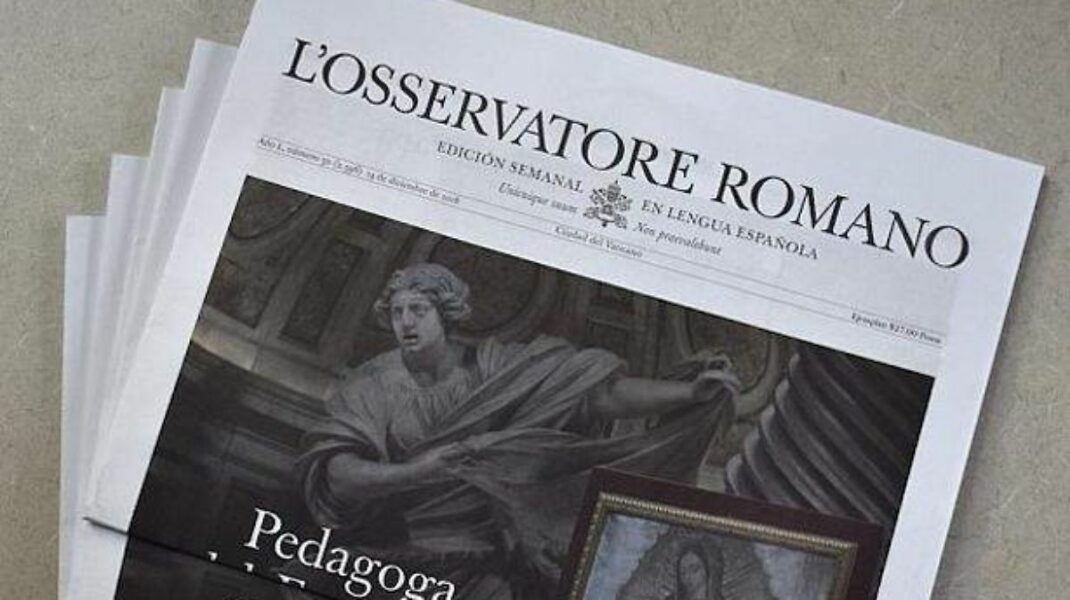
The latest issue of Donne Chiesa Mondo, the monthly supplement of L’Osservatore Romano, has sparked fresh controversy over its treatment of the figure of the devil. Under the title “The Devil in Us”, the publication brings together several articles that address evil from biblical, psychological, and cultural perspectives—an approach that has been criticized for diluting the Church’s traditional doctrine on the personal existence of Satan.
The focus of the controversy is an article by Italian theologian Marinella Perroni, professor of New Testament and one of the founders of the Coordination of Italian Women Theologians. In her essay, titled “The Serpent, the Woman, and the Fruit. And Satan?”, she argues that in the Genesis account “there is no devil” and explains that the identification of the serpent with Satan is an interpretation developed later within Jewish and Christian tradition.
A Historical-Critical Reading of Genesis
Perroni recalls that the text of Genesis 3 does not explicitly identify the serpent with the devil and places the development of Jewish demonology in a later period, marked by the influence of other cultures of the Near East and the Hellenistic world.
She also maintains that certain later interpretations of the biblical narrative contributed to associating woman, sin, and the devil within a patriarchal vision of relations between the sexes.
The article appears in a special issue devoted to evil, in which other contributions address the figure of the devil from psychological, cultural, and social perspectives. Among them is a text by writer Dacia Maraini, who reflects on the origin of evil in the human person, as well as various articles that link the experience of the “devil” with phenomena such as guilt, personal wounds, or social pressures.
Criticism for Omitting Church Doctrine
According to a more extensive analysis published on the portal Silere non possum, the overall approach of the issue ultimately presents the devil primarily as a cultural construct or a symbol of evil, relegating to the background the constant teaching of the Magisterium on his personal existence.
Among the objections raised is the absence of references to the Fourth Lateran Council (1215), which defined that the devil and the other demons were created good by God and became evil by their own choice, as well as to the Catechism of the Catholic Church, which in paragraphs 391 to 395 presents Satan as a fallen angel and not as a mere metaphor.
Critics also recall the words spoken by St. Paul VI in a general audience in 1972, when he stated that “whoever refuses to acknowledge his existence departs from the framework of biblical and ecclesiastical teaching,” as well as the frequent references of Pope Francis to the personal action of the devil in Christian life.
A Debate Returning to the Official Organ of the Holy See
The controversy is especially significant because it concerns a supplement published under the masthead of L’Osservatore Romano, the newspaper of the Holy See. Although Donne Chiesa Mondo has its own editorial line and its articles do not carry magisterial authority, its contents usually attract attention because they appear in the Vatican’s official newspaper.
This is not the first time the supplement has generated debate over the approach of some of its articles on theological or ecclesial issues. On this occasion, the discussion centers on a core matter of Catholic faith: the understanding of the devil and the way in which the witness of Sacred Scripture should be interpreted in light of tradition and the Magisterium of the Church.