


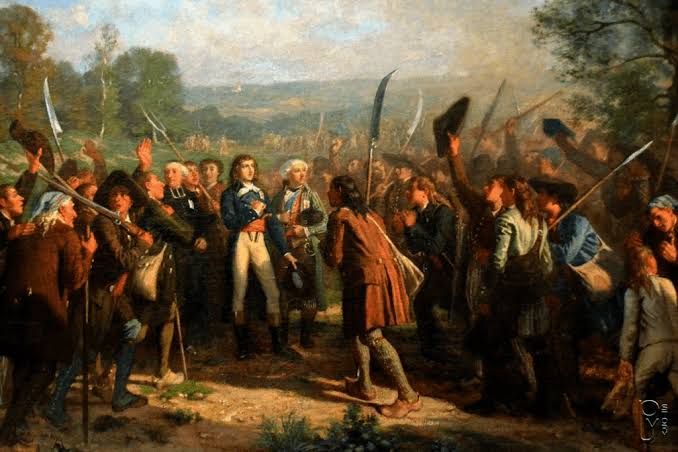
The French historian Reynald Secher, one of the leading specialists on the wars of the Vendée, maintains that the extermination carried out by the Jacobin regime against the Catholic population of this region during the French Revolution constitutes “the first modern genocide” and the precursor of the great totalitarianisms of the 19th and 20th centuries.
In an interview given to the Italian newspaper Il Sussidiario, Secher argues that the repression unleashed between 1793 and 1794 cannot be interpreted as a mere civil war, but rather as a deliberate plan by the revolutionary State to eliminate part of its own population for ideological reasons.
“Freedom or death”
Author of several studies on the Vendée, Secher explains that his research began following the work carried out with historian Jean Meyer and the compilation of official documents, testimonies, and archives which, in his view, reveal the existence of a perfectly structured chain of command from the Committee of Public Safety down to the troops tasked with carrying out the orders on the ground.
According to the historian, the revolutionary authorities considered the inhabitants of the Vendée an “irrecoverable” group because of their loyalty to the Catholic faith and the monarchy, which led them to adopt a policy of extermination.
“For the first time in history, a sovereign State consciously attempted to exterminate part of its own people, not for what they had done, but for what they represented,” Secher states.
The historian believes that the definition of genocide developed by jurist Raphael Lemkin—who coined the term after the Second World War—makes it possible to understand legally what happened in the Vendée.
The Civil Constitution of the Clergy and the origin of the insurrection
Although the compulsory levy decreed by the National Convention in 1793 is usually cited as the immediate trigger of the rebellion, the conflict had deeper roots. From the early years of the Revolution, a large part of the population of the Vendée had rejected the Civil Constitution of the Clergy, approved in 1790, which subordinated the Church to the new revolutionary State.
The law required bishops and priests to swear an oath of loyalty to the regime. Those who accepted this commitment became known as “constitutional priests,” while those who remained faithful to the Pope were removed from their parishes, persecuted, deported, or executed. In the Vendée, the population continued to support these “refractory” priests in large numbers, making the defense of the faith and of religious freedom one of the main drivers of the uprising.
The persecution of the Church at the center of the conflict
For Secher, the religious dimension is inseparable from the Vendéan insurrection. Although he recalls that in other regions of France there were also uprisings motivated by political or territorial reasons, he maintains that in the Vendée the defense of the Catholic faith and of religious freedom constituted the core of the resistance against revolutionary power.
The introduction of the compulsory levy was the immediate trigger of the rebellion, but the historian considers that opposition to the persecution of the Church and rejection of the anti-Christian policies promoted by the Jacobins were decisive elements in explaining popular mobilization.
“Here lie the roots of totalitarianism”
Secher maintains that the revolutionary project contained a totalitarian logic from its very origins.
“Anyone who seeks to create a new man cannot tolerate any form of disagreement with the official ideology,” he states, before asserting that the revolutionary slogan “freedom or death” encapsulates that political conception.
In his view, the will to eliminate those who rejected the new revolutionary order turned the Vendée into a historical precedent for later totalitarian regimes.
A debate still open in France
More than two centuries after those events, the historian considers that the French Revolution remains an especially sensitive issue in French public life.
Although he acknowledges that in recent decades several researchers have contributed to revising the traditional interpretation of the war in the Vendée, he regrets that school textbooks and much of the media continue to present those events from a perspective which, in his opinion, minimizes the persecution suffered by the Vendéan population.
Secher also maintains that the cultural divide that emerged during the Revolution has not completely disappeared and that a confrontation still persists between those who claim the revolutionary legacy and those who defend France’s Christian roots.