


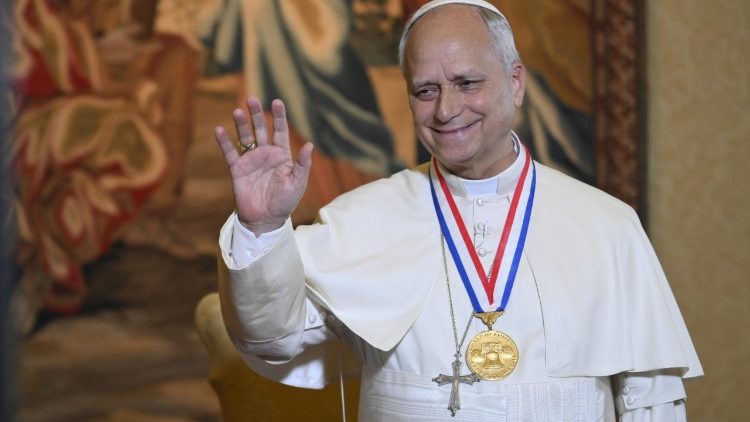
Pope Leo XIV has upheld the Christian foundations of freedom and human dignity upon accepting the 2026 Medal of Freedom awarded by the National Constitution Center of the United States. In a message delivered during the ceremony held in Philadelphia, the Pontiff stated that the fundamental rights proclaimed in the Declaration of Independence find their true foundation in natural law and in the biblical conception of the human being created in the image of God.
On the occasion of the 250th anniversary of the independence of the United States, Leo XIV recalled that the dignity of the person “precedes the establishment of any State” and defended that the right to life must be protected “from the moment of conception until natural death.” He also emphasized that authentic freedom does not consist in doing one’s own will, but in the capacity to know the truth and adhere to the good, while highlighting the importance of religious freedom as a guarantee for that pursuit.
Below we reproduce in full the message of the Holy Father:
Letter of His Holiness
Pope Leo XIV
on the occasion of the 250th anniversary of the founding
of the United States of America
I extend my most sincere congratulations to all Americans on the occasion of the 250th anniversary of the signing of the Declaration of Independence. This sesquicentennial and a half marks that decisive moment in the history of the United States of America, July 4, 1776, which gave lasting voice to the ideals of liberty, equality, the pursuit of happiness, justice, and democratic self-government. For two and a half centuries, generations of Americans have worked together to advance these principles through sacrifice, service, innovation, and civic participation. This anniversary constitutes an invitation not only to celebrate the extraordinary journey of the nation, but also to reflect on the responsibilities that the sons and daughters of this country have toward one another and toward the generations that will inherit the nation being forged today.
Among the most cherished of these principles is religious freedom: the right of every person to worship according to conscience and to practice their faith openly, without coercion or fear. In commemorating this anniversary, it is important to recognize that religious freedom has long been a central element of the American promise, protecting both the dignity of the person and the peaceful coexistence of a diverse people. This same freedom has allowed the Catholic Church to take root and flourish in the United States, to the benefit not only of its own members but of the entire nation. As faithful sons and daughters of the Church, Catholics are called to permeate every dimension of their existence with the charity of Christ (cf. 2 Cor 5:14), living the Gospel in the circumstances of daily life. This way of living has given rise to the many benefits the Church has contributed over the years to the development of this nation. I think, in particular, of its service in the fields of education, preferential care for the poor, healthcare, and basic social services, among others.
In the encyclical Sapientiae Christianae, my predecessor Pope Leo XIII wrote that “there is no better citizen… than the Christian aware of his duty” (n. 7). Indeed, faith, far from opposing the responsibilities of citizenship, gives new vigor to the pursuit of justice, peace, and the common good, bringing to fulfillment all the natural gifts granted by the Creator. Saint Paul himself exhorted the first Christians to pray for those in authority so that they might live a tranquil life in accordance with the will of God (cf. 1 Tim 2:2). In this sense, it is through the faithful fulfillment of their duties toward God and country that Catholics are called to continue serving the nation, as leaven for the growth of a civilization of love (cf. Mt 13:33).
Another of the principles that have guided the development of this country is the God-given dignity of all human life, for every person is endowed with an inherent worth that demands respect, protection, and care. From this perspective, a full understanding of that dignity leads to recognizing the importance of safeguarding human life from its beginning at conception until natural death, and of building a society in which the most vulnerable, the suffering, and the forgotten are always welcomed with compassion, solidarity, and love.
The defense of human life also includes welcoming, protecting, and assisting immigrants, whose hopes, sacrifices, and contributions have been part of the history of this country from its very origins. In every generation, those who have arrived seeking freedom, opportunity, and a place to belong have helped shape the character of the nation. Receiving them with compassion and generosity is not only an act of charity, but also a recognition of the dignity that belongs to every human person.
In my recent encyclical letter Magnifica Humanitas I wrote about the need to work together for the common good. “Building a world in which all can flourish requires shared responsibility and courage. No one can bear alone the weight of the challenges facing the world” (n. 13). We need one another and we need to work together to face the challenges the world presents today.
May this milestone renew the shared commitment to the promise of freedom, justice, opportunity, and democracy. May Americans honor the courage and vision of those who came before by strengthening their communities, respecting their differences, and working together for an ever more perfect union.
Congratulations on this extraordinary national anniversary. May the spirit of 1776 continue to inspire hope and unity as the United States of America moves toward the future. Assuring you of my prayers for your renewed efforts to strengthen the nation in the principles that guided its Founding Fathers, I commend you to the intercession of the Immaculate Conception, patroness of this country, that she may continue to watch over America and protect all who dwell in it.
From the Vatican, June 25, 2026
Leo PP. XIV