


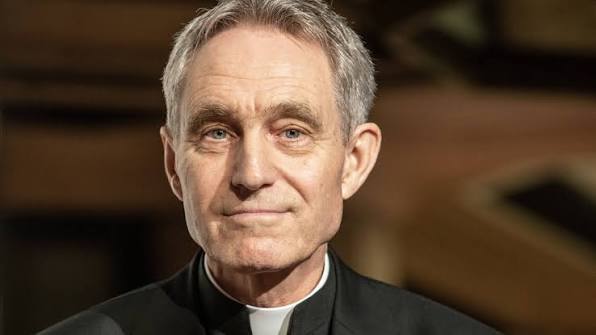
Archbishop Georg Gänswein, personal secretary to Benedict XVI for two decades and currently apostolic nuncio to the Baltic states, has stated that Pope Francis “made a mistake” by restricting the celebration of the traditional Latin Mass through Traditionis Custodes and has maintained that this decision “can and must be corrected.”
In an interview granted to the Italian daily Corriere della Sera, Gänswein argues that Rome should now show itself “more flexible, generous and paternal” toward the faithful attached to the traditional rite, especially those institutes and communities that celebrate the 1962 Missal in full communion with the Holy See.
The former secretary of Benedict XVI’s remarks come just days after the episcopal consecrations carried out by the Priestly Fraternity of Saint Pius X in Écône, a gesture that has once again highlighted the distance between the FSSPX and Rome. Gänswein nevertheless distinguishes between the doctrinal problem of the Fraternity and the liturgical question, and warns that not all traditional-Mass faithful should be identified with positions of rupture.
“The hardest sectors prevailed” in the FSSPX
Gänswein recalls that Benedict XVI sought to build bridges with the Priestly Fraternity of Saint Pius X, especially in 2009, when he lifted the excommunication of the four bishops ordained by Marcel Lefebvre. According to the German prelate, that gesture was that of “a father seeking to make peace,” yet the outstretched hand was not accepted.
“There was a radical fringe that prevailed: it did not want reconciliation then and does not want it now,” Gänswein states, showing particular severity toward the Fraternity’s recent evolution. In his view, the events in Écône demonstrate that the FSSPX is “even more hardened” than in Benedict XVI’s time.
The archbishop describes as “horrible” the claim, voiced in Écône, that Church authorities have been animated since the Second Vatican Council by a spirit contrary to the faith and have acted against Tradition. For Gänswein, that conception is not true tradition but a fixation on Catholic tradition up to Pius XII, as though everything afterward were marked solely by error.
The FSSPX problem is not liturgical
The nuncio insists that the Lefebvrist case cannot be reduced to a liturgical question. According to him, the underlying problem is not the traditional Mass but communion with the Pope and with the Church.
In this regard, he recalls that within the Church there are faithful and institutes that celebrate according to the traditional rite in full obedience to Rome. He expressly cites the Priestly Fraternity of Saint Peter, which celebrates the traditional liturgy “cum Petro and sub Petro,” that is, with Peter and under Peter, never against the Pope.
Gänswein further emphasizes that the post–Vatican II liturgical reform did not eliminate Latin from the liturgy and recalls that the constitution Sacrosanctum Concilium was also signed by Archbishop Marcel Lefebvre as a conciliar father.
Direct criticism of Traditionis Custodes
It is in his assessment of Traditionis Custodes, the motu proprio by which Francis in 2021 restricted the possibilities opened by Benedict XVI in Summorum Pontificum, that Gänswein is most explicit.
“I believe Pope Francis made a mistake, without realizing it,” the archbishop states. In his judgment, the decision to limit the traditional Mass across the board did not produce the desired effect but the opposite.
Francis justified those restrictions by arguing that the openness promoted by Benedict XVI had been used in some circles to increase distances, harden differences and create oppositions within the Church. Gänswein does not deny that abuses occurred, but he considers that those abuses did not justify a general prohibition or restriction.
“Abusus non tollit usum,” the prelate recalls: abuse does not eliminate use. According to Gänswein, the existence of some excesses was not sufficient reason to deprive all the faithful of the possibility of celebrating or attending the traditional Mass.
Recovering liturgical peace
Benedict XVI’s former secretary maintains that Summorum Pontificum had borne positive fruit for years and that the experience after 2007 showed that a broader liturgical coexistence within the Church was possible.
Therefore, he argues that Rome should now have “the courage and conviction” to correct a mistaken decision. In his view, greater openness toward the traditional Mass would allow the recovery of a liturgical peace that has been damaged by the restrictions imposed in recent years.
Gänswein’s thesis is clear: the Holy See must not confuse the legitimate liturgical sensibility of many faithful with the position of rupture held by the FSSPX. The challenge, according to the prelate, is to maintain firmness toward those who reject communion with Rome, yet without punishing those who live the liturgical tradition within ecclesial obedience.