


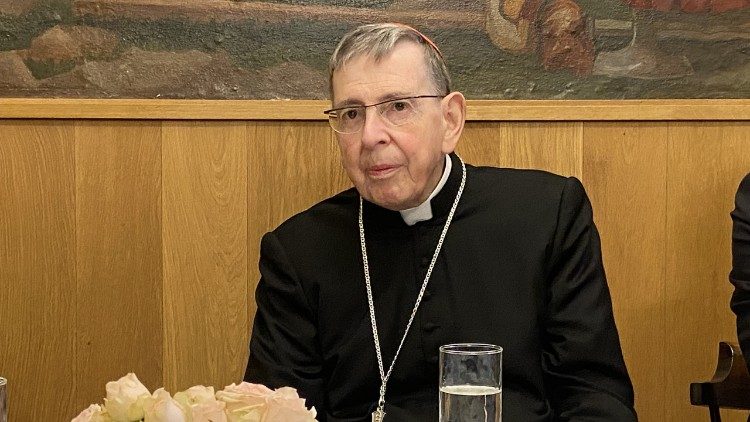
The recent episcopal consecrations carried out by the Priestly Fraternity of Saint Pius X (FSSPX) without a pontifical mandate do not definitively close the door to a future reconciliation with Rome. This is the view of Cardinal Kurt Koch, prefect of the Dicastery for Promoting Christian Unity, who expressed his conviction that it will still be possible to reopen dialogue with the Fraternity founded by Archbishop Marcel Lefebvre.
In the latest episode of the podcast of the German magazine Communio, the Swiss cardinal stated that an excommunication is intended to invite repentance and encourage a return to full ecclesial communion. For this reason, he expressed his hope that conversations may be resumed in the future “so that they may once again find the path to the Catholic Church.”
The debate on Tradition after the Council
Koch placed the current situation of the FSSPX within a recurring phenomenon in the history of the Church. He recalled that, after various ecumenical councils, groups emerged that accused the Church of having betrayed Tradition and introduced novelties incompatible with the received faith.
In his opinion, the real question is how to remain faithful to Tradition while still responding to the new challenges of each era. The cardinal believes that this balance constitutes precisely the core of the conflict with the Priestly Fraternity of Saint Pius X.
Although he acknowledges that the Second Vatican Council remains a relatively recent event in the history of the Church, he expressed confidence that the passage of time will open new avenues for understanding.
“We too must examine our conscience”
The prefect of the ecumenical dicastery also maintained that the debate sparked by the FSSPX should prompt the Church to review certain post-conciliar interpretations as well.
In this regard, he stated that it would be appropriate to “beat our breast” and ask which aspects need correction in order to demonstrate that many of the problems denounced by the Fraternity do not stem from the conciliar documents themselves, but from certain tendencies that arose after Vatican II.
According to Koch, only by distinguishing between the Council and some later interpretations will it be possible to respond credibly to the objections raised by the Fraternity.
Criticism of the consecrations without a pontifical mandate
The cardinal also referred directly to the recent episcopal consecrations celebrated in Écône. He considered that the justification offered by the FSSPX amounts to a form of “self-attribution of authority” to perform ordinations without the Pope’s consent.
Koch compared this attitude to that of certain progressive sectors that also seek to act outside the decisions of ecclesiastical authority.
“Once again it is clear that traditionalists and progressives can suffer from the same illness, even though they are admitted to very different wards of the same hospital,” he stated graphically.
An “incomplete” view of Tradition
The cardinal likewise criticized the conception of Tradition that, in his view, the Priestly Fraternity of Saint Pius X upholds. According to him, its error lies in considering that authentic Tradition was interrupted by the Second Vatican Council.
For Koch, this interpretation is partial because it does not take into account the full two thousand years of the Church’s history, but only a portion of it.
He also questioned the Fraternity’s interpretation of the well-known axiom Extra Ecclesiam nulla salus (“Outside the Church there is no salvation”). He recalled that Catholic tradition has always held that God desires the salvation of all people and that His mercy can also act in those who have never fully known the Gospel.
“When the Fraternity seems to consign to hell all those who do not belong to the Catholic Church, I wonder how the fundamental conviction of Sacred Scripture—that God wants to save all people—can be maintained,” the cardinal concluded, warning of the risk of placing human theological judgment above God’s definitive judgment.