


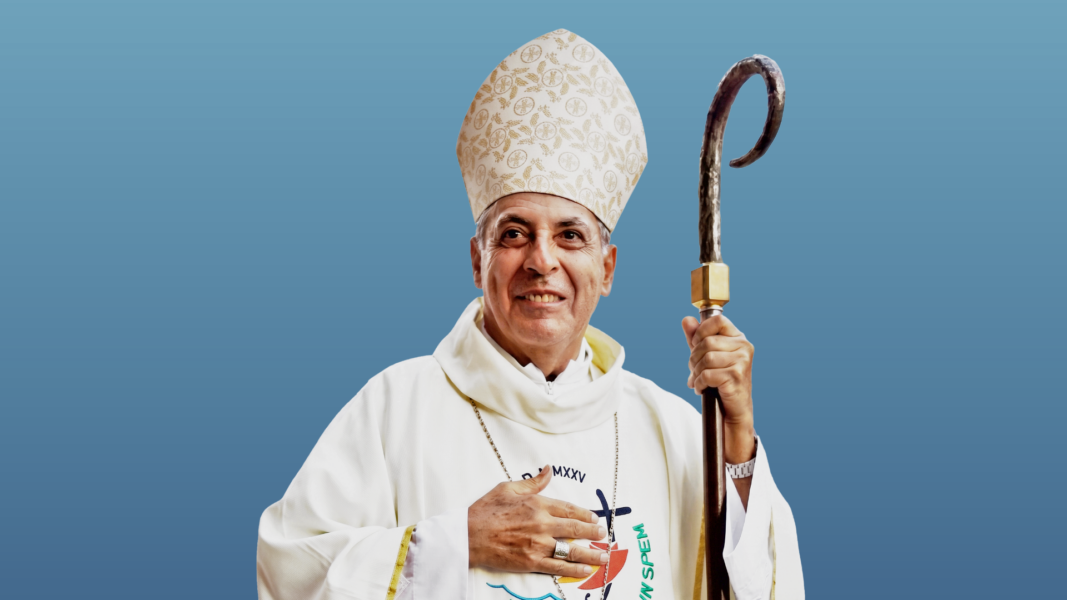
Pope Leo XIV accepted this week the resignation, for health reasons, of Mons. Joaquín Pertíñez Fernández as bishop of the Brazilian diocese of Río Branco, ending twenty-seven years of episcopal ministry in the Brazilian Amazon. With the acceptance of his resignation, the Holy Father has appointed Mons. Antonio Fortinele de Melo as apostolic administrator of the diocese, while his successor is designated.
A native of Monachil (Granada), Pertíñez has spent most of his priestly and episcopal life in Brazil, where he arrived as an Augustinian Recollect missionary in 1988. His career makes him one of the Spanish bishops with the greatest pastoral experience in the Amazon region.
From formator in Spain to missionary in the Amazon
Born on September 22, 1952, he entered the Order of Augustinian Recollects in 1973, made his solemn profession in 1977, and was ordained a priest on July 16, 1978.
His first ten years of ministry were spent as a formator at the minor seminary of San José de Lodosa (Navarra). However, in 1988 he left Spain to join the mission of Lábrea, in the Brazilian state of Amazonas, where he remained for another decade before being appointed bishop of Río Branco by Saint John Paul II on February 24, 1999.
He received episcopal ordination on May 30 of the same year and chose as his motto «To love more».
A Church marked by a shortage of priests
During his nearly three decades leading Río Branco, Mons. Pertíñez carried out his ministry in one of the most complex regions of Brazil, characterized by vast distances, the dispersion of communities, and a scarcity of priestly vocations.
The formation of the clergy was one of his main concerns. In an interview published in 2023 by the Augustinian Recollects, he explained that the diocese had around fifty priests—both religious and diocesan—and kept both the minor and major seminaries open, although he acknowledged that the difficulties remained significant.
In the conversation, he warned that the lack of priests and well-formed laity facilitated the growth of proselytism by evangelical groups, a reality he confessed to living with “deep pain.” He also lamented the scarcity of economic resources faced by the Amazonian Church, even to sustain the formation of future priests.
His participation in the Synod for the Amazon
Mons. Pertíñez actively participated in the Synod for the Amazon convened by Pope Francis in 2019, one of the most significant ecclesial events for the Latin American Church in recent years.
He later defended the need to understand the specific reality of the Amazonian Church, very different from that existing in other regions of Brazil, and stressed that evangelization in these territories requires pastoral responses adapted to the social and geographical conditions of the region.
An intense pastoral and social work
Alongside his evangelizing activity, the Spanish bishop promoted numerous educational and social projects supported by the diocese and maintained a constant presence on humanitarian issues.
In 2021 he made a public appeal, broadcast by Vatican News, calling for a solution to the crisis of hundreds of migrants stranded on the Integration Bridge between Brazil and Peru. In his message he requested the intervention of authorities and international organizations to end a situation he described as a “humanitarian crisis” and denounced the conditions of extreme vulnerability in which numerous families lived, including pregnant women and children.
“Can we stand idly by, waiting for one another?” the prelate asked at the time, before concluding with a prayer for “the poor, the needy, and the migrants, who do not even have the right to return to their country of origin.”
With the acceptance of his resignation, the episcopal ministry of Mons. Joaquín Pertíñez at the head of the diocese of Río Branco comes to an end, after twenty-seven years of service. The local Church now begins a new stage under the apostolic administration of Mons. Antonio Fortinele de Melo, while the Holy See is expected to proceed with the appointment of a new bishop.